Lynote.ai: Rethinking “Human” Content in the Age of AI-Powered Websites
The way websites are created has changed dramatically in just a few years.
A modern website is no longer simply a collection of pages designed once and left untouched. Businesses continuously publish blog posts, product descriptions, landing pages, email campaigns, social media updates, and other forms of digital content. At the same time, generative AI has made it possible to produce that content at a speed that would have seemed impossible a few years ago.
That convenience, however, has introduced a new challenge.
When AI becomes part of the content workflow, how can businesses tell whether a piece of content is genuinely original, AI-generated, or heavily rewritten by another AI tool? And when AI-generated drafts are useful but sound too mechanical, how can teams make them feel more natural without losing the original message?
This is the space where Lynote.ai is positioning itself.
Rather than treating AI detection and AI-powered rewriting as two completely separate problems, Lynote.ai brings both capabilities into one content-focused workflow. For website owners, marketers, developers, educators, and digital teams working with platforms such as MotoCMS, this creates a practical content-management challenge: producing content efficiently is only half the job. Making sure that content is accurate, natural, useful, and appropriate for a human audience is the other half.
The New Content Problem: Speed vs. Authenticity
Generative AI tools such as ChatGPT, Gemini, Claude, and DeepSeek have made AI in content creation dramatically faster, allowing businesses to produce first drafts, product copy, and other digital content more efficiently. A marketing team can generate a first draft in minutes. A small business can create product copy without hiring a large editorial team. A website owner can turn a rough idea into a structured article almost instantly.
But speed does not automatically equal quality.
AI-generated text can sometimes feel repetitive, predictable, or disconnected from the way people naturally communicate. Even when the information is accurate, the writing may lack the subtle variations in tone, rhythm, and context that make content feel genuinely human.
There is also another layer to the problem: detection.
Many organizations now need to understand how much AI has contributed to a piece of content. This can matter in publishing, education, marketing, internal communications, and other environments where originality and authenticity are important.
Lynote.ai approaches this challenge with an AI detector designed to go beyond a simple surface-level scan. The platform claims up to 99% accuracy and supports detection across major AI models, including GPT-5, Gemini, Claude, and LLaMA.
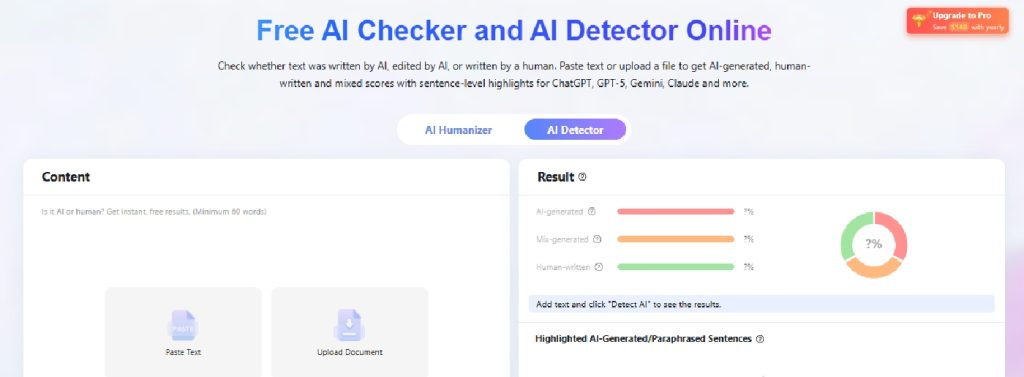
According to Lynote.ai, its detector can also review content that has been edited or paraphrased after AI generation. This distinction matters because basic detection systems can struggle when AI-generated text is modified to appear more natural.
For teams looking for a best free ai detector, the practical value is not simply receiving a percentage score. The real benefit is gaining another layer of visibility into how content was produced and whether it may have been generated or transformed by AI.
Detection That Looks Beyond One Language
The internet is multilingual by nature.
A global business may publish its website in English while maintaining localized content in Spanish, French, Portuguese, or German. A content agency may manage campaigns for clients across several markets. A digital marketing team may use AI to accelerate localization and translation.
That makes language coverage an important consideration when evaluating AI detection technology.
The platform’s humanizer supports more than 80 languages, according to Lynote.ai. This makes the platform potentially useful for international content workflows where AI-generated material does not always appear in English.
The broader implication is that AI detection is gradually becoming less about checking one document and more about establishing trust across an entire content operation.
When AI Content Needs to Sound Like a Person
Detection is only one side of the equation.
Sometimes the problem is not that AI was used. The problem is that the final result simply does not sound natural enough.
Anyone who has worked with AI-generated drafts has probably encountered this situation. The structure is technically correct. The grammar is clean. The information is organized. Yet something feels slightly off.
The writing may be too uniform. Transitions may sound formulaic. Sentences may follow similar patterns. The content might technically communicate the right idea, but it does not quite sound like something a real person would say.
This is where Lynote.ai’s AI humanizer enters the workflow.
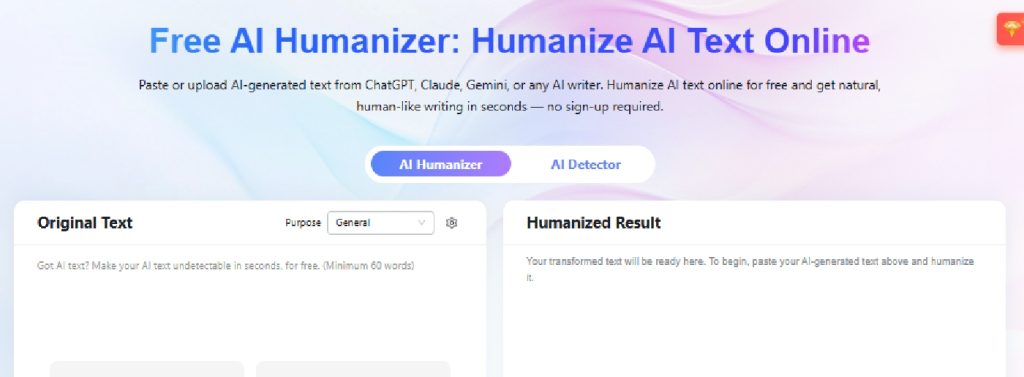
The platform describes its approach as “Human-like Content Transformation,” with compatibility across outputs from ChatGPT, Gemini, DeepSeek, and Claude. Rather than relying on simple synonym replacement, its context-aware rewriting technology is designed to understand the logic and meaning of the original text before transforming it.
That difference is significant.
A basic spinner might replace individual words while leaving the underlying sentence structure untouched. The result can be awkward because natural writing is not created by randomly swapping vocabulary. People make choices based on context, intent, audience, tone, and the relationship between ideas.
Lynote.ai’s approach focuses more heavily on preserving those elements while making the final content feel more natural.
For users searching for the best free ai humanizer, this kind of context-aware transformation can be more valuable than a tool that simply produces superficial variations of the same sentences.
More Than a Rewrite Button
Another interesting aspect of Lynote.ai is customization.
The platform offers customizable bypass modes and supports more than 80 languages. That broad language coverage can be useful for teams managing multilingual websites, international marketing campaigns, or content operations that extend beyond a single market.
Lynote.ai also advertises a 99% undetectable guarantee for its humanization technology.
Of course, no AI detection or humanization system should be viewed as a substitute for editorial judgment. Detection scores are signals rather than absolute proof, and humanization should never be used as an excuse to publish inaccurate or low-quality information.
The strongest use case is arguably more practical: AI can help accelerate the first draft, while tools such as Lynote.ai can help teams examine and refine the output before it reaches the audience.
A Different Kind of AI Content Workflow
Compared with conventional AI writing assistants, Lynote.ai occupies a somewhat different position.
The goal is not necessarily to replace the entire content creation process. Instead, it addresses what happens after AI enters the workflow.
A website owner might use ChatGPT or Gemini to generate an initial product description. A marketing team could use Claude to brainstorm a campaign. A developer might use AI to prepare technical documentation. An editor could then use Lynote.ai to review the content for potential AI-generated patterns or refine an overly mechanical draft before publication.
That creates a more complete loop:
Generate → Detect → Refine → Publish.
For businesses building and managing websites, this approach reflects the reality of modern digital work. As AI also changes how users discover information online, businesses need to consider AI search visibility when creating and publishing website content. AI is unlikely to disappear from content production. The more important question is how businesses can use it responsibly while maintaining quality, authenticity, and trust.
The Human Element Still Matters
The irony of generative AI is that the more content it produces, the more valuable authentic communication becomes.
People do not visit a business website merely to read words. They are looking for information they can trust, products they understand, and brands that communicate clearly. Whether the content was created entirely by a person, assisted by AI, or transformed through an AI-powered workflow, the final experience still needs to feel relevant to a human reader.
Lynote.ai’s combination of AI detection and human-like content transformation reflects that shift.
Its AI detector is built to analyze content across major models and multiple languages, while its AI humanizer focuses on context-aware rewriting rather than mechanical synonym substitution. Together, these capabilities offer a different perspective on AI-assisted content: the technology can help businesses move faster, but the final goal should still be content that people can read, understand, and trust.
For the next generation of website owners and digital teams, that may be the more important conversation—not whether AI belongs in the content workflow, but how to make AI-assisted content work better for the humans on the other side of the screen.




Leave a Reply