5 Website Elements Costing Sacramento Businesses Local Customers
A website can look completely fine and still be losing customers every week. Clean design, decent photos, a working contact page, and yet the phone isn’t ringing as often as it should. When that happens, the problem usually isn’t visible on the surface. It’s sitting in a handful of specific, fixable website elements that quietly work against a business every time someone nearby searches for what it offers.
Here are five of the most common ones, and what’s actually happening underneath each.
Your Site Looks Fine. That’s Not the Same as Working.

A website can look polished and still fail to convert local searchers, since most of what costs local customers happens beneath the surface, not in the visual design.
Visual design and functional performance are two different things. A site can pass every “does this look professional” test a business owner runs and still fail the tests that actually determine whether it shows up in local search or convinces a visitor to call. The five website elements below are the ones that come up most often when a locally focused site isn’t performing the way it should.
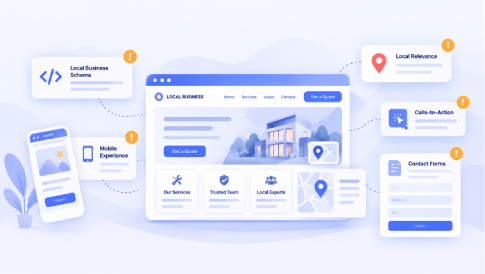
1. No Local Business Schema Markup
Since there is no structured data available, search engines are forced to rely on their best guess about the name of the business, its services, and hours of operation.
Schema markup is code added behind the scenes that explicitly tells search engines what a page is about. For a local business, that includes the business name, address, phone number, hours, and service area. According to Google Search Central’s documentation on LocalBusiness structured data, this markup helps search engines understand and correctly display local business information, which can influence how a business appears in local search results.
Without structured data, search engines have fewer explicitly provided signals about the business and its details.
- Mobile Experience That’s an Afterthought, Not a Foundation
Many local searches happen on mobile devices, making a strong mobile experience especially important for businesses that depend on nearby customers.
There’s a real difference between a site that technically displays on mobile and one that was actually designed for it. Signs of the “afterthought” version show up quickly:
- Text or buttons that require zooming in to read or tap accurately
- Navigation menus that are difficult to open or close on a touchscreen
- Images or layout elements that overlap or get cut off on smaller screens
- Load times that are noticeably slower on mobile data than on a desktop connection
MotoCMS’s own coverage of mobile-first SEO digs further into why this has become a baseline requirement rather than a nice-to-have, particularly for local businesses where a large share of searches happen on the go, often while someone is already nearby and deciding where to go next. Google’s own mobile-first indexing documentation confirms that Google predominantly uses the mobile version of a site’s content for indexing and ranking, which makes a genuinely mobile-optimized site a search visibility issue, not just a usability one.
3. Calls-to-Action That Don’t Say Anything Specific
With a generic “contact us” call to action, the visitor is expected to take the initiative and find out more for themselves. A vague CTA can make the next step less clear and create unnecessary hesitation.
Vague calls-to-action put the burden on the visitor to guess what clicking will actually do. Compare “Contact Us” to “Get a Free Quote Today” or “Schedule Your Appointment.” The second version tells the visitor exactly what to expect, which removes hesitation. HubSpot’s collection of call-to-action examples breaks down why specificity and clear value consistently outperform generic phrasing across industries, and Unbounce’s research on call-to-action button design adds that visual prominence and placement matter just as much as the wording itself.
This matters even more for service-oriented small businesses, where customers need immediate help with a problem that must be solved right away (like a leaky pipe, a toothache, or a malfunctioning machine).
4. No Real Signal That You Serve the Local Area
A homepage with no mention of the city or service area it serves gives search engines and visitors nothing to confirm local relevance.
It’s common for a small business site to describe what it does without ever clearly stating where it does it. A homepage that talks about “quality service” and “years of experience” without naming a city or service area leaves both search engines and visitors to guess whether the business is actually local to them. This matters more than it might seem. BrightLocal’s Local Consumer Review Survey has consistently found that local trust signals play a major role in whether nearby customers choose one business over another, and a site with no clear local identity is starting that trust-building process a step behind.
Fixing this usually isn’t about adding a city name to a footer. It’s closer to what a web design Sacramento would actually rebuild: dedicated service-area pages, locally specific copy throughout the site, and a homepage that makes the local connection obvious within the first few seconds a visitor lands on it. Moz’s Essential Local SEO Strategy Guide covers the broader set of local signals search engines look for beyond just on-page copy, including consistent business listings across the web.
5. Contact Forms With Too Much Friction
Long or unnecessarily complicated forms can create friction, particularly on mobile devices.
Long contact forms feel safe from a business owner’s perspective (more information collected up front), but they cost conversions. Baymard Institute’s research on marking required and optional fields found that most forms fail to clearly label which fields are actually mandatory, which creates unnecessary hesitation. A few patterns worth checking:
- Whether the questions asked on the form are really necessary in order to answer the question posed
- Whether required fields are clearly marked, so visitors aren’t guessing what’s mandatory
- Whether the form is easy to fill out on a phone screen without excessive scrolling or zooming
- Whether there’s a lower-friction alternative, like a phone number or click-to-call button, for visitors who don’t want to fill out a form at all
MotoCMS’s guide on user experience tips to boost retention without manipulation covers related friction points worth checking across a site, not just on contact forms specifically.
FAQ
How do I know if my site has local business schema markup?
The simplest way is to check the page source code and look for things like “LocalBusiness” or “schema.org.” According to Google Search Central, structured data testing tools can do this too.
Does mobile-friendliness actually affect local search rankings?
A strong mobile experience matters for both usability and search visibility. Google predominantly uses the mobile version of a site’s content for indexing, so businesses should make sure their mobile pages contain the same important content and information as their desktop versions.
What’s a reasonable number of fields for a contact form?
There is no universal ideal number of fields. Ask only for information the business genuinely needs to respond to the inquiry, and make the form easy to complete on mobile.
Can I fix these issues myself, or do I need a professional?
Some of those can be done yourself, such as tightening a form or rewriting the call-to-action. Others, including schema markup or even restructuring for a proper mobile-first approach, might be completed better by an experienced professional.
Conclusion
None of these five website elements is particularly shocking. That’s exactly why they are so easy to overlook. A website may look professional, yet it could underperform in search results and lose visitors right when they’re about to get in touch. Checking for local schema markup, true mobile optimization, relevant calls to action, proper local indicators, and effortless contact forms is a good place to start identifying customer leakage on a local business website.
For businesses looking to address these issues without rebuilding a website from scratch, a visual website builder such as MotoCMS can make ongoing improvements more manageable. Its responsive editing tools and built-in SEO settings allow businesses to update page content, headings, URLs, and image alt attributes while maintaining control over the site’s mobile experience. Local businesses can also customize templates and website elements with location-specific content and contact information.
Explore MotoCMS website templates to see how a local business site can be customized without coding.



Leave a Reply