Building Smarter AI Products: The Role of Claude, APIs, and AI Agents
Generative AI has changed the expectations people have for software.
A few years ago, a digital product was considered intelligent if it could automate a repetitive task. Today, users expect software to understand natural language, interpret documents, write content, answer questions, and sometimes even take action on their behalf.
This change has created a new challenge for developers.
Building AI products is no longer simply about adding a chatbot to an existing website. Developers now have to think about models, APIs, context, data retrieval, tool use, automation, and increasingly, AI agents.
Claude has become one of the notable LLM options in this environment. Its capabilities make it useful for applications that require strong language understanding, document analysis, coding assistance, and complex multi-step workflows.
At the same time, many development teams are discovering that they do not need to build everything around a single model. Multi-model AI architectures can provide greater flexibility, while API-based infrastructure makes it easier to connect different models to the same application.
The result is a new development landscape in which the most interesting AI products are often built from several technologies working together.
The AI Development Stack Is Getting More Sophisticated
Modern AI applications can look surprisingly different from the chatbot interfaces that first introduced generative AI to the mainstream.
Behind a simple text box, there might be an LLM, a retrieval system, several external APIs, a database, a tool-calling layer, and an agent responsible for coordinating the workflow.
The user may never see any of this.
They simply ask the application to do something.
For example, an employee might type:
“Look at this month’s customer feedback and tell me what problems are becoming more common.”
The application could retrieve the relevant feedback, organize it, send the material to an LLM, identify recurring themes, and present the results as a short report.
This is a fundamentally different experience from asking a chatbot a general question.
The AI has access to application-specific information and is connected to the systems that make the answer useful.
Why APIs Matter So Much to AI Developers
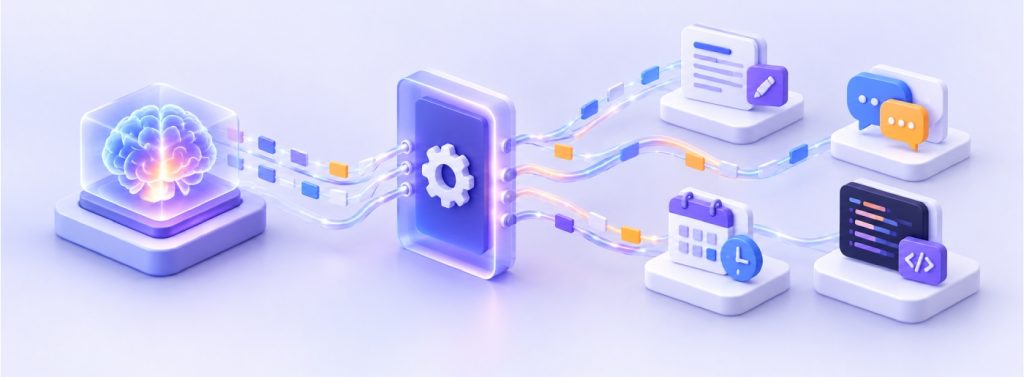
An AI model on its own is powerful, but an API allows that intelligence to become part of a product.
Developers can send information to a model, define instructions, receive a structured response, and use the output elsewhere in their application.
That basic mechanism supports a surprisingly wide range of AI products.
A startup can build an AI writing platform without training its own language model. A customer-support company can add automatic ticket classification. A productivity application can summarize meetings. A developer tool can provide AI-powered code assistance.
This has lowered the barrier to AI development.
Instead of spending years building a foundation model, teams can focus on solving a specific problem for a specific group of users.
That is one reason the AI API ecosystem continues to expand.
Claude’s Place in the LLM Landscape
Claude is particularly interesting for developers working on applications where language quality and context are important.
Not every AI task requires deep reasoning or lengthy input. A simple classification job might be better handled by a lightweight model.
But some applications involve complicated instructions and large amounts of information.
Think about a contract-analysis platform.
A user might upload a long document and ask the application to identify important clauses, explain potential concerns, compare sections, and produce a summary for a non-specialist.
The model has to understand the document as a whole rather than simply generate a generic answer.
This is the type of scenario in which capable LLMs can become valuable components of a larger application.
Text Understanding Beyond Simple Questions
Language understanding is also important for applications that deal with messy human input.
Users rarely write prompts in perfect technical language.
They may provide incomplete information, use casual expressions, change their minds halfway through a conversation, or combine several requests into one message.
A useful AI assistant needs to interpret what the user actually wants.
This can be especially important in enterprise software, where a single request might involve data from several systems.
Claude for Coding and Developer Tools
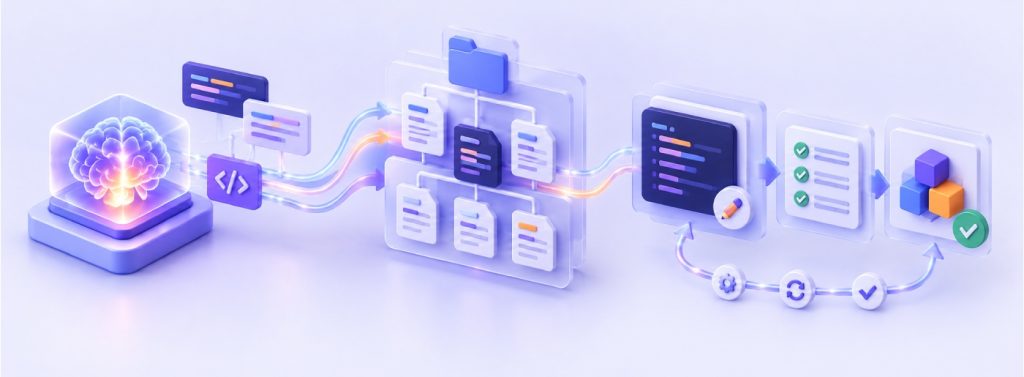
AI-assisted programming has become one of the most visible applications of LLM technology.
Developers can use Claude to generate code, explain existing implementations, suggest fixes, create tests, and explore unfamiliar technical concepts.
But AI coding is moving beyond individual prompts.
A more advanced coding agent can access a repository, inspect multiple files, make changes, and run tests before reporting the result. This shift is also changing how developers approach web development, as AI coding tools increasingly become part of everyday development workflows.
The model can understand how components are connected instead of looking at a single isolated function.
This is an important step toward agent-based development.
From Code Suggestions to Development Workflows
Imagine a developer reporting a bug:
“The checkout page crashes when a customer uses a discount code.”
A basic AI assistant might explain possible causes.
A more integrated AI coding agent could inspect the relevant files, search for the discount logic, identify a likely problem, propose a modification, run tests, and report what happened.
The developer still remains responsible for reviewing the change, but much of the investigative work can be accelerated.
This is one of the areas where LLMs are changing the daily workflow of software engineers.
AI Agents Turn Instructions Into Multi-Step Tasks
AI agents have moved from an experimental concept into a major area of software development.
The key difference between a normal LLM application and an agent is not simply that the agent uses a more powerful model.
It is that the agent can operate within a workflow.
A typical interaction might look like:
Instruction → Planning → Information Gathering → Tool Use → Evaluation → Action
These agent-based workflows can also be used to automate repetitive business processes.
The process can repeat until the task is finished.
For example, an AI recruiting assistant could receive a request to organize candidates for a particular role.
Depending on its permissions, the system might search a candidate database, summarize resumes, compare qualifications against job requirements, create a shortlist, and prepare interview questions.
The LLM is providing the language and reasoning capabilities, while the surrounding software provides access to the actual information.
Why Tool Use Changes the AI Experience
An LLM cannot automatically access every system a company uses.
That is where tools and APIs become important.
A tool can give an AI agent a specific capability.
For example:
- A search API lets it retrieve information.
- A database connector lets it access records.
- A calendar API lets it check schedules.
- An email service lets it prepare or send messages.
- A code repository lets it inspect software projects.
- A business API lets it interact with internal systems.
Developers can define what an agent is allowed to do.
This is important because useful automation requires boundaries.
An AI assistant might be permitted to create a draft invoice but not approve a payment. It might be allowed to summarize customer records but not modify them.
Good agent design therefore involves both capability and control.
Multi-Model AI Gives Developers More Options
Another major trend is the move toward multi-model architectures.
There was a period when developers focused heavily on finding the single best LLM.
That approach can become less practical as the number of capable models continues to grow.
Different models can be good at different things.
A smaller model may be ideal for quick classification. A more advanced model may be better for complex reasoning. A specialized model might perform better for coding or another particular task.
Instead of choosing one model for the entire application, developers can route requests according to their requirements.
A Practical Example
Consider an AI customer-service platform handling thousands of requests every day.
Most messages may be simple:
“How do I change my password?”
There is little reason to use the most expensive model for every request.
The application could use a faster model for straightforward questions and send complicated cases to a more capable LLM.
If a customer provides a long technical description, the system could route that request differently.
This approach can help companies control costs without giving up access to advanced models when they are actually needed.
For developers exploring AI infrastructure and different ways to connect models with applications, foxwire.ai is another option within the growing AI API ecosystem.
AI SaaS Is Becoming More Specialized
The expansion of AI APIs is also making it easier for startups to build highly focused SaaS products.
Instead of creating a general-purpose AI assistant, a company might develop an AI tool specifically for accountants, marketers, recruiters, programmers, researchers, or customer-support teams.
The specialized application can combine an LLM with industry-specific information and workflows.
That combination can be much more useful than a general chatbot.
AI for Customer Operations
A customer-support application could summarize every conversation automatically and identify recurring complaints. Similar AI support capabilities can also be added to business websites without requiring developers to build everything from scratch.
Managers could then see patterns without manually reading thousands of messages.
AI for Internal Knowledge
Companies often have useful information scattered across documents, emails, and internal systems.
An AI assistant can provide a natural-language interface for finding that information.
Instead of asking:
“Where is the document?”
An employee could ask:
“What was the reason we changed our pricing policy last year?”
The application can retrieve the relevant material and explain it in a conversational format.
AI for Workflow Automation
AI can also connect different steps in a business process.
For example, a new sales lead could trigger a workflow in which the system researches the company, summarizes relevant information, creates a briefing, and prepares a draft outreach message.
The human employee then reviews the result.
The goal is not necessarily complete autonomy.
Often, the most useful approach is AI doing the repetitive work while humans handle judgment and approval.
What to Consider Before Integrating a Claude API
Treat choosing an API as an engineering decision, not just a model comparison.
Accuracy and Consistency
A model may produce impressive results in a demonstration but behave differently when exposed to thousands of real-world inputs.
Developers need to evaluate performance using examples that resemble actual users and actual tasks.
Speed
Latency matters for interactive AI products.
A customer waiting for a response in a chatbot has very different expectations from a background process generating an overnight report.
The best model depends partly on the application’s timing requirements.
Cost at Scale
API expenses can grow alongside user adoption.
A system that is affordable during development may become expensive when usage increases dramatically.
Model routing, caching, shorter prompts, and appropriate model selection can all become important parts of cost management.
Integration
A good AI API needs to fit into the rest of the technology stack.
Developers may need structured outputs, authentication, tool calling, streaming responses, logging, evaluation, and reliable error handling.
For teams considering a Claude API, these factors deserve attention alongside the model’s core capabilities.
Building Better AI Assistants
The quality of an AI assistant depends heavily on what surrounds the LLM.
Give an assistant no context, and it may provide generic answers.
Give it access to relevant documents, user preferences, application data, and carefully selected tools, and it can become much more useful.
This is why modern AI development often looks more like system architecture than traditional chatbot development.
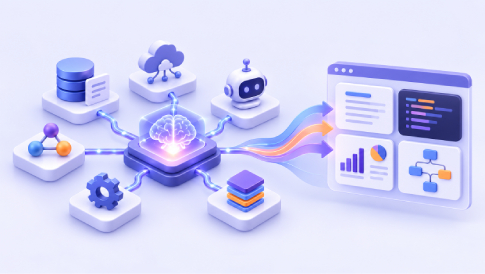
A useful assistant might combine:
- An LLM for language understanding
- Retrieval for finding relevant information
- APIs for external services
- A database for application data
- An agent layer for coordinating tasks
- Guardrails for controlling actions
- Evaluation tools for measuring performance
Each component solves a different problem.
The LLM does not need to handle everything.
The New Challenge: Making AI Reliable
As AI moves into real workflows, reliability becomes increasingly important.
A creative writing application can tolerate an occasional strange sentence.
A system handling financial records or business operations cannot be designed with the same expectations.
Developers therefore need to think carefully about verification and human oversight.
An agent might generate a recommendation first and require approval before taking action.
A document-analysis system might display the source information supporting its conclusion.
A customer-service application might automatically answer simple questions but escalate uncertain cases to a human.
These patterns can make AI systems more practical in production.
Where AI Development Goes From Here
The next stage of AI development will probably not be defined by one technology alone.
LLMs provide the intelligence layer. APIs connect models to software. Retrieval systems provide context. Tools give agents the ability to interact with external systems. Multi-model architectures allow developers to select different models for different jobs.
AI agents bring these pieces together into workflows.
That combination opens the door to applications that feel fundamentally different from traditional software.
A business dashboard could explain why a metric changed instead of merely displaying the number.
A development environment could investigate a bug rather than simply highlight syntax errors.
A customer-service platform could resolve routine requests instead of just displaying a knowledge-base article.
A project-management system could identify risks before a deadline is missed.
The interface may still look familiar.
The intelligence underneath it will not.
Final Thoughts
AI development is moving away from the idea that one model should answer every question.
The more interesting future is likely to involve specialized models, flexible APIs, intelligent agents, external tools, and applications designed around real-world workflows.
Claude is one of the models developers can use within this transition, particularly for applications involving language, coding, documents, and complex workflows.
But the real opportunity lies in what developers build around the model.
An LLM alone is powerful.
An LLM connected to company data, external tools, APIs, automation, and carefully designed business logic can become something far more valuable: a practical software component that helps people get real work done.
That is ultimately where the AI API revolution is heading—not toward more chat windows, but toward software that understands what users need and can increasingly help make it happen.

Leave a Reply