How to Build SEO and AI Search Visibility Without a Full Team
Launching a website is easier than it used to be. A small business can choose a template, customize pages, add product or service information, connect a domain, and publish a professional-looking site without hiring a full development team. That is a huge advantage for founders, freelancers, agencies, consultants, and local businesses. Building a website is only the first step, which is why tools like Auspia are becoming useful for small teams that need to keep their websites discoverable through ongoing SEO and AI search visibility work.
The harder question comes after launch: how do people find it?
A site can look clean, load well, explain the offer clearly, and still struggle to attract organic traffic. Many website owners know they should work on SEO, publish helpful content, monitor rankings, and update old pages. The problem is that SEO quickly becomes a long list of recurring tasks.
There are keywords to research, articles to plan, pages to optimize, technical issues to check, rankings to track, and performance data to review. Now there is another layer too: AI search visibility. Businesses also need to understand how traditional optimization is evolving alongside AI-powered discovery. Buyers may now ask AI assistants such as ChatGPT, Perplexity, Claude, Gemini, or Google’s AI-powered search features for recommendations before they ever click a traditional search result.
The challenge of maintaining SEO and AI search visibility begins after launch.
Why SEO Becomes Heavy After a Website Goes Live
Most website owners start with the basics.
They add page titles, meta descriptions, service pages, product pages, contact information, images, and maybe a blog. That foundation matters, but it does not create a complete system for SEO and AI search visibility.
Organic growth needs repetition.
A site has to answer new search questions, expand useful topics, refresh outdated pages, add internal links, fix crawlability issues, and learn from performance data. If that work only happens once every few months, growth becomes inconsistent.
Small teams often run into the same problems:
| Challenge | Typical Result |
|---|---|
| No publishing schedule | Irregular traffic growth |
| Old pages aren’t updated | Rankings decline |
| Technical issues go unnoticed | Lost visibility |
| AI visibility isn’t monitored | Missed discovery opportunities |
None of these problems mean the website is bad. They mean the site needs an operating system for organic growth.
SEO Is No Longer Just a Checklist
Traditional SEO advice often sounds simple: find keywords, write content, optimize pages, and build links.
That advice is still useful, but the actual work is more connected than it sounds.
A keyword is not valuable by itself. It needs to match the business, the audience, the page type, and the searcher’s intent. A blog post is not finished when it is written. It needs to be published, indexed, measured, and improved. A ranking is not the only signal that matters. Clicks, impressions, technical health, and content quality all affect the long-term outcome.
This is why many small businesses struggle with SEO even when they understand the basics. The work is not difficult because one task is impossible. It is difficult because the tasks never stop.
That is where automation becomes useful.
The goal is not to remove human judgment. The goal is to remove repetitive manual work so the team can make better decisions faster.
Turn SEO Into a Daily Growth Queue
A practical SEO workflow should answer one simple question every day:
What should move forward next?
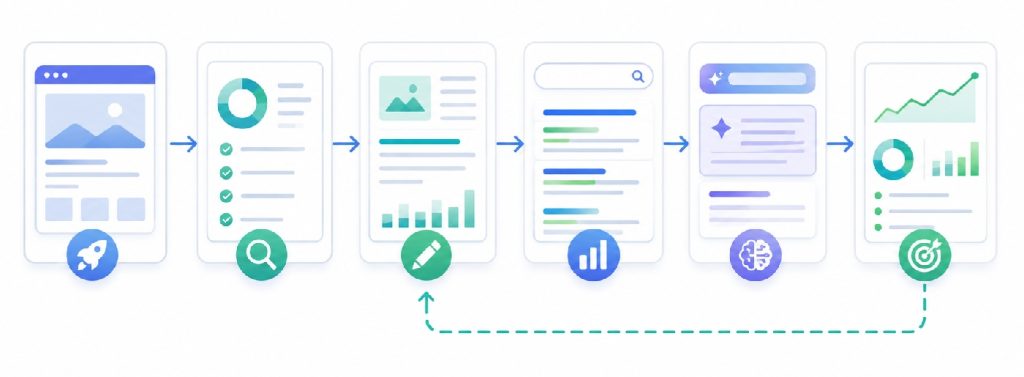
For a website owner, that next action could be:
- publish a new blog post;
- update an existing landing page;
- improve a page title;
- add internal links;
- expand a weak article;
- check whether a page is indexed;
- review which queries are earning impressions;
- fix a broken link;
- refresh a product comparison page;
- prepare content for AI search visibility.
When these actions are scattered across different tools, managing SEO and AI search visibility feels messy. When they are organized into a queue, the work becomes easier to review and approve.
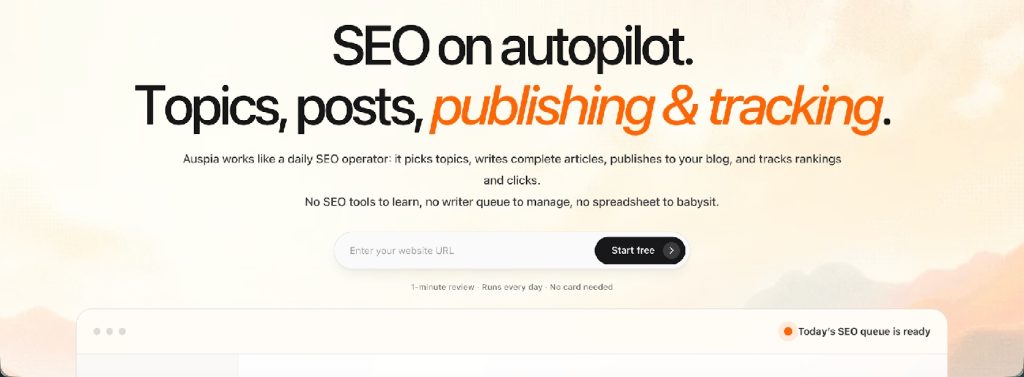
An Auspia AI SEO growth tool can help small teams build this kind of repeatable loop. Auspia reads a website’s product context, search demand, and competitor signals, then helps turn the next SEO actions into topics, content, publishing, tracking, and optimization.
For website owners, the value is simple: SEO becomes less like a forgotten side project and more like a system that keeps moving.
| Without a Workflow | With a Workflow |
|---|---|
| Content published irregularly | Consistent publishing schedule |
| Technical issues found late | Regular monitoring |
| Random topic selection | Prioritized content plan |
| SEO tasks scattered across tools | Centralized workflow |
| Reactive updates | Continuous optimization |
Product-Aware Content Matters
Planning tasks is only part of the process. The content itself also needs to support business goals. One common problem with AI-generated SEO content is that it can become too generic.
A generic article may target a keyword, but it may not explain the business clearly. It may attract visitors who are not ready to buy. It may rank for a broad topic but fail to support the actual product, service, or conversion path.
Website owners should not publish content just because a keyword has volume.
They need content that understands:
- what the business sells;
- who the target customer is;
- what problems the customer has;
- what makes the offer different;
- which search queries show real intent;
- which pages should support conversion.
This is especially important for SaaS websites, service businesses, agencies, ecommerce brands, and niche online tools. Traffic that does not match the business can look good in a report but produce little value.
A better workflow connects SEO content to the product itself.
That means a blog post should not only answer a search question. It should also help the right visitor understand why the website is relevant.
Publishing Consistency Is Usually the Bottleneck
Many teams do keyword research once, create a content plan, and then publish inconsistently.
The reason is rarely laziness. It is usually operational friction.
Someone has to choose the topic, write the article, edit the draft, format it, upload it to the CMS, add links, check the slug, create metadata, publish it, and then monitor results. If the team is small, every step competes with sales, product work, customer support, and daily operations.
This is why SEO content plans often fail between “idea” and “published page.”
A better process shortens the distance between opportunity and execution.
For example, a small team could follow this loop:
- Review the next recommended topic.
- Approve or skip it.
- Generate or prepare the article.
- Publish it to the blog or CMS.
- Track indexing, rankings, and clicks.
- Use performance data to adjust the next topics.
This is the kind of system that helps websites grow steadily without requiring a large editorial team.
AI Search Adds a New Visibility Layer
Search behavior is changing.
People still use Google, but they also ask AI tools for recommendations, comparisons, explanations, and product options. This means website owners need to think beyond traditional rankings.
A potential customer might ask:
- What is the best tool for this problem?
- Which software should a small business use?
- What are the top options for this use case?
- How do I solve this workflow?
- Which company offers this service?
If AI systems answer without mentioning your brand, your website may be invisible in an important part of the discovery journey.
This is why AI-powered search platforms have become a serious topic for website owners. The goal is not to “trick” AI tools. The goal is to make a website easier to understand, crawl, cite, and connect to relevant questions.
That may involve clearer product pages, better structured content, stronger topical coverage, crawlable pages, useful summaries, technical readiness, and third-party signals.
No responsible tool can guarantee that ChatGPT or any AI answer engine will cite a specific website. But a website can improve its readiness by making content clearer, more useful, and easier for machines and people to understand.
What GEO Means for Small Websites
GEO, or generative engine optimization, is about preparing content for AI-powered answer environments.
Traditional SEO focuses on search engine results pages. GEO focuses on whether AI systems can understand, trust, and potentially cite your content when generating answers.
For small websites, this does not mean abandoning SEO. It means expanding the workflow.
A practical SEO and GEO workflow may include:
- improving product and service explanations;
- creating content that answers specific customer questions;
- using clear headings and structured sections;
- keeping important pages crawlable;
- checking whether AI crawlers can access relevant content;
- refreshing outdated pages;
- building topical depth around key use cases;
- monitoring whether the brand appears in AI answer contexts.
The same content foundation can support both search engines and AI answer systems when it is built carefully. As AI continues to reshape search, it’s also worth understanding which traditional SEO practices still deliver results. Learn more in our guide to SEO in the Age of AI.
Technical SEO Still Matters
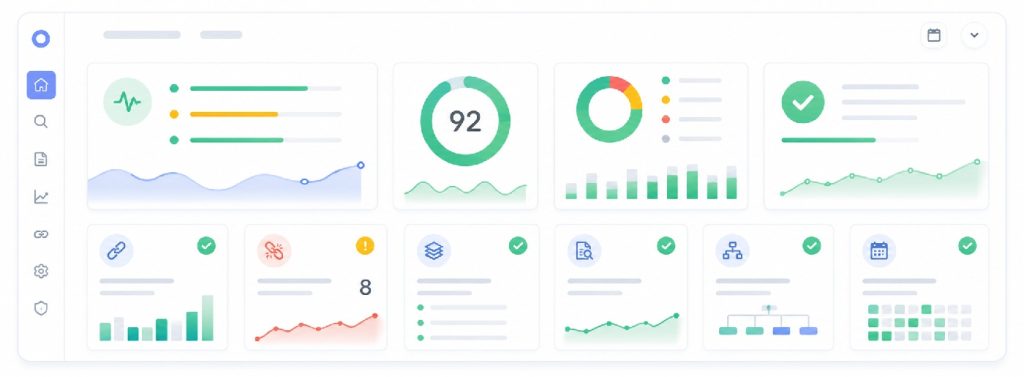
Building SEO and AI search visibility still depends on technical SEO. If a page is blocked, broken, slow, poorly structured, or difficult to crawl, it will struggle across both traditional search and AI discovery.
If a page is blocked, broken, slow, poorly structured, or difficult to crawl, it will struggle across both traditional search and AI discovery. Website owners should still pay attention to the basics.
Important checks include:
- indexing status;
- canonical tags;
- broken links;
- schema gaps;
- sitemap health;
- robots.txt settings;
- internal linking;
- duplicate or thin pages;
- mobile usability;
- page speed.
Technical SEO can feel intimidating, but it does not have to be handled all at once. The key is to monitor issues regularly instead of waiting until traffic drops.
A healthy website gives content a better chance to perform. Strong search visibility also depends on how well your site’s design and optimization work together. Learn how to achieve effective web design and SEO integration to create a website that’s both user-friendly and search-friendly.
Human Review Still Belongs in the Process
Automation is useful, but it should not publish without judgment.
Website owners still need to review whether the content is accurate, on-brand, and helpful. This is especially important for businesses where trust matters: SaaS, finance, healthcare, legal services, B2B tools, consulting, education, and ecommerce.
A simple review checklist can prevent weak content from going live.
Before publishing, ask:
- Does this article match the audience?
- Is the advice accurate?
- Does it reflect the product or service correctly?
- Is the title clear?
- Does the article answer the search intent?
- Are internal links useful?
- Is there a logical next step for the reader?
- Does the page avoid exaggerated claims?
Automation should speed up the workflow. It should not remove responsibility from the website owner.
A Practical SEO Workflow for Website Owners
For a small business or independent website, a workable process might look like this:
- Identify topics that match customer questions and business goals.
- Create or update content around those topics.
- Publish consistently and strengthen pages with internal links.
- Monitor indexing, rankings, clicks, and technical issues.
- Refresh underperforming content based on real performance data.
- Improve content for both traditional search engines and AI-powered search experiences.
This workflow does not require a large team. It requires consistency.
What Website Owners Should Measure
Not every metric deserves daily attention.
Small teams should focus on numbers that lead to action:
- new pages published;
- pages indexed;
- clicks from search;
- impressions by topic;
- ranking movement for priority queries;
- pages with declining performance;
- internal links added;
- technical issues fixed;
- AI visibility checks;
- content updates completed.
The purpose of measurement is not to create a bigger dashboard. It is to decide what to do next.
If a page earns impressions but few clicks, improve the title and meta description. In case an article ranks but does not convert, adjust the content or add a stronger next step. If a topic cluster performs well, publish supporting content. If important pages are not indexed, check technical issues.
Data is only useful when it changes the work.
SEO Growth Needs a System
A website is not finished when it goes live.
It needs content, maintenance, search visibility, technical health, and now AI search readiness. For small teams, that can feel like too much to manage manually.
The solution is not to chase every SEO trend or publish generic AI content at scale. The better approach is to build a repeatable workflow: identify the right topics, create product-aware content, publish consistently, monitor performance, resolve technical issues, and improve pages based on real data.
Platforms such as Auspia can help website owners organize SEO and AI search visibility into a more structured workflow, turning scattered tasks into a consistent optimization process rather than a series of one-off projects.
For businesses using modern website platforms, that distinction matters. A well-built website provides the foundation, but long-term growth depends on consistently improving and expanding its visibility.
The future of website growth belongs to teams that build a repeatable process for improving SEO and AI search visibility, combining technical health, helpful content, and continuous optimization.



Leave a Reply