Building High-Quality Infrastructure for Web Intelligence
Infrastructure for web intelligence runs on plumbing that nobody puts in the pitch deck. Companies budget generously for dashboards and models, then wonder why the competitor pricing feed goes stale by Tuesday afternoon.
The bottleneck usually sits upstream, in collection. Pulling clean public data at scale takes more thought than spinning up a scraper and hoping the target site plays along.
Getting it right means treating the network layer as a first-class engineering problem, not something bolted on after the parser breaks in production.
Start With the Network Layer
Most collection projects fail in the same spot. Parsing logic that works beautifully on a laptop falls apart at 50,000 requests a day, when the target starts serving CAPTCHAs, empty templates, or quietly incorrect prices to traffic it doesn’t trust.
That last behavior deserves more attention than it gets. Some sites don’t block suspicious visitors outright; they serve them altered or stale content, which poisons a dataset without throwing a single error. Debugging that six months later is miserable work.
The numbers look plausible, the charts render fine, and nobody notices until a strategy has already been built on top of them.
So the IP layer quietly decides what a pipeline can actually see. Teams doing serious price monitoring or brand protection work route requests through IPRoyal’s premium residential proxies because addresses issued by consumer ISPs get read as ordinary visitors rather than as automated traffic.
Datacenter addresses still have a place. They’re faster, cheaper per request, and perfectly adequate for public pages that don’t scrutinize who’s asking. The mistake is using one address type for every job in the pipeline.
Website Architecture and Data Accessibility
Web intelligence depends partly on how websites publish their content. Two sites can display similar product information to visitors while exposing it very differently to automated systems.
Server-rendered HTML often makes essential information available in the initial response. JavaScript-heavy websites may require additional rendering before prices, availability, or product details appear. Structured data, descriptive URLs, consistent page templates, and stable content fields can make information easier to identify and validate, although none guarantees that a page will be accessible to every collection tool.
When collecting information from dynamic websites, the technical approach should also account for access restrictions and responsible use. This ethical guide to web scraping for dynamic site content explains how to approach dynamic pages while considering website rules and data privacy.
These considerations matter when building or maintaining a website, too. A well-structured product catalog, consistent metadata, and clear separation between page content and presentation can improve maintainability and support integrations with analytics and other business systems. When dynamic rendering is necessary, developers should test which content is present in the initial HTML and which becomes available only after JavaScript executes.
For teams responsible for both a website and its data workflows, the goal is not to make every page identical. It is to keep the underlying information consistent, clearly structured, and dependable as the site evolves.
Rotation, Sessions, and Protocol Choices
Rotation strategy matters as much as pool size. Hammering a site with one address for 10,000 requests will get that address flagged, but rotating mid-session causes its own problems: it breaks cart flows and login states, and it looks stranger to a fraud system than a single persistent visitor would.
A workable pattern holds one address for the length of a logical session, then switches between discrete tasks. Choose rotation behavior according to the task. Keep a consistent IP for workflows that depend on session continuity, and use request-level rotation only when it suits the workflow and the target site’s rules. In either case, apply appropriate rate limits and monitor response quality.
Protocol choice can also affect compatibility. HTTP proxies are designed for HTTP traffic, while SOCKS5, specified in RFC 1928, supports TCP connection relaying and UDP relay. It can be useful for compatible non-HTTP clients, provided the proxy, client, and destination support the required connection type.
Designing a Reliable Data Collection Pipeline
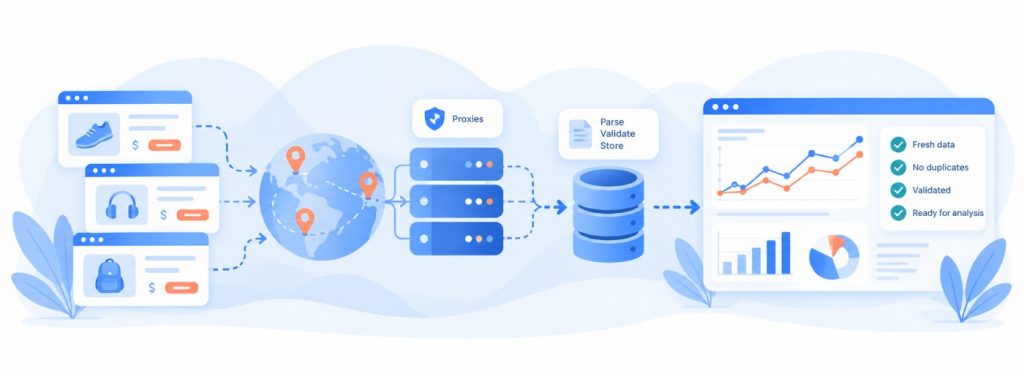
A proxy pool cannot compensate for a pipeline that loses jobs, duplicates records, or fails silently. Once collection moves beyond a single script, the surrounding architecture becomes just as important as the network layer.
Separate fetching, parsing, validation, and storage into distinct stages. A failed parser should not require downloading every source again, and a temporary network interruption should not erase completed work. Queues can absorb bursts in incoming tasks, while bounded retries and checkpoints help jobs recover without restarting an entire collection run.
Deduplication matters, too. The same product may appear across category pages, regional storefronts, and search results. Normalize URLs and record identifiers before storing observations, but preserve the original source URL and retrieval timestamp so that every record remains traceable.
Finally, define freshness requirements for each dataset. Competitor prices may need frequent updates, while a directory of company locations may change much less often. Scheduling around business value, rather than collecting everything at the same frequency, reduces unnecessary requests and infrastructure costs for web intelligence. For smaller monitoring projects, a spreadsheet can be a practical starting point before investing in a more complex pipeline. See how Google Sheets web scraping can help collect website data for research and monitoring workflows.
Geography Is a Performance Decision
Proxy location often outranks proxy type in practical terms, and plenty of buyers get this backward. When monitoring prices on Amazon.de, German IP addresses can help reproduce the experience of visitors in Germany. Results may differ by location, so validate regional pricing, availability, and delivery information before comparing datasets.
Latency follows the same logic. Routing requests through a proxy far from the target can increase round-trip time, and that overhead compounds across large collection jobs. Benchmark candidate locations against the actual destinations before choosing a setup.
Coverage depth varies wildly between providers. US and Western European pools are easy to find, while genuine city-level coverage across Southeast Asia and South America stays patchy enough to reshape what a project can promise.
Collect Responsibly or Pay for It Later
Infrastructure for web intelligence carries legal and reputational risks. Review each site’s published access rules, including its robots.txt directives, and implement reasonable rate limits. These steps are part of responsible collection, but they do not replace a review of applicable law, website terms, privacy obligations, and the specific data being collected.
Aggressive collection can degrade the source, too. Sending a large volume of requests to a retailer without accounting for its capacity can overwhelm its infrastructure, disrupt service for other visitors, and create legal and reputational risks.
Exponential backoff is straightforward to implement and helps prevent repeated requests from overwhelming a source. Start conservatively, follow published rate limits, and reduce request frequency when responses indicate throttling or service stress. Retry transient failures with increasing delays rather than sending requests in a tight loop.
Treat the Pipeline Like a Product
Harvard Business Review’s distinction between defensive and offensive data strategy also applies to data collection. Defensive work focuses on reliability, validation, and audit trails. Offensive work uses reliable data to identify market opportunities, understand competitors, and support strategic decisions.
Monitoring deserves emphasis because so few teams do it properly. Track success rate per target rather than in aggregate: a healthy-looking 94% can easily hide one critical source failing 70% of the time.
And validate content, not just status codes. A 200 response carrying a CAPTCHA page registers as success in most logging setups, which is exactly how silent failures survive for months.
Infrastructure for web intelligence should also be evaluated by the cost of usable data, not simply the cost per request. A cheaper proxy pool can become expensive if it produces more failed fetches, repeated retries, or records that require extensive manual correction. Track the cost per validated record alongside freshness, failure rates, and processing time. These metrics help teams decide where additional capacity improves results and where better validation or scheduling would be more effective.
What Holds Up Next Year
Reliable web intelligence tends to come from teams that spent their early effort on address quality, rotation logic, and validation rather than on clever parsers. The analytics layer is comparatively easy once the inputs stop lying.
IPv6 pools and edge deployments will keep changing what’s possible on the network side, while detection systems keep improving at spotting automation. Infrastructure built with that back-and-forth in mind ages reasonably well. Infrastructure for web intelligence built around this quarter’s blocking rules gets rewritten by the next one.