The Future of the Classroom: How EdTech is Humanizing Learning in 2026
The classical vision of a classroom – the lines of wooden desks, dusty chalkboard, etc. – one-fits-all curriculum is quickly becoming history. Education Technology (EdTech) is no longer merely a textbook digitalisation or a lecture transfer to Zoom, as we enter further into the decade. Rather, we can observe a radical change to hyper-personalized learning.
Modern EdTech is aimed not to replace the teacher, but to eliminate the mechanical barriers that do not allow students to understand complex aspects. With the incorporation of smart tools into everyday learning, we are finally getting a learning process that is student-friendly, or at least student-modified, rather than a student-fixed system.
Developing Visual Learning by Breaking the Abstract Barrier
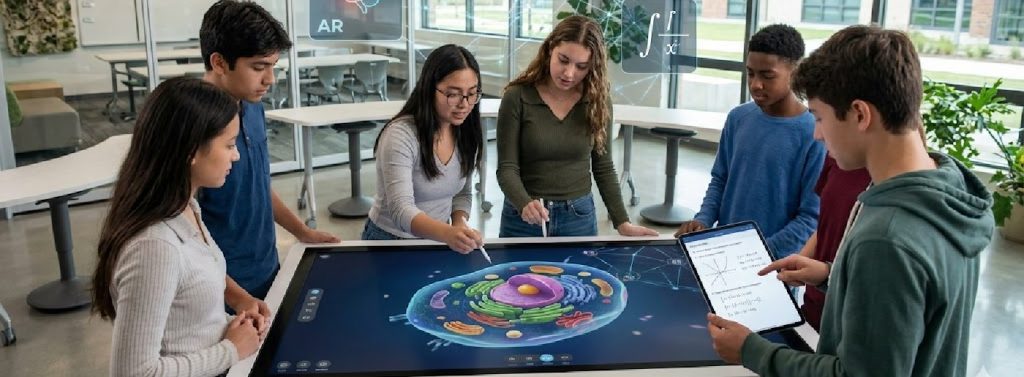
The Abstract Barrier has always been one of the greatest obstacles to education. There are those subjects, such as history, physics or biology, that many students have difficulty with but it is not due to lack of intelligence, but simple because they are unable to visualize static information. Whenever a student gazes at a map of a cell or a historical map, his/her brain is forced to do a huge heavy lift of imagining how such systems move and interact.
This is the place where artificial intelligence and creative media are colliding in a tremendous way. Teachers and learners are now trying to put life into dead curriculum materials. For instance, a student studying the French Revolution can take a historical painting and use Image to Video AI without login to animate the scene, providing a visceral sense of the atmosphere and movement of the era.
In the event that a standing diagram is converted into a moving sequence, the brain’s mirror neurons are affected on a deeper level. Such a change from passive looking to active observing helps create a gap between knowing something as a fact and understanding it as a process. With these tools so conveniently available, without all the annoying barriers, EdTech lets students concentrate on the imaginative production of their projects rather than on the technical baggage that accompanies high-end animation packages.
Problem Solving: The Transformation of Solving into Understanding
The back of the book was the only option students had to refer to in order to verify their work over the decades. When they failed to give the correct response, they were left staring at a number with the slightest idea of where they went wrong. With the emergence of intelligent tutoring systems, this ladder of trial and error has been changed radically.
Students in the modern age have been provided with advanced assistants that are more like personal tutors than calculators. When a student hits a wall with a complex calculus equation or a physics problem, using an AI Math Solver provides more than just a final result. The step-by-step breakdown is the real value. Such tools break down the logic of a problem, giving a reason of why every transformation is accomplished.
This change is vital, as it shifts the educational focus from rote learning to algorithmic learning. By seeing where the student went wrong in their reasoning, they will learn a lesson that will last much longer than a red circle marked X on the homework sheet. It is all about gaining confidence through transparency.
The Emergence of the Dystopian Model of the Personalized Tutor
Democratization of quality support is the greatest benefit of the current EdTech market. Personalized tutoring was historically a luxury for those who could afford individual sessions. Nowadays, there is an AI-based platform that serves as a safety net for students day or night.
- Self-directed Discovery: Students who are visual learners will be able to spend more time on AI-based simulations, whereas learners with logical-mathematical proficiency will be able to explore step-by-step proofs in depth.
- Reducing Academic Anxiety: Often, a student is terrified to ask a seemingly simple question in front of a group of 30 other students. AI tools offer a non-judgmental environment in which a student can request that a concept be explained 5 times until it finally sinks in.
- Imaginative Project-Based Learning: Students will no longer write a typical essay; they now make multimedia reports. They are merging transcribed interviews, AI-improved pictures, and an interactive dataset to demonstrate mastery of a topic. As these AI-assisted formats become common, some schools also reference tools like proofademic.ai to confirm written portions of student work remain authentically their own.
New role of the Teacher: Lecturer to Mentor
Since these tools are concerned with the mechanical side of the teaching process – marking multiple-choice tests or describing fundamental arithmetic operations – the teacher is changing. Teachers are shifting from the Sage on the Stage to the Guide on the Side.
The technical heavy lifting is outsourced to smart software, thus allowing teachers to have more bandwidth to focus on social-emotional learning (SEL) and critical thinking. They are able to conduct Socratic seminars on ethics, mentor students on multifaceted yearlong projects, and offer the human compassion that is impossible to achieve with an algorithm.
Conclusions: An Empowerment Future
EdTech revolution of 2026 does not have to do with the gadgets, it is empowerment. It can be a middle-schooler visualizing a scientific theory with the help of AI or a college student mastering linear algebra with the help of a solver; the point is the same: the learning process is frictionless. This is our mission as we continue to perfect these tools: to make the world a place where a student’s curiosity is not stifled by a lack of resources and where there is a clear, easily navigable path to understanding every concept considered abstract.




Leave a Reply