Instagram Data for Website Owners: What to Collect and Why
Most small businesses treat Instagram as a place to post and hope. A photo goes up, a few likes come in, and the account is considered “active.” Meanwhile, the same platform is full of information that could shape what you put on your website: which products people actually talk about, which hashtags your niche rallies around, which creators your audience trusts, and what competitors are quietly doing well.
The trouble is that Instagram is built for scrolling, not for analysis. Looking at fifty profiles by hand is tedious. Looking at five hundred is not realistic. So the real question is not whether the Instagram data is useful, but how to gather it without wasting a week or crossing lines you should not cross.
Decide What You Need Before You Collect Anything
It is tempting to grab everything and sort it out later. That usually ends with a huge spreadsheet nobody opens twice.
Start with a single question instead. A café owner might want to know which local hashtags bring in real customers. A fashion store might want to see which styles get the most comments rather than the most likes. A web designer building a portfolio site could be checking how other studios present their work. Each of these needs a different slice of information, and none of them needs a full copy of a profile.
Once you have your question, the list of useful fields gets short quickly. Post captions, hashtags, posting dates, public engagement counts, and profile descriptions cover most marketing research. You rarely need more than that.
Why Manual Research Stops Working
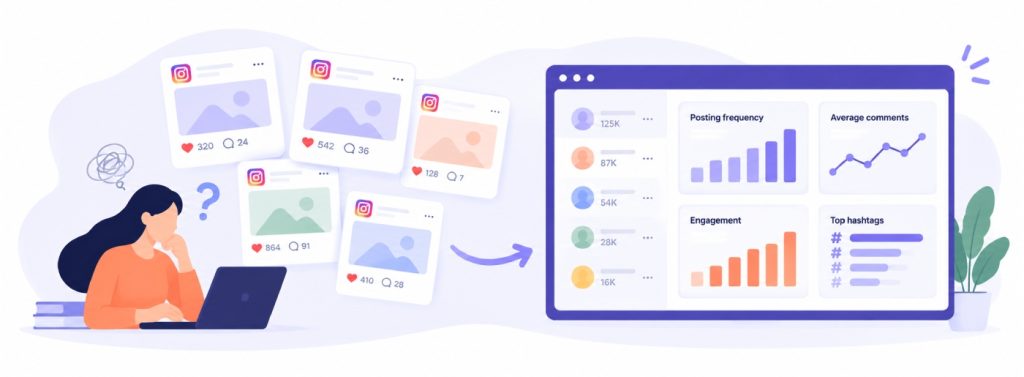
Doing this by hand works for a quick look. The problem is consistency. Two people reviewing the same account will notice different things, and a note like “good engagement lately” is hard to compare across twenty brands.
Consistent measurements make comparisons easier. Tracking posting frequency, average comments, and hashtag usage across a defined set of accounts can reveal patterns that casual browsing might miss, although engagement counts alone do not establish audience loyalty or business results.
Where Automation Fits In
This is the point where many teams look for tooling. Writing your own script is possible, but Instagram changes its pages often and limits automated access. A homemade script that worked in March can fall apart by June.
A purpose-built Instagram Scraper takes that maintenance off your plate. Instead of wrestling with page layouts and blocked requests, you ask for specific public data and receive it in a structured format, ready to drop into a spreadsheet or a dashboard. For agencies and marketers who need the same kind of data every month, that predictability matters more than any single feature.
Whichever route you take, keep the scope narrow. Public profiles, public posts, and public hashtags are the sensible territory. Anything private, or anything that identifies individuals in ways they would not expect, should stay out of your dataset entirely.
Turn Raw Numbers Into Decisions
Collecting Instagram data is the easy half. The useful half is deciding what to do with it.
Here are a few ways website owners put Instagram research to work:
- Content planning. If a certain kind of post consistently earns replies in your niche, you know what to feature on your blog or homepage.
- Product pages. Customer comments can reveal the words people use to describe their needs and product experiences. Use those insights to make your own copy clearer, without copying individual comments or presenting customer opinions as verified product claims.
- Partnership shortlists. Sort creators by genuine engagement and audience fit instead of guessing.
- Seasonal timing. Posting dates across a few months show when your market gets interested.
Keep the source link and collection date beside each record. A figure without a date becomes misleading within weeks.
Mind the Rules and the People Behind the Profiles
Public does not mean unlimited. Before collecting data, review Instagram’s terms and the service provider’s conditions. If your research involves identifiable people, consider applicable privacy and data protection requirements, including the GDPR where relevant. Public availability alone does not remove all data protection obligations.
A few habits keep you on safe ground:
- Collect only what supports your original question.
- Avoid storing personal details you do not need, such as names tied to private information.
- Delete Instagram data once the project is finished instead of letting it sit forever.
- Never use collected information to contact people in ways they did not invite.
Treat the accounts in your spreadsheet as real people running real businesses, because they are. Research should help you improve your own work, not copy theirs.
Bring the Findings Back to Your Website
Insights only pay off when they change something. Maybe your research shows that short tutorial clips outperform polished product shots in your niche. That is a signal to add a video section to your site. Maybe a handful of customer comments keep asking the same question. That deserves a proper FAQ page.
For influencers and content creators, these insights can also guide personal website design. Audience interests can help shape portfolio categories, collaboration pages, service descriptions, and calls to action. A ready-made website template gives creators a starting point they can customize with their own branding, content, and offers. For example, MotoCMS offers an Instagram influencer website designed for personal promotion and showcasing services.
If your site is built on a no-code platform, these changes are quick to make. Pair your social findings with on-site metrics, and you get a much fuller picture of how visitors move from a post to a purchase. MotoCMS has a helpful walkthrough on website analytics for no-code builders if you want to connect those dots.
A Simple Starting Plan
You do not need a big budget or an Instagram data team to begin. Pick one question, choose five to ten public accounts that matter to your market, and gather a small sample first. If the fields answer your question, expand gradually. If not, adjust before you scale up.
Instagram research works best as a steady habit. A monthly check of your niche, kept tidy and respectful, will tell you more about your audience than any guessing.

Leave a Reply