How to Study Web Development: Strategies That Actually Work
Learning web development can feel inconsistent. You may understand a lesson perfectly and then get stuck when you try to build something yourself. That’s normal: coding requires both understanding concepts and repeatedly applying them.
The answer isn’t necessarily more study hours. A better strategy is to divide your time between learning, practicing, troubleshooting, and reviewing what you’ve built.
Turn What You Learn Into Something You Can Remember
When you are taking a web development course, it will not be enough for you to read or watch a lesson once. Your brain needs repeated exposure to the important concepts you learn in class.
One simple way to do that is to turn key lessons into questions and answers. This way you can review them regularly. You can create flashcards for terms and basic concepts and practice them over and over again.
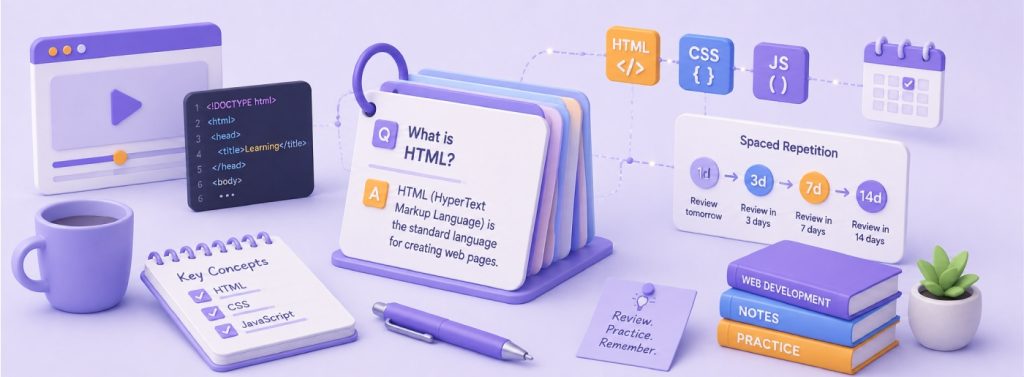
Similarly, you can remember common coding patterns or nuances about how different parts of a website work by revising the questions and answers daily. For example, instead of memorizing what an algorithm is, ask yourself where you might use one when building a website or solving a coding problem.
This will make your brain process this information as if you are solving a problem.
Once you begin learning more difficult concepts, you can still come back to your cards and review the old concepts from time to time. Your main goal is not to memorize the concepts but to recognize them when you use them during real-life applications.
Give Yourself Small Website Projects to Learn More Practically
You cannot learn web development effectively without eventually building something yourself. Building projects gives you firsthand experience with problems tutorials cannot fully prepare you for.
However, don’t make your first project a huge website or a complicated mobile app.
You can start with your personal page, or even try making a small portfolio. Once you gain a bit of confidence, you can go for a blog layout or try making a basic concept for an online store. By doing this, you will be able to turn those class notes into a real-life model.
Do this after every important lesson. For example, if you have just had a lesson about how to structure a page, then create a simple homepage. If the next lesson covers styling a page, improve the layout and appearance of that homepage.
With each improvement, you will have a reason to use what you have learned in class.
You can see a clear picture of where you may reach professionally. As your skills improve, you can move from practice projects to real-world websites for small businesses, portfolios, blogs, or online stores. This way, you will find a practical purpose for your skills.
Study in Short Sessions Where You Can Focus Instead of Long Hours
A misconception you might have when you study web development is that spending five or six hours studying automatically means your progress is excellent. But the truth is, if you study for a long time at a stretch without breaks, you will not be able to pay attention.
You need more concentration than you think for web development, especially when you are trying to figure out why something is not working.
Instead of studying for a long time, break your study time into focused sessions. For example, spend 40 minutes learning a concept, take a short break, then spend 40 minutes applying it to a project. Finish with 10–15 minutes of review.
Then, go back and review what you completed. Remember: during each session, you need a clear objective for how you will spend the time. Do not just think you have to cover the entire subject in the back of your mind.
Keep breaks short enough that they don’t interrupt your study rhythm. Give your mind a few minutes to reset before returning to a concept that is confusing you.
Keep breaks short enough that they don’t interrupt your study rhythm.
Learn by Building, Breaking, and Then Fixing It Back Up
You will make mistakes when you study web development, and that is part of the process. Some of the most useful lessons come from figuring out why something you built does not work as expected.
When a page looks different from what you intended or a new feature refuses to work, resist the urge to start over immediately. First, identify what changed and what you expected to happen. Then check the code or design element you changed most recently and try to isolate the problem.
If you are taking a course, return to the relevant lesson or documentation and compare it with what you have built. Try changing one thing at a time rather than making several fixes at once. This helps you understand not only what fixed the problem, but why it worked.
It can also help to keep a simple troubleshooting log. Write down the problem, what you tried, and what eventually solved it. Over time, this becomes your own reference guide and makes similar problems much easier to handle.
You will not always know the answer immediately, and that is fine. The goal is to become comfortable investigating problems instead of expecting yourself to solve everything on the first attempt.
Keep a Study Journal to Track What You Actually Understand
A study journal can be surprisingly useful when you study web development. But do not make it too complicated. Just at the end of each of your study sessions, make sure you spend a few minutes writing down what you have learned and what confused you while practicing.
For example, you could write,
“Today I learned how different parts of a webpage are organized. I used the idea to create a simple product page. I still need to practice making the layout work well on smaller screens.”
This gives you a clearer picture of your progress than simply counting completed lessons.
Your journal will also help you to identify where you always get stuck. It might be that you understand new concepts really quickly, but when you try to apply them to a website, you get stuck. Or, maybe you will find that you are really good at building pages, but you cannot solve unexpected problems.
Once you can identify your problem areas, then you can focus on how to fix them. You can also track the good things, such as completing your first webpage, so you can see your progress and stay motivated.
Practice Explaining What You Have Learned
Another simple way to test the concepts you have understood is to explain them to someone in your own words. Choose a classmate or friend and imagine they have never studied web development.
Your task is to explain to them what you have learned that day without looking at your textbooks or notes.
If you can explain the concept clearly without relying on your notes, that’s a strong sign that you understand it. However, if you use a lot of difficult terms without explaining what they mean, you need to go back and review the concept.
If you do not have another person to help you practice, you can still do it by yourself. You can say it aloud to yourself or in front of a mirror. On the flip side, you can write a short summary about the topic while pretending that you are teaching a beginner.
You can use these strategies before an assessment or a project presentation. Rather than reading your notes again and again, you test yourself by explaining the concept without using complicated words.
Make Your Study Space Something That Motivates You
Your study environment can affect how well you concentrate. You don’t need an expensive setup — just a space with minimal distractions.
Keep your phone out of reach, organize your desk, and keep your web-development projects and study files clearly named and easy to find. A simple, organized environment makes it easier to stay focused and manage your study routine.
Review Older Skills While You Try to Learn New Ones
Web development is a cumulative process, and every new thing you learn will depend on something you learned earlier.
For this reason, you cannot just forget the older concepts. You have to go back and constantly review them one section at a time. You do not need to complicate your life and repeat the entire course every week, but you should go back and visit your old projects.
You can also go back and improve some of your older projects. This way, you will be able to review and make more progress with your learning.
Final Thoughts
Learning web development isn’t about absorbing as much information as possible. It’s about repeatedly turning what you learn into something you can build, break, explain, and improve.
Use small projects to study web development, practice new concepts, keep track of the problems you solve, and revisit older skills as you progress. Over time, those habits turn individual lessons into practical confidence — which is what you ultimately need to build websites on your own.




Leave a Reply