8 Best Inventory Management Software for Ecommerce
Need a quick answer? Use the matrix below to match eight inventory tools to common operating models, from a lean, single-store Shopify setup to a marketplace-heavy enterprise. Spot the row that feels closest to your business, then keep it handy as we dig deeper.

| Software | Best for | Public starting price* | Native Shopify app | Marketplace reach | Forecast / AI level | Committed Stock Tracking | Primary limitation |
| Organizely | Brands that make what they sell and need materials, machines and people planned together | Pricing on request (demo) | Not its focus | Not its focus | AI agents; team approves plans | Not its focus | Manufacturing focus, no public price |
| Zoho Inventory | Budget-minded SMB multichannel | Free → $29/mo | ✅ | Amazon, eBay + connectors | Rules-based | Partial | Tier caps |
| Prediko | AI planning for Shopify brands | From $49/mo (GMV) | ✅ | Dozens | Agent + PO calendar | Unverified | Revenue-based fees |
| Katana | Makers with BOM & light MRP | Free → $299/mo | ✅ | Connectors | AI positioning | Unverified | Add-on costs |
| inFlow Inventory | B2B, wholesale, distribution | $129/mo (annual) | ✅ | Amazon + others | BI-style | Unverified | One location in entry tier |
| Descartes Finale | Barcode-first high-volume ops | $499/mo | ✅ | 40+ | Velocity forecast | Unverified | Contract term |
| Cin7 Core / Omni | Omnichannel, wholesale, EDI | $349/mo | ✅ | 700+ ecosystem | ForesightAI | Unverified | Setup burden |
| Linnworks | Global marketplace orchestration | Quote | ✅ | Strongest | Forecast module | Unverified | No public price |
*Prices were verified on August 25, 2026. Always check the vendor’s live pricing page before purchasing, as prices and plan limits may change.
If some cells are marked “Unverified,” it means the feature could not be confirmed in the vendor’s publicly available documentation. This does not necessarily mean the ecommerce inventory management software lacks the functionality. Use the 30-minute acceptance test later in this guide to verify these features during a product demo or trial.
1. Organizely: AI Agents for Brands that Make what They Sell

Some ecommerce brands make what they sell, and for them a clean stock count is only half the job. Materials, machines and people also have to line up before an order can ship. Organizely now works on that problem. Behind the scenes, Organizely’s inventory workflow tool is now a set of specialized AI agents for manufacturing that connect materials, equipment and labor. When an order arrives, an agent maps the materials, machines and people it needs, flags shortages and conflicts before work starts, and drafts purchasing, production and staffing plans for your team to review and approve.
Organizely does not publish prices. You book a demo, walk the team through your workflows and existing systems, and discuss deployment and pricing from there.
Organizely is built for mid-market and enterprise manufacturers, not for single-store sellers who only need an accurate count. If your brand runs its own production and loses time to material shortages and last-minute changes, add it to your shortlist and run the 30-minute acceptance script below against it.
2. Zoho Inventory: Multichannel Muscle on a Starter Budget
When cash flow is tight, you want clear limits, not surprise invoices. Zoho Inventory gives you that predictability.
The free plan covers 50 orders a month, perfect for a test drive. Step up to the Standard tier at $29 per month when billed annually (or $39 month-to-month) and you unlock 500 orders, two users, and two Shopify stores. Higher tiers widen those caps in the same visible increments: orders, locations, users, and API calls, so you always know the fee.
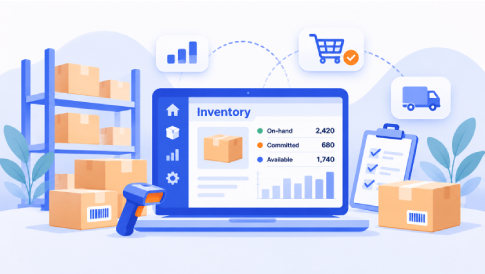
Out of the box, Zoho syncs Shopify, Amazon, eBay, and popular carriers, while handling purchase orders, serial numbers, and basic warehouse moves. Built-in reports separate stock into on-hand, committed, and available-for-sale quantities, which stops reserved items leaking back onto the storefront.
Trade-offs surface as you scale. Cross 7 000 orders or open a fourth warehouse and the Plus plan loses its price edge. Forecasting stays rules-based, and deep manufacturing lives outside the Zoho stack. For merchants juggling a few channels and SKUs, though, Zoho offers a solid backbone long before an ERP becomes essential.
3. Prediko: AI Planning that Fills the Gap before You Notice It
Fast-moving Shopify brands juggle purchase orders at sprint speed. Prediko calms the chaos by showing you what to buy, and when, before stockouts appear.
The engine ingests sales velocity, lead times, and seasonality, then builds a 12-month PO calendar. A conversational agent named Pia drafts orders or sends “buy now” alerts the moment coverage falls below your threshold.

Prediko AI inventory planning and PO calendar dashboard
Pricing follows revenue. Below US $100 000 in annual GMV, the fee is $49 a month and includes unlimited users, SKUs and POs. Need raw-material forecasting or a basic BOM? Add $20 a month for that module. Higher GMV tiers climb in the same clear steps outlined on Prediko’s pricing page.
Limitations remain. Prediko treats Shopify as the system of record, so barcode picks and deep warehouse logic stay in your WMS or 3PL apps. Public docs do not clarify how stocktakes handle open commitments, so make that Step 1 in your demo script. Pass that test and Prediko can turn gut-feel reordering into repeatable, AI-backed discipline.
4. Katana: Manufacturing Clarity for eCcommerce Makers
If your stock lives in bins of screws and pigment instead of finished goods, Katana speaks your language.
One dashboard tracks raw materials, work in progress, and finished SKUs. Bills of materials connect every component to the parent item, so the moment a sales order lands, Katana checks parts on hand and flags shortages before the line stalls.
Plans start with a free tier for up to 30 SKUs. The Core plan at $299 a month unlocks unlimited SKUs, users and integrations, plus shop-floor tasks and batch tracking. Need multi-location fulfillment? Add extra sites à la carte rather than jumping to an enterprise bundle.
Katana’s AI suggests smarter stock placement and production timing, yet you approve every move. It is guidance, not autopilot.
Watch-outs: Core supports only one location, which may limit businesses managing inventory across multiple warehouses. For Shopify, WooCommerce, or BigCommerce makers who want ERP-grade traceability without ERP bloat, Katana is a solid contender.
5. inFlow Inventory: Wholesale Workhorse with B2B DNA
If you move pallets on Monday and single units on Tuesday, you need ecommerce inventory management software that treats a carton, case, and each as first-class citizens. inFlow was built for that mix.
Every sales order supports negotiated pricing, customer-specific terms, and partial shipments, and you do not need an ERP to get started. Warehouse tools handle bar-code picks, serial tracking, and standard pick-pack-ship flows. Need light manufacturing or kitting? Switch to the Manufacturing edition without losing margin visibility.
Pricing begins at $129 a month when billed annually for one location and one integration, enough to pair Shopify with QuickBooks and prove value fast. See the inFlow pricing page for live tiers. Upgrade to Growth or Scale for extra locations, users, and a self-serve B2B portal so wholesale buyers can place POs at 2 am.
Read the fine print: excess orders cost $0.20 each, and some tiers charge for onboarding. Forecasting is dashboard-only, so heavy demand planning may stay elsewhere. Public docs do not explain how stocktakes treat open commitments, so add that check to your demo script.
For distributors and hybrid retailers who live in purchase orders and pallets yet still want ecommerce agility, inFlow provides sturdy B2B foundations without a six-figure ERP invoice.
6. Descartes Finale: Barcode Precision for High-Volume Pick-Pack-Ship
When your daily orders climb into four digits, memory is not a safety net. Finale keeps you accurate with scan-verified moves at every step: receiving, transfers, picks, and shipments. Lot numbers, expiry dates, and serials stay linked to each unit without slowing the line. Need to switch warehouses? Tap the handheld, change the location and keep moving.

Descartes Finale barcode inventory management warehouse UI
The Essentials plan costs US $499 a month and now bundles mobile-scanner licenses plus higher order ceilings. Growth rises to US $799, and enterprise contracts climb into five figures for multi-site operators. Older listicles still quote $99, so check Finale’s current pricing before you budget.
Descartes acquired Finale on August 4, 2025, adding TMS, parcel rating, and compliance tools to the roadmap while raising questions about contract portability and support SLAs. Review the acquisition release and ask those questions before signing a multi-year deal.
Forecasting relies on sales velocity; you get a practical reorder report, not conversational AI. Documentation does not yet explain how stocktakes treat open commitments, so make that Test #2 in your demo script. If mis-picks, oversells, and manual labels are eating margin, Finale’s scan-verified workflow can pay for itself in avoided penalties.
7. Cin7 Core / Omni: One Console for Omnichannel and EDI
If your catalog stretches across Shopify, Amazon, Walmart, three wholesale portals and retailer EDI feeds, most mid-market tools tap out. Cin7 steps in, wiring storefronts, POS, 3PLs, and EDI hubs into a single console.
Core starts at US $349 a month and includes unlimited locations but only two integrations and 6 000 sales orders per year. According to Cin7’s pricing page, Pro and Advanced widen those limits, add built-in MRP, and unlock a full WMS with wave picking. Omni is quote-only and rolls the legacy Cin7 system into a cloud rewrite for enterprise scale.
At Summit 2025, Cin7 introduced ForesightAI, a forecasting layer that grades SKUs by seasonality and lead time, then serves replenishment tasks in propose mode for your approval.
Implementation is the rub. G2 reviews praise breadth but flag complex mapping and surprise overage fees. Before you sign, press sales on five numbers: required integrations, annual order volume, EDI partners, onboarding hours and support SLAs. With those dialed in, Cin7 can keep ecommerce, wholesale and retail inventory singing from the same ledger.
8. Linnworks: One Console for Every Marketplace
Cross-border sellers often juggle more dashboards than browser tabs. Linnworks collapses them into a single queue, so orders from Amazon US, Shopee Malaysia, TikTok Shop UK, Walmart and more than 100 other channels land in one pick list for you to process.
Listing tools push catalog changes back to each marketplace, protecting VAT rules, unit pricing, and local content. A rules engine can route each order to your warehouse, FBA or a 3PL in milliseconds based on size, stock or destination.
Pricing is quote-only; plans scale with monthly order volume and optional modules such as WMS, forecasting, or listing enrichment. Linnworks’ pricing page outlines tier breaks and overage fees before you sign.
Where Linnworks shines: global marketplace breadth and automated routing. Where it falls short: no deep manufacturing (BOM or shop-floor control) and a steep learning curve, which means the platform works best when you can dedicate an operations owner to manage it.
Which Inventory Tool Fits Your Operating Model?
Stop chasing features; match ecommerce inventory management software to the pain that eats most of your week.

| Main pain point | Start with… |
| Materials, machines and people planned together for in-house production | Organizely |
| Low-cost multichannel sync | Zoho Inventory |
| AI-driven purchase planning | Prediko |
| BOM, raw materials, shop-floor control | Katana |
| B2B sales orders and wholesale terms | inFlow Inventory |
| Barcode speed for high-volume picking | Descartes Finale |
| Omnichannel control plus EDI | Cin7 Core / Omni |
| Global marketplace command console | Linnworks |
Quick guardrails
- Run one store on one channel and manage fewer than 1 000 SKUs? Try native Shopify first.
- Outsource fulfilment? Skip systems that charge for wave picking or labour tracking.
- Use several 3PLs? Prioritise event reconciliation over dashboard polish.
- Manufacture in-house? Demand component-level traceability, not only finished-goods counts.
- Ship cross-border? Require landed-cost, duty and importer-of-record fields.
Treat this table as a compass, not a verdict. Short-list two platforms that fit your reality, run the same 30-minute acceptance script in each sandbox, and let real data crown the winner.
The 30-Minute Committed-Stock Acceptance Test
Sales demos move quickly and hide edge cases. Run the eight mini-scenarios below, each taking about four minutes, to prove your shortlisted platform can keep customer promises intact.

| # | Scenario | Pass = what you should see |
| 1 | Open order: create a 6-unit order, unfulfilled | On-hand 10, committed 6, available 4 |
| 2 | Physical count: find only 9 units | On-hand 9, committed 6, available 3 |
| 3 | Partial fulfilment: ship 4 units | On-hand 9, committed 2, available 3 |
| 4 | Cancellation: cancel 1 unit | On-hand 9, committed 1, available 4 |
| 5 | Return in quarantine: receive 1 scratched unit | On-hand 10, unavailable 1, committed 1, available 4 |
| 6 | Bundle order: sell a kit of 2 components | Bundle SKU 0 / 0; each component committed +2 |
| 7 | Location transfer: dispatch 3 units, not yet received | Source shows 3 in transit; destination shows 3 incoming; global available unchanged |
| 8 | Integration outage: pause connector 15 min, take 1 sale | Order back-fills; stock adjusts; no duplicates |
Why these tests matter
Failing any step exposes you to oversells, false stock-outs or data drift. A vendor that aces all eight proves it:
- Keeps committed stock separate from sellable stock.
- Maintains integrity during counts, bundles, transfers, and returns.
- Recovers cleanly when integrations hiccup.
Compare Total Cost, Not Sticker Price
Monthly fees may look harmless until overage bills, extra connectors, paid onboarding or a few barcode scanners double the tab.
The table below shows a 12-month model for a mid-tier ecommerce brand. Imagine 5 000 SKUs, 2 000 orders a month, three users, two warehouses, Shopify plus Amazon, QuickBooks and one 3PL connection. Swap the numbers to match your own reality.

| Tool | Year-1 software | Onboarding | Order overages* | Extra connectors | Hardware / add-ons | Est. 12-month TCO |
| Zoho Inventory Plus | $1 548 | $0 | $0 | $0 | $0 | $1 548 |
| inFlow Growth | $5 388 | $1 000 | $0 | $0 | $600 scanners | $6 988 |
| Katana Core + 2 locations | $5 148 | $1 500 guided | $0 | $0 | $0 | $6 648 |
| Cin7 Pro | $7 188 | $3 500 | $0 | $1 800 extra integrations | $0 | $12 488 |
| Finale Growth | $9 588 | $2 000 | $0 | $0 | $1 200 mobile devices | $12 788 |
*This model assumes each plan’s bundled order limit covers the 24 000-order annual volume. Confirm limits before you quote.
Prices verified August 25 2026. Vendors update tiers often, so always check the current pricing page.
Key takeaways: Zoho remains the cheapest after a year, while Finale’s barcode edge adds hardware and onboarding cost. Cin7’s bill climbs fastest because integration count, not order volume, drives its price.
Cross-Border Rules: the Hidden Deal-Breaker
When you ship abroad, “print label and hope” no longer works. Recent policy shifts turned paperwork into profit or penalties.
- United States: Duty-free de minimis ended on August 29, 2025, for every country. Each parcel now needs an HS code, declared value and calculated duty.
- European Union: Customs screened ≈ 4.6 billion low-value packages in 2024, enforcing strict data validation and spot audits.
If your inventory system cannot store landed-cost fields (freight, duty, brokerage, insurance) and country of origin, expect clearance delays and surprise invoices.
Gut-check a vendor demo
- Show HS code, COO and duty rate fields in the product record.
- Export a shipment file that lists those fields for every line item.
- Change a tariff mid-stream and watch landed cost recalculate instantly.
Pass all three and you can sleep through peak season while parcels clear without drama.
Sustainability: Inventory Decisions That Trim Miles and Waste
Green badges mean little if pallets still bounce across oceans. The right inventory system can cut emissions without adding a single leaf icon.
- Placement. Amazon’s 2025 Sustainability Report says smarter node selection avoided 127 million vehicle miles in one year. Fewer miles lower diesel use and fulfilment spend. Choose ecommerce inventory management software that recommends optimal fulfilment nodes or flags SKUs ready for forward staging.
- Dead stock. DHL’s 2026 E-commerce Trends Report finds 30 percent of shoppers expect sustainable logistics within five years, yet 42 percent of businesses admit they are not ready. Obsolete stock is the silent culprit: goods that consume warehouse energy before heading to landfill. Accurate forecasting and tight reorder points keep products moving instead of ageing.
- Returns. Systems that feed defect data back into purchasing can spot quality issues early and spare the round-trip haul entirely.
Demo litmus test
Ask the vendor:
“Where can I export inventory age, transfer distance and disposal reason?”
If the team stumbles, sustainability lives only in their slide deck.
Migration checklist: Clean Data in, Fewer Regrets Out
Most go-lives fail because your inputs are dirty, not because the code is buggy. Use this five-step checklist to bullet-proof your migration.
| Step | What you decide or do | Why it matters |
| 1. Define the system of record | Assign one source of truth for products, variants, locations, orders and returns | Dual authority creates duelling SKUs |
| 2. Scrub the catalogue | Merge duplicate barcodes, standardise units and archive variants unsold for 18 months | Bad data multiplies once imported |
| 3. Map stock states | Translate old “available” numbers into new available, committed, reserved buckets; test with sample SKUs | Prevents launch-day oversells |
| 4. Capture in-flight events | List transfers, open POs and returns awaiting inspection in separate columns | Teams often skip these and face five-figure variance |
| 5. Run a parallel period | Keep old and new systems live for one full reorder cycle; flag variance over 2 percent daily | Catches mapping bugs before you switch off legacy |
Treat migration like a product launch, not an after-hours spreadsheet chore, and you will start day one with confidence, not crisis.
FAQs
What is committed inventory?
Committed inventory is stock already promised to open orders or draft transfers. It sits on the shelf but is not available to new shoppers. Any platform you choose must track that bucket separately to prevent overselling.
Can Shopify manage inventory on its own?
Yes, if you run one location, a modest SKU count and no manufacturing. Once you add bundles, multiple 3PLs or forecasting needs, a dedicated system usually costs less than constant manual fixes.
How much should iecommerce inventory management software cost?
Entry-level plans range from free to around $30 per month, while mid-market and enterprise solutions can cost several hundred or even more than $1,000 per month, before onboarding, integrations, and hardware expenses. See the TCO table above for a real-world model.
Is real-time sync a silver bullet against oversells?
No. Instant webhooks cannot fix bad stocktakes, delayed returns or API outages. Run the 30-minute acceptance test to see whether a tool reconciles those gaps.
Best Stocky replacement after August 31, 2026?
Shopify retired Stocky on August 31, 2026. Multichannel sellers should compare Zoho Inventory and Cin7 Core based on order volume and integration count.
What is the difference between IMS, OMS, WMS and MRP?
- IMS tracks inventory quantities
- OMS routes and allocates orders
- WMS, runs warehouse tasks (pick, pack, and ship)
- MRP plans production and material requirements
Still have a question? Drop it in the comments and we will answer each week.