10 GEO Tools to Track Brand Visibility Across AI Search Platforms
Imagine someone asks an AI assistant, “What are the best CRM platforms for a growing SaaS company?”
The answer lists five products. Three are your direct competitors. Your company, despite having a competitive product and a well-optimized website, does not appear.
Traditional SEO tools show how your website performs in search results, which keywords bring visitors, and which pages attract backlinks. They do not fully explain how AI assistants describe your brand, recommend competitors, or cite sources when answering questions.
That is where generative engine optimization (GEO) comes in.
GEO focuses on understanding and improving how brands and content appear in AI-generated answers. For SaaS companies, this can mean monitoring brand mentions, recommendations, citations, and competitor visibility across AI-powered search experiences.
Manually checking multiple AI platforms is difficult to do consistently. GEO tools help by organizing prompts, collecting responses, and reporting how visibility changes over time.
This guide compares 10 tools with different strengths, from dedicated AI search monitoring to broader marketing platforms that combine visibility research with content or SEO workflows. Features and platform coverage can vary by plan, so check the vendor’s current product details before choosing.
What Is a GEO Tool?
A GEO tool helps businesses understand how their brands and content appear in AI-generated answers.
Depending on the product, it may monitor brand mentions, recommendations, citations, sentiment, competitor visibility, and changes across selected prompts or topics.
For example, a SaaS company that sells customer support software might track questions such as:
- What are the best customer support platforms for startups?
- Which help desk tools integrate with Shopify?
- What are the best alternatives to Zendesk?
- Which customer service software offers AI-powered automation?
A monitoring platform can collect answers to these questions and show whether the company appears alongside competing products.
It is important to distinguish three outcomes:
- Mention: An AI answer names your company or product.
- Recommendation: An AI answer actively suggests your product for a particular need.
- Citation: An AI answer references your website or another source.
These outcomes are related, but they are not interchangeable. A brand can be mentioned without being recommended, and a website can be cited without the product being named.
Quick Comparison: 10 GEO Tools
| Tool | Best suited for | Distinguishing capability |
| Addlly AI | Enterprise teams connecting visibility research with execution | Multi-market AI visibility analysis and brand-trained content agents |
| Profound | Enterprise marketing and brand teams | Answer Engine Insights, prompt-volume research, agent analytics, and AI Marketer workflows |
| Peec AI | Marketing teams that need clear reporting | Visibility, position, sentiment, prompt segmentation, and source-use/citation analysis |
| Otterly.AI | Teams starting with structured AI search monitoring | Prompt research, brand reports, competitor tracking, and citation monitoring |
| AthenaHQ | Teams linking visibility data to optimization work | Prompt-level tracking, citation analysis, optimization recommendations, and Ask Athena |
| Scrunch AI | Brands investigating how AI systems access and represent their sites | AI visibility monitoring plus crawler insights and Agent Experience Platform (AXP) |
| Semrush AI Visibility | Existing SEO teams expanding into AI search | AI visibility benchmarking, prompt tracking, competitor research, and AI site audits |
| Ahrefs Brand Radar | SEO teams researching brand presence at scale | Large search-backed AI prompt index and custom prompt tracking |
| Writesonic | Teams combining AI visibility analysis with execution | AI visibility monitoring, action prioritization, and content/technical workflows |
| SE Visible | Businesses wanting a focused AI visibility dashboard | Daily prompt tracking across ChatGPT, Gemini, Google AI Overviews, and AI Mode |
The main difference is the type of work each platform supports. Some concentrate on measuring visibility; others add prompt research, site diagnostics, content recommendations, or broader SEO intelligence. The table is a starting point, not a performance ranking.
1. Addlly AI
Best for: SaaS companies that want to connect GEO monitoring with content optimization.
Tracking brand mentions is a useful starting point, but the data becomes more valuable when your marketing team can act on it.
Suppose you discover that ChatGPT frequently recommends three competing products when users ask for the best marketing automation tools. Your brand appears occasionally, but the answers rarely explain your product’s main advantages.
The next questions are obvious: What information is missing? Which customer questions should your website answer more clearly? Are there useful comparison pages or educational resources you have not published?
Addlly AI is worth considering for this type of workflow.
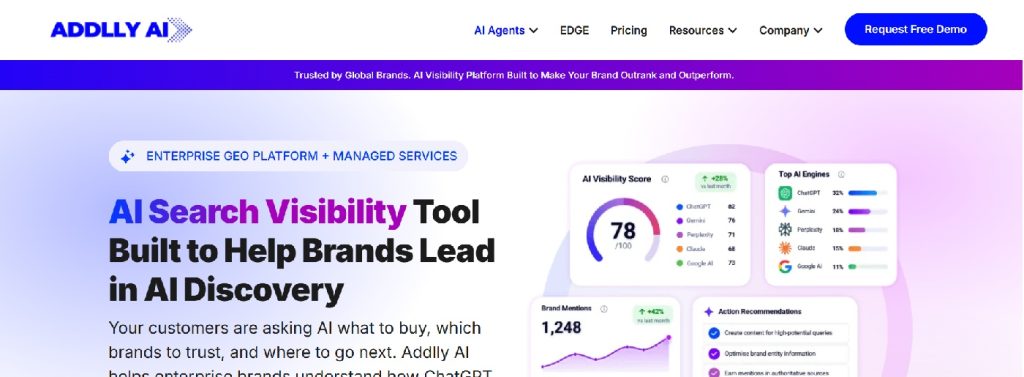
The platform focuses on AI marketing and Generative Engine Optimization. Its GEO offering includes visibility audits, monitoring, sentiment analysis, citation analysis, and AI-assisted content workflows designed to help teams investigate their presence in AI search and identify potential improvements.
For SaaS marketing teams, this creates a connection between understanding visibility gaps and planning content to address them.
Key capabilities to explore:
- GEO audits to assess current AI search visibility.
- AI visibility and competitor monitoring.
- Citation analysis and sentiment insights.
- Query research and content opportunity identification.
- AI-assisted content creation and optimization workflows.
What to consider: Confirm which AI platforms are supported by your chosen plan, how prompt tracking works, and whether the available reporting matches your team’s requirements.
Our take: Addlly AI is a relevant option for businesses that want to bring AI visibility analysis and content execution closer together, rather than treating monitoring as a standalone activity.
Website: https://addlly.ai/
2. Profound
Best for: Enterprise marketing teams that need broad AI search intelligence.
Profound presents itself as an AI marketing platform rather than only a brand-mention tracker. Its product areas include Answer Engine Insights, Prompt Volumes, Shopping, Agent Analytics, and AI Marketer workflows.
For a company with several product lines or customer segments, this broader scope can help connect what people ask AI systems with how the brand and its competitors appear in generated answers. The platform also describes citation analytics and visibility reporting across AI search experiences.
Capabilities highlighted by the vendor:
- Answer Engine Insights and AI visibility reporting.
- Prompt-volume research to understand what people ask AI.
- Citation analytics and platform-level visibility views.
- Agent analytics and AI-assisted marketing workflows.
What to check: Ask which answer engines and datasets are included in the proposed plan, how prompt volumes are estimated, and what access controls and reporting features are available. Profound is positioned toward larger marketing operations, so compare implementation needs with your team’s resources.
Our take: Profound is worth evaluating when AI search is part of a broader enterprise marketing and competitive-intelligence program.
Website: tryprofound.com
3. Peec AI
Best for: Marketing teams that want clear visibility and source reporting.
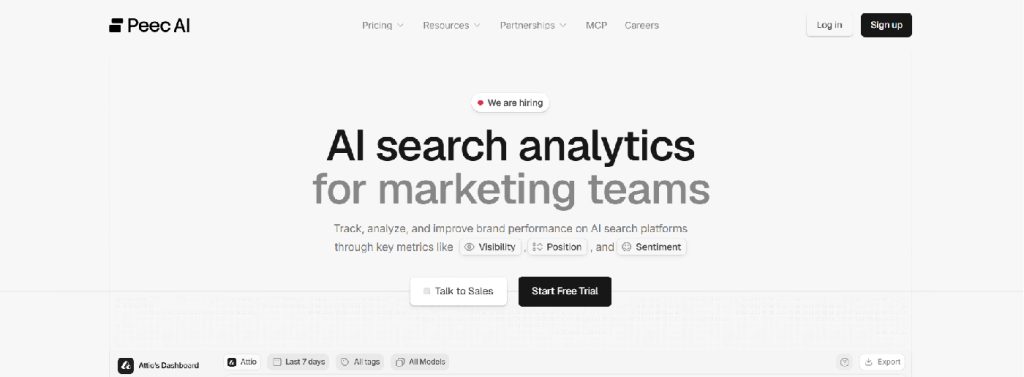
Peec AI focuses on AI search analytics for marketing teams. Its dashboard emphasizes three core measures: visibility, position, and sentiment. Teams can add their own prompts, organize them with tags, and segment reporting by AI model, country, or audience-related prompt groups.
One useful distinction in Peec AI’s documentation is its treatment of source use and explicit citations. It describes tracking when content informed an AI answer separately from when a URL is visibly cited. That can help teams understand whether their content contributes to answers even when the brand itself is not named.
Capabilities highlighted by the vendor:
- Brand visibility, position, and sentiment reporting.
- Custom prompts and prompt tagging.
- Model- and country-level segmentation.
- Source-use and URL-citation analysis.
- Reporting integrations, including Looker Studio and an API.
What to check: Review the available models, prompt allowances, reporting integrations, and refresh frequency in the plan you are considering. Peec says selected prompts are run daily on chosen AI models, but the available configuration can depend on the subscription.
Our take: Peec AI is a good candidate for teams that want a dedicated reporting environment and a clearer distinction between brand visibility and source visibility.
Website: peec.ai
4. Otterly.AI
Best for: Teams that want a straightforward starting point for AI search monitoring.
Otterly.AI is built around prompt research, AI search analytics, and optimization. Its product pages describe monitoring brand mentions and website citations across several AI search experiences, with reporting that can be filtered by engine, market, and prompt category.
For a smaller SaaS team, a practical starting point might be a focused list of category, comparison, and alternative queries. The team can review which brands appear, where its website is cited, and whether the pattern changes over time.
Capabilities highlighted by the vendor:
- Prompt research and AI search monitoring.
- Brand-mention and competitor reporting.
- Website citation monitoring.
- Reporting by AI engine, market, and prompt tags.
- AI search optimization features.
What to check: Confirm the AI engines available in the plan, whether some engines are add-ons, the number of prompts included, and the reporting history retained. These details matter more than the headline starting price.
Our take: Otterly.AI is worth exploring if your immediate need is to establish a repeatable monitoring routine without adopting a larger enterprise marketing platform.
Website: otterly.ai
5. AthenaHQ
Best for: Teams that want to turn AI visibility data into optimization tasks.
AthenaHQ combines AI search visibility tracking with analysis and recommendations. Its product information highlights cross-platform tracking, citation-source analysis, and content optimization recommendations. The company also describes Ask Athena, an AI copilot that answers questions using a customer’s own visibility data, competitor benchmarks, and citation tracking.
This can be useful when a marketing team needs to move from “Where are we missing?” to “Which pages or topics should we investigate next?” For example, a SaaS company could examine prompts where competitors are cited more often and use the findings to prioritize product-page or comparison-content improvements.
Capabilities highlighted by the vendor:
- Prompt-level visibility tracking across multiple LLMs.
- Citation-source and competitor analysis.
- Content recommendations based on visibility gaps.
- Ask Athena for questions about account-specific performance.
- Integrations with selected analytics and publishing platforms.
What to check: Confirm the AI engines, prompt volume, integrations, and features available at your subscription level. Some enterprise capabilities, such as access controls and expanded reporting, may be plan-dependent.
Our take: AthenaHQ stands out for teams that want an analysis-and-action workflow, rather than visibility measurement alone.
Website: athenahq.ai
6. Scrunch AI
Best for: Brands that want to understand both AI visibility and how AI systems access their websites.
Scrunch combines AI search monitoring with site-level insights. Its product describes tracking prompts, topics, entities, citations, competitor positions, and AI bot activity. It also offers an Agent Experience Platform (AXP), which creates a machine-readable version of a site intended to make information easier for AI agents to process.
This makes Scrunch different from a tool focused only on counting mentions. A company can investigate which answers cite its content and whether technical access issues may prevent AI crawlers from reading important pages.
Capabilities highlighted by the vendor:
- Prompt-, topic-, and entity-level monitoring.
- Citation, competitor, and ranking insights.
- AI bot traffic and crawl monitoring.
- Optimization guidance and crawl-error detection.
- AXP for serving structured, agent-oriented site content.
What to check: Ask how AXP is implemented alongside your existing website, what technical changes it requires, and which monitoring and optimization features are included in your plan.
Our take: Scrunch is particularly relevant when a brand wants to investigate both its representation in AI answers and the technical accessibility of its website to AI agents.
Website: scrunch.com
7. Semrush AI Visibility
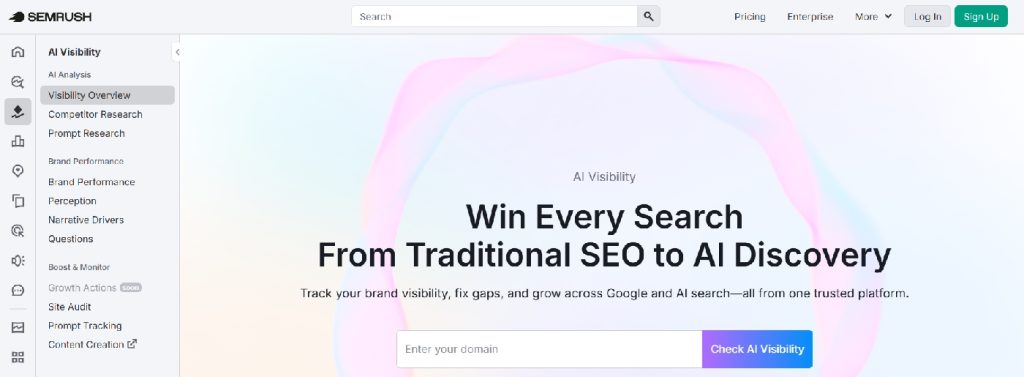
Best for: SEO teams that want to add AI search reporting to an existing marketing workflow.
Semrush extends its established SEO and competitive-research environment with AI visibility features. Its AI Visibility Toolkit describes benchmarking a brand against competitors, analyzing sentiment and narratives, researching prompts, and monitoring selected prompts over time.
The platform also connects AI visibility work with site auditing and content recommendations. This can be convenient for teams already using Semrush for keyword research, backlinks, and organic search reporting.
Capabilities highlighted by the vendor:
- AI visibility scores and competitor benchmarks.
- Brand sentiment and narrative analysis.
- Prompt research and prompt tracking.
- AI crawler accessibility audits.
- Content recommendations and reporting.
What to check: Verify the AI platforms and prompt limits in the specific package. Semrush’s official materials describe coverage across ChatGPT, Gemini, Perplexity, and Google AI experiences, while exact features and allowances vary by toolkit and plan.
Our take: Semrush makes the most sense for teams that already rely on its SEO toolkit and want AI visibility research in a familiar marketing environment.
Website: Semrush AI Visibility
8. Ahrefs Brand Radar
Best for: SEO teams that want to research brand visibility across a large prompt dataset.
Ahrefs Brand Radar combines AI visibility research with the company’s broader SEO intelligence. It offers two complementary approaches: exploring an indexed dataset of AI prompts and setting up custom prompts to monitor questions that matter to a specific business.
The indexed approach can help a team discover where a brand appears across a broad range of topics. Custom prompt tracking is more targeted: marketers can monitor buyer questions and compare their brand with competitors over time.
Capabilities highlighted by the vendor:
- AI brand mentions and competitor benchmarking.
- AI Share of Voice and citation research.
- A large search-backed prompt index.
- Custom prompt tracking with selectable AI platforms and refresh schedules.
- Related web, search-demand, and emerging-channel research.
What to check: Brand Radar has separate index and custom-prompt options. Confirm which AI platforms, prompt allowances, refresh frequencies, and add-ons are included in the package you intend to purchase.
Our take: Ahrefs Brand Radar is a strong option for SEO teams that value broad discovery research and want to connect AI visibility with existing search and web intelligence.
Website: Ahrefs Brand Radar
9. Writesonic
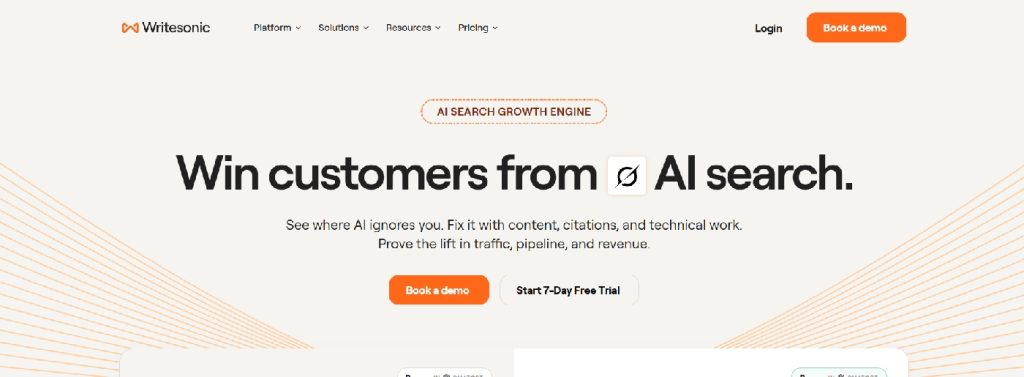
Best for: Marketing teams that want to connect AI visibility research with execution.
Writesonic now presents itself as an AI Search Growth Engine. Its product combines AI visibility monitoring and research with an Action Center and AI agents for content and technical work. The platform describes tracking prompts and visibility across multiple AI platforms, reviewing citations, and prioritizing opportunities such as content gaps or technical issues.
This is broader than a traditional AI writing assistant. A marketing team can use the monitoring data to identify where competitors appear, investigate cited sources, and plan content or site improvements.
Capabilities highlighted by the vendor:
- AI visibility monitoring and prompt research.
- Citation and competitor analysis.
- AI search dataset and brand/topic research.
- Action prioritization for content and technical issues.
- AI agents and workflows for content optimization and execution.
What to check: Confirm which AI platforms, markets, and workflows are available in your plan. Also distinguish between visibility tracking and execution features: having content-generation tools does not by itself prove that a brand is gaining AI visibility.
Our take: Writesonic is worth considering for teams that want monitoring and content/technical execution to sit within one broader AI search workflow.
Website: writesonic.com
10. SE Visible by SE Ranking
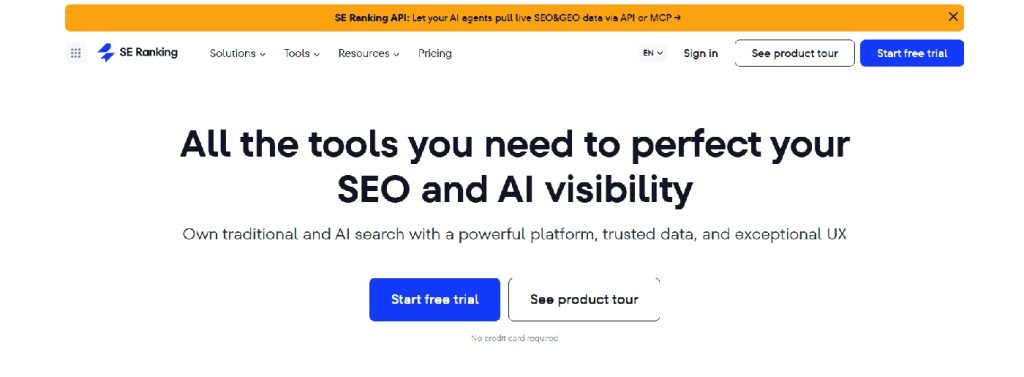
Best for: Businesses that want a focused AI visibility dashboard alongside their SEO work.
SE Visible is SE Ranking’s dedicated AI visibility platform. It shows where a brand appears in AI-generated answers, how it compares with competitors, and which pages or sources are cited. Its current product information lists ChatGPT, Google AI Overviews, Google AI Mode, and Gemini as supported AI systems.
The platform also supports country and language configuration. Its help documentation describes browser-based response collection and scheduled prompt refreshes. Check the current plan details for the available refresh settings. .
Capabilities highlighted by the vendor:
- Brand mentions and visibility comparisons.
- Website citation and source reporting.
- Competitor share-of-voice and sentiment metrics.
- Prompt tracking across four listed AI systems.
- Country- and language-specific project settings.
What to check: Confirm supported countries and languages for your target market, along with prompt allowances and plan limits. The vendor’s published list of supported regions is not universal.
Our take: SE Visible is a focused option for teams that want AI answer monitoring without moving to a broader enterprise marketing platform.
Website: SE Visible
How to Track Brand Visibility in AI Search Effectively
Choosing a platform is only the beginning. The quality of your insights depends on how consistently you measure visibility.
Step 1: Build a list of customer questions
Start with questions people ask when researching your product category. Include:
- Category questions: “What are the best CRM tools for startups?”
- Comparison questions: “HubSpot vs. Salesforce for a small business.”
- Alternative questions: “What are the best alternatives to [competitor]?”
- Use-case questions: “Which project management tool works best for remote teams?”
- Feature questions: “Which email marketing platforms offer advanced automation?”
Use both branded and non-branded prompts. Branded prompts show how AI describes your product; non-branded prompts help reveal whether your brand appears during broader discovery.
Step 2: Establish a baseline
Run your selected prompts through the relevant AI platforms and record the results. Track whether your brand appears, whether it is recommended, its position in the answer, and whether your website is cited.
Keep the prompt set consistent. Record changes in model, market, language, settings, or collection method so that you do not mistake a change in methodology for a change in visibility.
Alongside AI visibility monitoring, applying proven on-page optimization techniques can help make your website content clearer and easier to navigate.
Step 3: Monitor competitors
Track which companies appear alongside yours. Look beyond total mentions: are competitors recommended for particular use cases, appearing earlier in answers, or supported by sources that your website does not provide?
This can help identify gaps in product positioning and supporting content.
Step 4: Investigate citations and missing information
If an AI platform repeatedly cites a competitor’s comparison page or an independent industry resource, examine what that source contributes. Does it explain a use case clearly? Does it provide useful comparisons or detailed product information?
Use these findings to improve your own resources and avoid common website optimization mistakes. The goal is to publish a more useful answer, not to copy a competitor’s wording.
Step 5: Measure changes over time
After updating content or product information, keep monitoring the same prompts. Look for changes in mention rate, recommendation rate, citation frequency, and competitor share of voice.
AI answers fluctuate. A single appearance or disappearance does not prove that an optimization worked or failed. Repeated observations provide a more reliable picture.
Which GEO Metrics Matter Most?
Different metrics answer different questions, so they should not be treated as interchangeable.
| Metric | What it tells you |
| Brand mention rate | How often your brand appears in the monitored answers |
| Recommendation rate | How often an answer explicitly recommends your product |
| Share of voice | How your visibility compares with competitors in the tracked sample |
| Citation frequency | How often your website or other sources are cited |
| First-position rate | How often your brand is the first brand named |
| Sentiment | How your brand is described, where the tool can measure it reliably |
| Entity accuracy | Whether product details and brand descriptions are correct |
| Referral traffic | Whether AI-related visits reach your website |
| Conversions | Whether those visits contribute to sign-ups, demos, or sales |
For example, a brand may appear in 40% of tracked answers but receive few direct recommendations. Another brand might appear less often but be recommended more frequently for high-intent questions.
Connect visibility measurements to website analytics and business outcomes wherever attribution is reliable. More mentions do not automatically mean more customers.
How to Choose Right GEO Tools
Before subscribing GEO tools, consider five questions.
Which AI platforms matter to your audience?
If ChatGPT is your priority, confirm that the chosen plan tracks it. If your customers also use Gemini, Perplexity, Google AI Overviews, or other systems, compare platform coverage rather than relying on a generic “multi-platform” claim.
How many prompts do you need to monitor?
A small business may need a focused set of high-intent questions. A larger company may need separate prompt groups for product lines, customer segments, countries, and languages.
Do you need monitoring or optimization as well?
Some tools focus on measurement. Others add citation analysis, content recommendations, technical audits, or execution workflows. Choose based on what your team can realistically implement.
Can you inspect the underlying answers and sources?
A dashboard score is useful, but the actual answer explains what happened. Look for access to individual responses, cited URLs, competitor mentions, and historical results.
Does the tool fit your budget and workflow?
Compare prompt allowances, supported models, refresh frequency, reporting, team access, integrations, and implementation requirements. Evaluate the total cost rather than the entry-level price alone.
If you’re building or updating your company’s online presence, explore these business website templates to find a design that fits your brand.
Frequently Asked Questions
Can I track brand mentions in ChatGPT for free?
Yes. You can start manually by asking ChatGPT a consistent set of relevant questions and recording whether your brand appears. Some providers also offer free trials, limited plans, or one-time visibility checks. These options can help establish a baseline before investing in ongoing monitoring.
What is the difference between a brand mention and a citation?
A brand mention occurs when an AI answer names your company or product. A citation is a source reference that supports or links to information in the answer. Your brand can be mentioned without your website being cited, and your website can be cited without your product receiving an explicit recommendation.
Do GEO tools guarantee more AI recommendations?
No. GEO tools help measure visibility and identify opportunities, but they cannot guarantee that an AI platform will mention or recommend a brand. Answers can change depending on the prompt, context, model, available information, and other factors.
How often should I monitor AI search visibility?
The right frequency depends on your market, budget, and reporting needs. Daily monitoring may help teams managing active campaigns or rapidly changing categories. Smaller teams may find weekly or monthly reporting sufficient. Consistency matters more than collecting large amounts of data without a clear purpose.
Are GEO tools a replacement for SEO tools?
No. SEO platforms help with technical audits, keyword rankings, backlinks, and organic search performance. GEO tools focus on how brands and content appear in AI-generated answers. Some products cover both areas, but their metrics should still be interpreted separately.
Final Thoughts
GEO tools give SaaS companies another way to understand how potential customers discover and compare products through AI-powered search.
The useful question is not simply whether your brand appears. It is which prompts lead to mentions, how your product is described, which competitors receive recommendations, and what sources influence the answers.
A dedicated monitoring platform may be enough for some teams. Others will benefit from deeper analytics, competitive research, or content and technical workflows that help them act on the findings.
Start with a focused set of real customer questions, establish a baseline, and monitor changes consistently. The goal is not to chase every AI mention. It is to help the right customers discover your product, understand its value, and find accurate information when they are deciding what to buy.

Leave a Reply