Best Virtual Cards for Advertising Campaigns in Google Ads
Running successful Google Ads campaigns involves more than choosing the right keywords, audiences, and creatives. The payment method behind each campaign can also affect account stability, especially as Google continues to strengthen its fraud detection systems.
Today, Google’s automated security checks evaluate billing activity alongside other account signals. Factors such as unusual payment patterns, mismatched billing information, or repeated card declines may trigger additional verification or even lead to account suspension. For media buyers managing multiple campaigns, choosing a reliable virtual credit card (VCC) provider has become an important part of reducing operational risk.
The right virtual card can do more than process payments. High-quality providers offer trusted BINs, flexible card management, and features designed specifically for advertising platforms, helping teams organize spending while supporting smoother campaign management.
This guide explains the key criteria for evaluating providers of virtual cards and compares five popular services for Google Ads based on factors such as BIN quality, geographic coverage, scalability, fees, and management features.
Evaluation Criteria: How Media Buyers Assess Virtual Cards
Navigating the virtual card market requires looking beyond basic marketing promises. To build an objective ranking, we evaluate payment providers using six operational benchmarks that directly impact Google Ads stability:
- BIN trust level: Google cross-references the first six to eight digits of a card (the BIN) with financial databases to identify the issuing bank, card type (credit, debit, or prepaid), and country. Premium credit BINs from major US or European banks carry the highest trust score.
- Geographical diversity: Matching the card issuer’s country with the Google Ads account billing country and proxy location reduces the risk of automated security triggers.
- Scalability and Issuance limits: High-volume media buying teams require the ability to generate hundreds of unique cards instantly via dashboard control or API.
- Anti-fraud resilience: High-quality providers retire compromised BINs and replace them with fresh, clean ranges to prevent shared-pool contamination.
- Fee structures and Funding methods: The total cost of capital depends on card issuance fees, monthly maintenance, deposit commissions, and currency conversion markups.
- Team management and Integration: Large agencies need multi-user roles, shared balances, spending limits, and API access to automate card creation within their proprietary systems.
The following ranking of the top five providers of virtual cardsis structured strictly around these technical parameters.
Top 5 Virtual Cards for Google Ads (2026)
| Provider | Best For | API | Cashback | Free Cards | Standout Feature |
|---|---|---|---|---|---|
| Spend.net | Cashback + clean BINs | — | ✓ | ✓ | Multiple advertising BINs |
| PSTNET | Advertising payments | — | ✓ | ✓ | Platform-specific cards |
| EPN | High-volume teams | — | — | — | Tiered pricing |
| Mybrocards | Agencies | ✓ | — | 50 | Agency infrastructure |
| Flexcards | Beginners | Limited | — | — | Fast onboarding |
Based on rigorous testing against our core criteria, we have selected and compared five distinct VCC services suited for different operational scales and strategies.
1. Spend.net
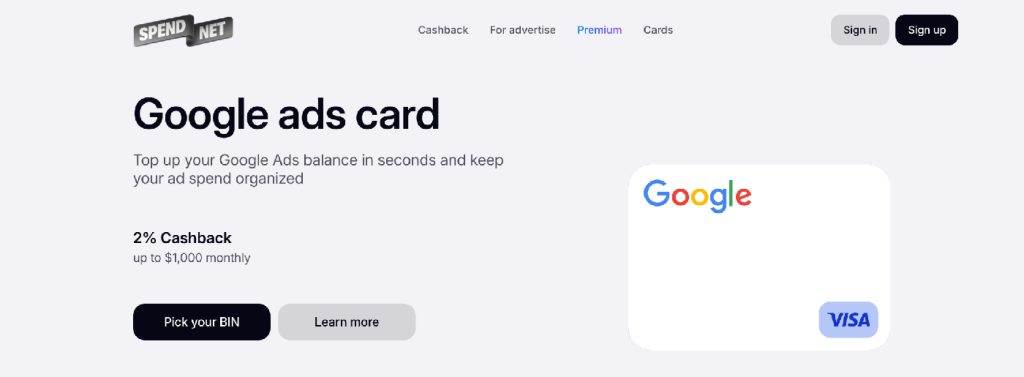
Best for: advertisers looking for cashback and a wide selection of clean advertising BINs.
Spend.net combines business payment features with tools designed for media buying, making it suitable for teams that manage advertising spend across multiple campaigns. While it supports standard operational expenses, the platform’s core architecture is engineered to optimize digital advertising deployment. Media buyers can use this service to pay for Google Ads while automatically receiving a 2% cashback credited directly to their balance.
Key features:
- BIN quality: Offers twenty distinct BIN options, including six highly exclusive, clean BIN ranges dedicated to advertising platforms.
- Automated cashback: Generous cash rewards are built into the system, though standard non-advertising payments receive a lower rate of 1%.
- Dynamic deposit fees: Implements a sliding-scale commission model where larger deposits trigger lower fees, allowing high-spending buyers to optimize operational costs.
- Onboarding: Features a quick registration process via Google or email, with a straightforward passport or ID KYC check and free card issuance.
A good choice for advertisers looking for a balance between clean BINs, cashback, and straightforward pricing.
2. PSTNET
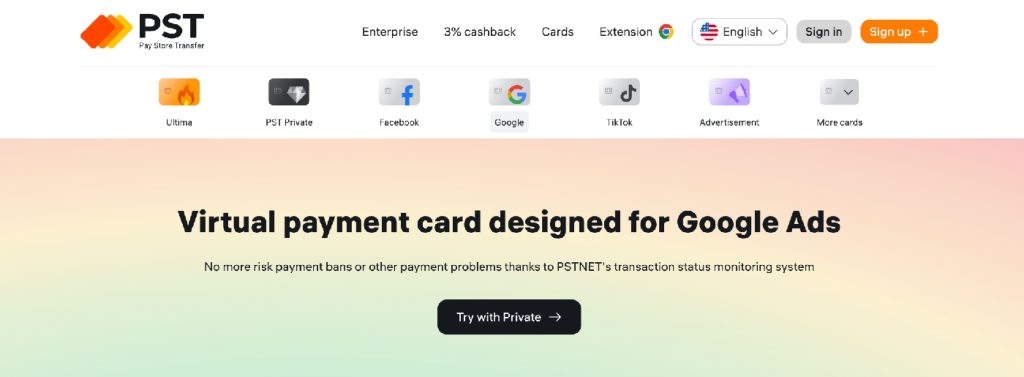
Best for: teams that prefer platform-specific cards and predictable transaction costs.
PSTNET focuses specifically on advertising payments, offering card options tailored for major ad platforms such as Google Ads, TikTok Ads, and Facebook Ads. Unlike Spend.net, which serves as a broader payment utility, this service groups its virtual cards by specific advertising platforms, ensuring that users deploy cards pre-optimized for Google’s payment gateways.
Key features:
- Transaction-friendly pricing: Zero fees on transactions, balance withdrawals, or declined payments on frozen cards, protecting buyers from hidden maintenance costs.
- PST Private programme: An elite tier offering 3% cashback on ad spend, free card creation, and reduced deposit fees for high-volume teams without requiring complex documentation.
- Zero-fee first deposit: New users can test the platform infrastructure by making their initial deposit in USDT with a 0% commission rate.
- Platform diversity: Provides specialized cards for Google Ads, TikTok Ads, and Facebook Ads, alongside a versatile universal “for advertising” card.
PSTNET remains the preferred option for media buying teams seeking maximum protection against transaction-fee leakage and highly targeted payment profiles.
3. EPN
Best for: teams that prefer platform-specific cards and predictable transaction costs.
EPN operates on a tiered account structure where platform capabilities, card costs, and BIN access scale in parallel with the user’s monthly spending volume. While it provides excellent stability, it requires more active management compared to the top two choices.
Key features:
- Tiered BIN access: Starter “Standard” accounts are limited to seven regularly rotated advertising BINs, with premium BINs unlocked at higher spend tiers.
- Variable funding fees: Deposits under $999 incur a 1% platform fee, while deposits of $1,000 or more drop to 0%, though third-party payment processors can add 2.5% to 5% to the final cost.
- Cross-border markups: Standard transactions not processed in USD incur a 3% currency conversion fee.
- Manual funding workflows: Shifts processing times for traditional WIRE transfers or partner platform integrations to manual support tickets, taking up to several days.
EPN is a strong contender for established operations that can navigate manual compliance workflows and maintain high spending tiers to unlock the lowest available rates.
4. Mybrocards
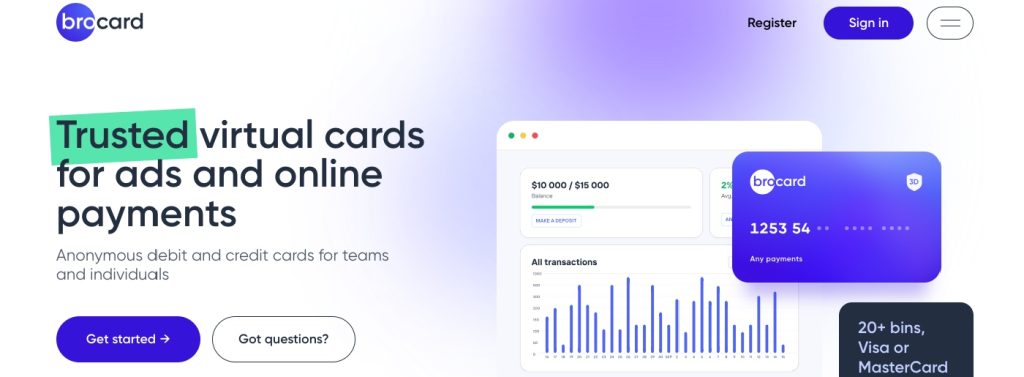
Best for: teams that prefer platform-specific cards and predictable transaction costs.
Mybrocards is a deeply integrated, invite-friendly platform tailored for advanced media buying teams and agencies requiring customized financial logic and deep automation.
Key features:
- Advanced infrastructure: Provides agency ad accounts for Google, TikTok, Reddit, and X (formerly Twitter) alongside full API access for programmatic card management.
- Tailored financial tools: Offers the ability to subsidize temporary payment holds and segment agency accounts by specific promotional niches.
- Introductory trial: New users receive their first 50 virtual cards free of charge after completing registration and KYC.
- High-touch Onboarding: Registration involves a live chat interview on their website, making it less accessible for casual buyers but highly secure for professionals.
Best suited to agencies that require API access and advanced account management features.
5. Flexcards
Best for: freelancers, solo media buyers, and small teams that need quick setup.
Flexcards functions as a lean, agile payment solution designed for rapid deployment and minimal administrative friction. It trades deep system integrations for speed and simplicity.
Key features:
- Rapid deployment: Instant card issuance within minutes of account creation, backed by a simplified KYC process for the majority of users.
- Low-cost entry: Card issuance fees are capped at $4 USD depending on the chosen BIN, with zero ongoing monthly maintenance fees.
- Manual team activation: Adding team members requires submitting a manual request to a dedicated manager via Telegram.
- Affiliate incentives: Features a structured referral programme offering up to 30% revenue share from referred users’ activity.
Flexcards is a highly practical entry point for solo buyers and growing teams that need a reliable backup payment method without facing complex setup procedures.
Best Practices: Using Virtual Cards without Account Bans
Having the best virtual cards is only half the battle. Google’s anti-fraud algorithms evaluate the entire environment surrounding a transaction. To ensure maximum account longevity, media buyers must implement a disciplined operational framework.
First, always maintain a clean local environment. A trusted BIN will still trigger a suspension if linked to an account accessed via a dirty residential proxy or a mismatched anti-detect browser profile. The billing country of the virtual card, the IP address of the browser profile, and the country specified in the Google Ads billing settings must align perfectly.
Second, avoid frequent card declines. Google interprets multiple payment declines within a short window as a sign of financial instability or potential fraud. Always fund the parent platform balance before the Google Ads billing threshold is met.
Third, distribute your financial risk. Do not link a single virtual card to multiple Google Ads accounts. If one account is suspended for policy violations, Google will blacklist the associated card, instantly affecting other accounts using the same payment method across all other accounts sharing that card. Allocate one unique virtual card to one unique advertising account.
While reliable payment methods help reduce billing-related issues, they are only one part of a successful advertising strategy. Well-structured campaigns, audience targeting, and ongoing optimization are equally important. If you’re looking to improve overall campaign performance, explore our guide on why Google Ads are essential for marketing success.
For example, an agency managing campaigns for 20 clients may assign a separate virtual card to each Google Ads account. This simplifies expense tracking while reducing the risk that payment issues affecting one account will interrupt campaigns for other clients.
Conclusion: Matching Payment Solutions to Your Strategy
No single provider of virtual cards is perfect for every scenario; the right choice depends entirely on your operational scale and business model.
- Solo media buyers: Spend.net provides an optimal mix of high-trust BINs, simple onboarding, and a built-in 2% cashback reward to improve profit margins.
- Growing teams: PSTNET delivers robust organization, platform-specific card grouping, and cost efficiency through its zero transaction fee model.
- Large agencies and aggressive scaling: Mybrocards and EPN offer the necessary API access, agency account integrations, and custom payment management required to manage thousands of active campaigns simultaneously.
- Beginners: Flexcards offers the lowest barrier to entry with its rapid setup, low issuance fees, and minimal KYC friction.
Once your payment setup is in place, tracking campaign performance becomes the next priority. Accurate conversion data helps you measure ROI, optimize budgets, and make informed advertising decisions. If your website runs on MotoCMS, our guide to using Google Tag Manager for smarter tracking explains how to collect and manage this data effectively.
Choosing the right virtual card provider can help reduce payment-related issues, but it is only one part of a successful Google Ads strategy. Reliable billing works best alongside well-structured campaigns, consistent optimization, and careful account management. Together, these elements create a more stable foundation for long-term advertising performance.





Leave a Reply