Outrank Competitors in LLM Product Recommendations
Imagine two protein powder brands selling similar products at comparable prices, with similar ingredients and reviews. A shopper asks an AI assistant, “What is the best protein powder for sensitive stomachs?” One brand appears in the answer, while the other does not.
Why might that happen? AI-generated recommendations can vary depending on the question, the information available to the system, and the sources it retrieves. While no brand can guarantee a place in every answer, businesses can improve their product information, build a credible online presence, and monitor how they appear in AI-powered discovery.
This guide explores practical ways to improve your brand’s visibility in LLM product recommendations without relying on shortcuts or guaranteed-ranking claims.
Know what LLM’s Really Look for
Language models do not prioritize pages as a search engine does. They organize their answers from resources they believe are reliable and select a few products to answer the question. Three things usually make a brand make the short list: clear, specific product information; consistent facts online; and independent voices endorsing the product, such as reviewers, editors, and customers.
Be aware that those are not tricks. The key to overtaking a competitor is being more helpful, more consistent, and better documented than the competitor. The remainder of this guide explains how that’s done on purpose.
Why Did the Bot Pick Them? How to Outrank Competitors in LLM Product Recommendations
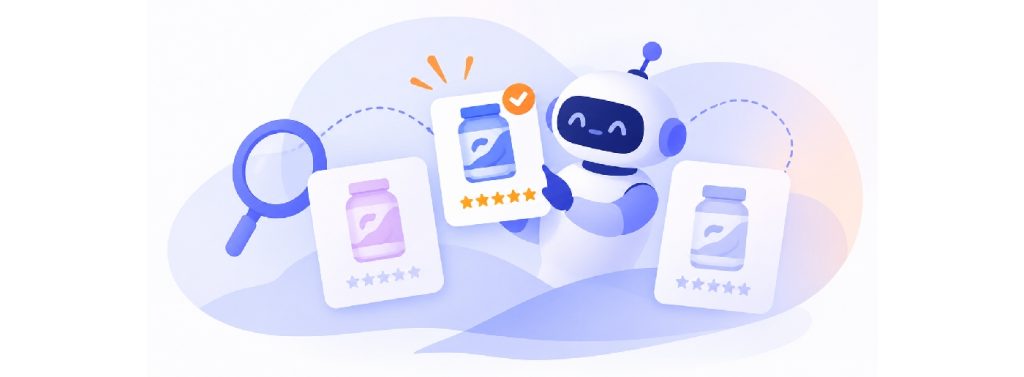
Step 1: Map the Prompts That Matter with Yotpo Discover
Start by listing the questions customers ask before they buy. These may range from broad discovery questions, such as “How do I choose a standing desk?”, to specific comparisons, such as “What is the best standing desk under $500 for a small apartment?” These prompts are the basis for any set of LLM product recommendation optimization strategies.
If you are capable of writing 40 – 60 of these by hand, that’s a great start, but Yotpo Discover can make your life easier. It uses actual shopper words from your reviews, Q&A and shopper interactions to create prompts that sound like actual questions, not guesses. It fetches your product catalog and feeds structured prompts to ChatGPT, Claude, Perplexity, and Gemini, and monitors your product, categories, and buying cycle.
Prompts can also be customized to your brand and buyer’s stages. What this means is that you will have a scoreboard that will tell you who you will see named and in which order, as well as who you are actually facing, even “AEO competitors” you never would have thought of.
Step 2: Study the Winners, not Just Your Own Pages
Compare the sources that appear in AI-generated answers with the information available on your own site. Does a competitor publish a useful buying guide? Are its product specifications easier to compare? Does it provide detailed customer reviews or answer common buyer questions more clearly?
Use these observations to identify specific gaps in your content and product information. A competitor’s visibility may reflect several factors, including the sources available to the AI system, the wording of the prompt, and the product attributes relevant to the request. Avoid assuming that a single article, review, or technical change explains the difference.
Step 3: Make Your Product Pages Impossible to Misread
Your product pages should answer the questions a shopper is likely to ask before making a purchase. Instead of relying on vague claims such as “premium quality” or “perfect for everyone,” provide specific details about materials, dimensions, ingredients, compatibility, warranty terms, and intended use.
Be clear about limitations, too. For example, a standing desk page could explain its height range, weight capacity, and whether it is suitable for smaller workspaces. This helps shoppers compare products and understand which option fits their needs.
Use accurate product structured data to describe details such as price, availability, and product identifiers. Make sure these details match the visible information on your website and in your product feeds. Structured data helps search engines interpret product information, but it does not guarantee that an AI assistant will recommend your product.
Step 4: Build Proof that Sounds like Real Customers
Customer reviews can reveal what buyers value, which problems a product solves, and where expectations may not be met. Encourage customers to share honest feedback about their experience, including how they use the product and what they would want other buyers to know.
Use recurring questions and feedback to improve your product pages. If shoppers repeatedly ask whether a standing desk is stable at its maximum height, for example, provide a clear answer supported by product specifications or testing.
You can also add a useful FAQ section covering common concerns about sizing, setup, compatibility, delivery, or returns. Learn how to display customer reviews on your website to present authentic customer feedback in a clear, useful way. Keep the answers accurate and specific. Reviews and FAQs can help shoppers make informed decisions, although neither guarantees visibility in LLM product recommendations.
Step 5: Get Mentioned Where Models Look
Shoppers often consult sources beyond a brand’s own website, including product reviews, comparison articles, specialist publications, forums, and community discussions. Depending on the question and platform, these sources may also inform AI-generated answers.
Start by researching the sources that appear for important buying questions in your category. Are specialist reviewers comparing products like yours? Do reputable publications publish buying guides in your niche? Are customers discussing common product problems in relevant communities?
Where it makes sense, provide accurate product information to reviewers, contribute useful expertise to industry publications, and participate honestly in relevant discussions. Focus on earning genuine coverage and helping people understand your product rather than generating large numbers of low-quality mentions.
The aim is to make reliable information about your brand available in relevant places, not to assume that every mention will influence an AI recommendation.
Step 6: Publish Comparison and Buying-Guide Content
Shoppers often compare several options before choosing a product. Help them make that decision with buying guides that explain important features, trade-offs, and differences between products.
For example, a standing desk brand could publish a guide comparing desk sizes, height ranges, weight capacities, adjustment mechanisms, and prices. A comparison page could also explain which type of desk is best for a small apartment, a shared office, or a taller user.
When comparing your product with competitors, use verifiable information and acknowledge meaningful differences. Your product will not be the best fit for every buyer, and explaining who it suits—and who may prefer another option—makes the guide more useful.
Keep these pages up to date as specifications, prices, and availability change. The goal is to help shoppers choose confidently, not simply to declare your product the winner.
Step 7: Solve the Technical Details
Make sure important product information is accessible to search crawlers and that your site does not unintentionally block the services you want to reach. For ChatGPT search visibility, check that OAI-SearchBot is allowed if you want OpenAI’s search crawler to access your pages. Other platforms have their own crawling and eligibility requirements.
Also check page accessibility, internal links, loading performance, and whether key product information is present in a form that search engines can interpret. Prioritize your highest-value product pages first. These steps can improve discoverability, but they cannot guarantee inclusion in AI answers.
Step 8: Keep Watch with Yotpo Discover
AI-generated answers can change over time, so checking your visibility once is not enough. This is where an ai visibility monitoring platform comes in handy, and Yotpo Discover is at its best. Leverages your product, category, and buying stage data across your catalog, reviews, loyalty, and commerce data to track your presence on ChatGPT, Claude, Perplexity, and Gemini. It counts mentions, competitor exposure and funnel coverage, and it will identify ‘AEO competitors’ that you never thought of.
Then you’re assisted by three AI agents who will help you act on what you’ve found. Yotpo claims a 16 percent increase in #1 product placements – but that’s a vendor statistic, so request case studies. Discover is in early access for brands who have an annual GMV of approximately $10M or higher.
A Realistic Timeline
Improving AI visibility takes time, and results vary by product, platform, and competition. Correcting inaccurate product details or making important information easier to access can be a useful first step, while earning third-party coverage and building a stronger reputation may take longer.
Establish a baseline before making changes. Track a consistent set of prompts, note which products and competitors appear, and repeat the checks regularly. Compare results over several weeks or months rather than drawing conclusions from a single answer.
Review the results monthly. Identify the biggest gaps, choose two or three improvements to prioritize, and monitor whether visibility changes afterward. This makes it easier to distinguish meaningful patterns from normal variation in AI-generated responses.
Conclusion
Improving your brand’s visibility in LLM product recommendations starts with making it easier for shoppers—and the systems that help them discover products—to understand what you offer. Keep product information accurate, use genuine customer feedback to answer common questions, build credible third-party coverage, and publish useful buying guides.
Monitor how your products appear in relevant AI-generated answers, but remember that LLM product recommendations can vary and no single tactic guarantees a place in them. Whether you begin with a simple spreadsheet or use an AI visibility monitoring platform as your needs grow, focus on providing reliable information that helps customers make better decisions.



Leave a Reply