Competitor Analysis: A One-Afternoon Website Review
Before rewriting your website, take an afternoon to review how two comparable businesses present their services, advertise their offers, and respond to customer questions. A focused competitor analysis can help you identify useful improvements to your own website, provided every observation is tied to a public source and a specific decision.
Keep the sample small: two comparable businesses and one service you offer. Use this route through the evidence:
| Look at | Question to answer |
| Websites | What do visitors see about the service, price, and next step? |
| Public ads | Which promise does an ad make, and where does its link lead? |
| Public reviews | Which questions or complaints recur in the selected sample? |
| Your site | What page change could you make and check? |
The example is a hypothetical local service business, not a report on named competitors. The afternoon limit keeps the research tied to one website decision, and a sample this small cannot represent a market.
Start Competitor Analysis With the Website
Open each homepage as a new visitor would. Write down the first service claim, the audience it appears to address, and the path from the menu to a relevant service page. Then follow that path. Note where the page explains scope, what the public price page says if there is one, and how a visitor reaches the contact or booking step. A missing public price is an observation, not proof that the business hides its rates.
Record those details by hand, or use a competitor analysis agent to organize public page headings, claims, and price text in a sourced comparison. Open its source links before using any line in your own table; pages change, and context can be missed. Treat the output as a research draft rather than a website edit.
For each page, keep the URL, date checked, exact wording, and your interpretation in separate columns. If a service page makes a broad promise, copy only the short phrase needed for comparison and note the surrounding conditions. The wording shows how that page presents its offer. It does not tell you how many visitors believed it or bought anything.
In our hypothetical case, imagine a rival’s price explanation takes several clicks to reach. Check whether your own price or quote process is equally hard to find. If your work requires an individual estimate, a clear explanation of what affects the quote may serve visitors better than publishing a misleading fixed price. That choice depends on what the business can actually deliver.
Read Public Ads for the Offer, Not the Outcome
Next, search for the same businesses in a public Meta Ad Library. Record the advertiser page, the visible creative or text, the date you checked it, and any landing page you can open. Use the library yourself rather than assuming a competitor research tool has a direct connection to it. Check the destination page too: does it explain the promise made in the ad, or does the visitor have to hunt for it?
The ad library shows which messages an advertiser chooses to run. It does not show conversions, profit, or spending, so a repeated phrase tells you what the advertiser wants to say and nothing about whether it works.
For the local service example, suppose an ad emphasizes fast scheduling while its landing page says little about availability. That mismatch would suggest a question for your own site: do visitors see the scheduling terms before they submit a form? It would not justify copying the ad or promising speed your team cannot maintain. If no relevant ad appears under your search conditions, write “none found in this search,” with the date, rather than treating absence as proof that the business does not advertise.
Group Review Complaints Without Treating Them as a Poll
Look at public reviews on one platform for both businesses, within a similar date range. Save the link and date for each relevant review. SpringBrand is one optional research tool, though a manual spreadsheet also works; check the original discussion rather than assuming a tool read the platform you chose.
Group complaints by the problem described, such as unclear service scope or difficulty booking, and note reviews that point the other way. A handful of posts can surface questions worth checking, but they say little about customers as a whole.
Read the original wording before turning a theme into a site recommendation. A complaint about a delayed appointment may concern staffing, travel, or a one-off problem; a new FAQ cannot solve those causes. If several reviews in your small sample ask what is included, the narrower inference is that scope deserves a closer look on your own service page. Ask your team whether prospects raise the same question.
Turn the Comparison Into Three Website Changes
Now put the three evidence types in one sheet. A useful row has a source URL and checked date, what was actually visible, the limited conclusion it supports, a question about your own site, and a proposed edit. Leave the edit blank when the evidence does not justify one. That blank is useful: it stops a striking screenshot from becoming a design instruction.
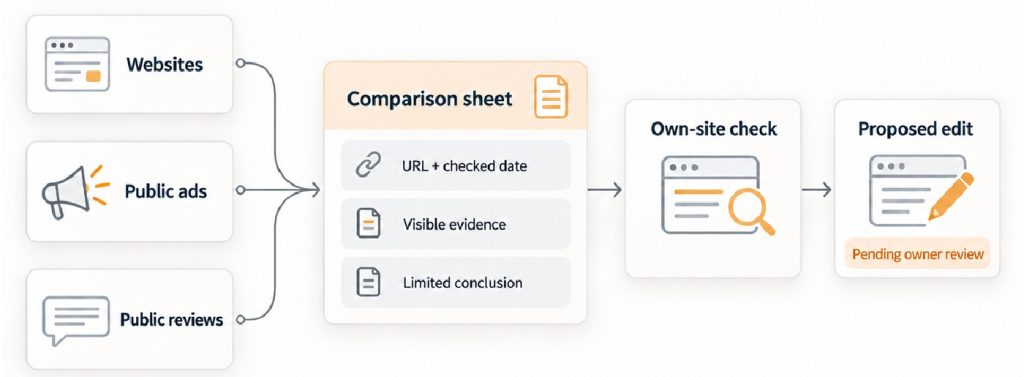
Illustrative workflow: public observations enter a sourced comparison; a proposed website edit stays pending until the owner checks the promise.
| If you observe… | Check on your site | Possible edit, if true |
| A rival states its audience clearly near the top of a service page | Can a visitor tell who your service is for? | Rewrite the opening claim using your actual service scope. |
| An ad promises one thing while its destination leaves conditions unclear | Does your own landing page explain its offer and limits? | Move the relevant terms nearer the form. |
| Several sampled reviews ask about what is included | Do your prospects ask the same question? | Clarify the scope on the service page or FAQ. |
These are conditional edits, not findings about a real competitor. For the hypothetical business, the best first change may be the one its own inquiries already support. If callers regularly ask what a service includes, a precise scope paragraph is more defensible than a new claim borrowed from an ad. If the team cannot verify the scope, pause the copy change until it can.
Assign each proposed edit an owner and a check. The owner confirms the business can honor the wording and publishes it. The check might be whether visitors reach the contact form from the edited page, whether form questions shift, or whether staff hear fewer scope questions. Use your own available site and inquiry records; public competitor material cannot supply those results. Record the old wording and the date of the change so later feedback has context. If your business serves a local audience, these local SEO audit recommendations can help you identify additional opportunities to improve your website’s local search visibility.
The most useful competitor analysis is not the amount of information collected, but the decisions it supports. By connecting public observations with questions raised by their own customers, businesses can make focused website improvements without simply copying competitors. Start with one evidence-backed change, check its impact using your own website and inquiry data, and expand the process only when the results justify it.





Leave a Reply