Quiet Disruption of AI Creative Tools in 2026: From Prompt to Music Video
There’s a strange new habit forming in 2026. People open AI creative tools “just to test something,” type a sentence like “dreamy electronic track with cinematic neon city visuals”, and within a few minutes, they’re staring at a finished music video.
Not a rough draft. Not a concept animation. A finished piece that looks like it came from a full production studio with lighting designers, editors, and a director who hasn’t slept in three days.
Except none of that happened.
No filming. No editing suite. No production meetings.
Just a prompt → a result.
And what makes this interesting is not that it’s fast. It’s that it collapses the distance between “thinking of something” and “seeing it exist.”
The Hidden Shift: Creativity Is No Longer a Workflow
For a long time, making music videos followed a predictable industrial pattern. It was structured, slow, and dependent on coordination between multiple roles.
You’d typically need:
- a music idea
- production tools
- recording time
- video planning
- editing cycles
- revisions
- final approval layers
Each step acted like a checkpoint. If one slowed down, everything behind it stalled.
The result was simple: ideas aged faster than they could be produced.
By the time a video was finished, the original spark often didn’t feel the same anymore.
Creativity wasn’t limited by imagination.
It was limited by time gaps between steps.
Why This Change Happened Now (Not 5 Years Ago)

This shift didn’t happen because AI suddenly became “smart enough.”
It happened because the environment around the content changed first.
Three pressures pushed everything toward acceleration:
1. Content stopped being “occasional”
Platforms now reward constant output. If you pause, visibility drops. If you stay consistent, you survive.
2. Attention became extremely unstable
People don’t “wait and evaluate” anymore. They decide in seconds whether something is worth their time.
3. Production speed became the bottleneck
Ironically, creativity wasn’t the problem anymore. Execution speed was.
So AI didn’t introduce creativity.
It removed the waiting layer between idea and execution.
Music Generation: When Words Start Turning Into Sound
One of the most noticeable changes is how music creation no longer requires traditional skill entry points.
With an AI Song Generator, a user doesn’t need instruments, software training, or production experience.
They just describe a feeling:
- “slow emotional synth track that feels like walking through an empty futuristic city”
- “bright pop song that sounds like summer memories you can’t fully remember”
- “dark ambient music for a sci-fi survival scene”
And the system builds it.
What used to require layers of technical work is now reduced to describing intent.
But the more interesting change is not output—it’s behavior.
People start experimenting more. They adjust descriptions slightly. They compare variations. They begin to learn taste through repetition instead of education.
It’s less about “making music.”
It’s more about “discovering what a mood sounds like.”
Video Generation: When Sound Starts Designing Its Own World
Music alone is no longer the final form of content. In most platforms today, sound without visuals feels incomplete.
So naturally, music starts pulling visuals with it.
AI systems respond by interpreting sound as structure.
- Rhythm becomes motion
- Tone becomes color style
- Energy becomes camera movement
- Drops become scene transitions
This is where the second layer appears.
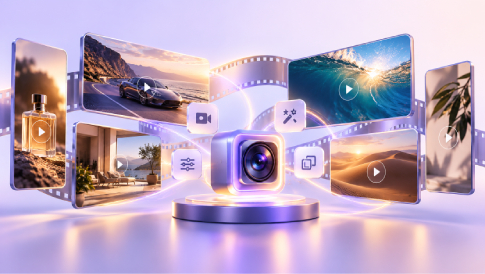
With tools like the AI Music Video Generator, music doesn’t just get a video attached.
It gets translated into a visual system.
Instead of editing clips manually, the system builds motion around the audio itself.
The result feels less like “video editing.”
And more like “music growing a body.”
The Strange Addiction of “One More Try”
Anyone who has used AI creative tools has probably experienced this:
You generate something → it looks interesting → you tweak one word → you generate again → suddenly 40 minutes disappear
This isn’t a bug. It’s the design of instant iteration.
In traditional workflows, making another version is expensive in time and effort. So people hesitate.
In AI workflows, making another version costs almost nothing.
So the loop becomes:
try → react → adjust → try again → repeat
And because there’s no penalty for exploring, people explore more than they intended.
Sometimes the final result is not even planned—it just emerges during repetition.
Who Is Actually Using These Tools (It’s Not Just “Creators”)
What’s interesting is that AI music video tools are not limited to professionals.
They’re being used by very different groups:
- indie musicians testing ideas before studio production
- TikTok / YouTube creators producing fast visual content
- marketers generating campaign visuals on demand
- game developers building placeholder cinematic trailers
- casual users just playing with ideas for fun
Across all of them, one pattern shows up clearly:
When effort drops, experimentation increases.
People don’t just produce more content.
They explore more versions of themselves creatively.
Beyond Entertainment: How Businesses Are Using AI Creative Tools
The first wave of AI music and video generation attracted musicians, filmmakers, and content creators. Today, the audience is much broader. Small businesses, startups, agencies, and ecommerce brands increasingly use these AI creative tools to experiment with marketing ideas before investing in full-scale production.
Imagine a small online store preparing to launch a new product. Instead of organizing a video shoot, hiring editors, and licensing background music, the marketing team can generate several concept videos in a single afternoon. They can test different visual styles, moods, and soundtracks across social media, gather feedback, and then decide whether a larger production is worthwhile.
The same approach works for landing pages, promotional campaigns, product explainers, and social media content. For teams focused on explainers specifically, invideo makes it simple to go from a script to polished AI-generated explainer videos without a studio setup. AI-generated videos won’t replace professional creative teams for every project, but they dramatically lower the cost of experimentation. Rather than asking, “Can we afford to test this idea?” businesses can now ask, “Which version performs best?”
Of course, great creative assets still need a place to live. Whether the goal is to showcase a new product, launch a campaign, or publish educational content, businesses benefit most when AI-generated videos are paired with website elements that improve user engagement and conversions.
The Real Shift: From Skill Ownership to Direction Control
For decades, creative advantage belonged to people who mastered AI creative tools.
If you knew editing software, production workflows, or sound design, you had the advantage.
That structure is changing.
Now the advantage is moving toward:
- how quickly you test ideas
- how well you recognize good outputs
- how effectively you refine direction
In other words, it’s not about “can you make it?”
It’s about “can you guide it?”
The role of the creator shifts from operator to decision-maker.
From builder to selector.
What This Actually Means (Beyond the Hype)
It’s easy to think AI creative tools are just “making things faster.”
But the deeper change is something else.
In the old system, ideas had to survive friction to become real.
Now, ideas don’t need to survive friction at all.
They can be tested immediately.
This creates a very different creative environment:
- more variations
- half-formed experiments
- more unexpected results
- less fear of trying
Creativity becomes less about committing to one idea.
And more about exploring many.
Conclusion: Creativity Didn’t Disappear—It Just Stopped Waiting
At the center of all this is a simple shift:
Creativity no longer waits for production.
The process is no longer:
idea → plan → execute → finish
It becomes:
idea → generate → react → refine → repeat
Inside that loop, something subtle changes. Creating stops feeling like a “project” and starts feeling like a conversation.
AI music and video generators don’t replace creativity. Instead, they become another example of how technology decisions shape the way modern businesses communicate with customers.
They remove the delay between imagination and perception.
And once that delay disappears, something unexpected happens:
People realize they didn’t run out of ideas.
They were just running out of time to see them.


Leave a Reply