How to Turn Years of Social Video Into Website Content You Control
A small business can spend years building an audience on Facebook, publishing tutorials, answering customer questions, recording live sessions, and explaining the same services on camera. After three years, there may be hundreds of useful videos sitting on a social account, yet the company’s own website may contain little more than a homepage, a few service descriptions, and a contact form.
That creates a hidden content problem. The business has produced valuable information, but much of it remains locked inside videos hosted on someone else’s platform. Turning that information into well-structured website text makes it easier for visitors to read, search engines to understand, and the business to reuse across its own site.
The good news is that the social video may not be lost. If the original files are gone but some Facebook post URLs still lead to accessible videos, those posts can provide a practical starting point for recovering years of useful spoken content.
Everything You’ve Published in Three Years Sits on Land You Don’t Own
Social media is excellent for distribution, but it is not the same as owning your content infrastructure. When a business publishes a video on Facebook, the platform controls the environment where that video lives.
This matters more as the archive grows. A company may have hundreds of posts containing product explanations, customer questions, demonstrations, offers, tutorials, and live conversations. Much of the business’s real knowledge may exist only in those recordings.
The website, meanwhile, may remain surprisingly thin.
That creates a long term dependency. If the platform changes how content is displayed, limits access, removes an old post, or changes its policies, the business has less control over an important part of its own history.
This Isn’t the Usual Complaint About Reach, It’s About the Words
The issue is not simply that social media algorithms can reduce reach. The bigger problem is that the actual language used by the business remains locked inside social video.
Think about the questions answered during a live session. A business owner may explain pricing, describe a complicated service, address common objections, or tell a detailed customer story. Those words can be more useful than carefully written marketing copy because they reflect the questions real customers actually ask.
Yet if the information exists only in a video, it is difficult to quote, edit, organize, and reuse.
Turning that spoken knowledge into website content changes the situation. A three year old explanation can become a useful service page today.
What Makes It Recoverable: The Files Are Gone, the Links Aren’t

The original video file isn’t always essential. An accessible URL to the published post can provide a practical starting point.
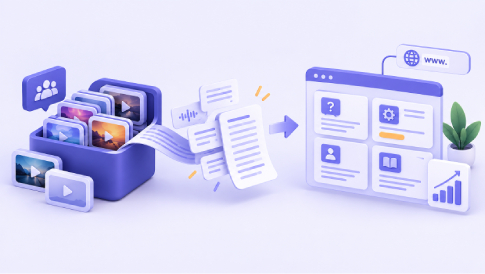
If an old Facebook video is still publicly accessible, its URL may provide a practical starting point for recovering the information contained in the recording. Tools that can convert a video link to text make this recovery process much easier because they can turn a published video into a transcript that becomes raw material for new website content.
This is particularly valuable for small businesses that never maintained a proper video archive. Instead of trying to locate old files on forgotten phones, computers, or cloud accounts, they can begin with the URLs that survived.
The transcript is not the finished article. It is the recovered source material.
Start With Facebook If It Holds Your Largest Archive
If Facebook holds most of your older videos, it can be a practical place to start the audit. Start with the Videos tab and collect the URLs of published videos. Do not try to process everything at once.
Live recordings deserve special attention. They are often the richest source of reusable material because they tend to contain longer explanations, customer questions, spontaneous answers, demonstrations, and discussions that were never written elsewhere.
Once the URLs are collected, work through them in order of view count. The most watched videos are a sensible starting point because they already demonstrate audience interest.
A spreadsheet can make the process manageable. Record the video URL, title, view count, date, topic, and potential website use. After transcription, add notes about the strongest sections worth turning into pages.
This turns a scattered social archive into a manageable content inventory.
What Comes Back
The recovered material can often reveal more than expected. A live question and answer session can become an FAQ page built around questions customers actually asked.
An explanation that has been repeated fifty times on camera may deserve its own service page. Instead of forcing a writer to invent a generic explanation, the business can use its own language and experience as the foundation.
A customer story recorded on camera can become a case study, with the strongest details reorganized into a clear problem, solution, and outcome. This is where website storytelling can turn recovered material into content that feels useful and authentic.
Even the business owner’s natural phrasing has value. Spoken explanations often contain practical examples, comparisons, and expressions that make website copy feel more authentic.
The goal is not to reproduce everything that was said. It is to recover the useful knowledge and reshape it for the website.
Don’t Paste Transcripts on the Site
A transcript should be treated as raw material, not as a finished webpage.
Long transcripts often contain greetings, repetition, jokes, unrelated questions, and explanations that made sense in conversation but do not belong on a page.
Instead, edit the transcript aggressively. Identify the central question, extract the strongest points, remove repetition, and organize the information under useful subheadings.
The result should read like intentional website content rather than a recording converted into text. If several videos cover the same topic, you can combine their strongest sections into one comprehensive page instead of creating several thin ones. The goal is to turn scattered material into useful pages that can support content reach and engagement.
Once the content is ready, a website builder such as MotoCMS can make it easier to create and update these pages without rebuilding the site each time.
Why Reposting the Video Doesn’t Fix It
Embedding the original video on a website can be useful, but it doesn’t give you control over where the video is hosted or how long the original post remains available. Google can index videos embedded from third-party platforms such as Facebook, but the video still depends on the third-party host being available and accessible. An embedded social video is still displayed through an iframe. The video remains hosted on the social platform, while much of the spoken information is still contained within the video itself.
If the original post disappears, the embedded experience can disappear with it.
This is where a transcription service such as UniScribe can fit into the recovery workflow. Instead of relying on an embedded recording alone, a business can use the available video source to extract the spoken material, review the transcript, and turn useful sections into original website copy.
The video can still be embedded as supporting media, but the page should contain substantial written information that serves the visitor even without the recording.
One Honest Limit: Most Social Video Is Filler
It is important to set realistic expectations.
Not every old social video deserves a webpage. Social accounts contain announcements, short updates, repeated promotions, casual conversations, technical issues, introductions, and content that made sense only at the time it was published.
Only a portion of the archive is likely to contain enough useful information to justify creating a substantial website asset.
That is not a failure. It is the reason to prioritize rather than blindly transcribe everything.
The objective is to find the valuable explanations buried inside the archive.
Start With Your Ten Most Watched Videos
The simplest way to begin is with your ten most watched Facebook videos.
Collect their URLs, prioritize the longest and most informative recordings, and recover the spoken content. Look for recurring customer questions, detailed explanations, useful stories, and language that clearly represents how the business communicates.
Then turn the strongest material into pages your business actually owns.
Instagram and TikTok can be audited later, but Facebook is a practical first target because years of live recordings and longer videos often contain substantial knowledge.
A social video archive should not remain a forgotten collection of posts. It can become a source of FAQs, service pages, case studies, guides, and useful website copy. The reach may belong to the platform, but the knowledge can be brought home and turned into content that lives on your own domain.



Leave a Reply