
Let’s be honest—most business workflows are a mess. Repetitive tasks eat up time. Teams bounce between apps. Data gets lost in handoffs. And when deadlines hit, nobody knows where the bottleneck is. Sound familiar? This is where AI agents automation steps in, not only as tools, but also as smart colleagues who can identify inefficiencies, operate on them and ensure your processes run freely. They’re not here to replace people. They’re here to free them from the clunky, repetitive, low-value work that drags everything down.
What is AI Agents Automation?
Forget everything you know about automation bots and rigid workflows. AI agents’ automation is a different breed.
These agents are built on large language models (LLMs) and can understand context, make decisions, and take intelligent actions within a system—autonomously. They go far beyond task-based bots. Instead, they generate responses, write content, trigger workflows, interpret data, and even learn from feedback.
In practical terms? You can assign them work.
You can give them access to email, files, CRMs, APIs, and more. And they’ll complete tasks with a human-like understanding of nuance—often better than hardcoded scripts or templates.
But it’s not just about the tech. The real difference is in how they’re implemented. And that’s where a seasoned AI Development Company or AI Consultant makes all the difference.
Why Workflows Get Stuck (and Why Most Automation Doesn’t Help)
Here’s the problem: most workflows are a patchwork of tools and partial automations. A task in one app triggers a ping in another. Someone checks a spreadsheet. Another person emails a status update. Nothing feels connected.
What you end up with is a system that is slow, error prone and requires human glue to hold it all together.
Conventional automation assists, but on a certain level only. It handles predictable, repetitive tasks. But the second there’s an exception, a weird condition, or a missing field? It breaks.
Autonomous AI agents, on the other hand, are flexible. They can:
- Fill in missing data
- Ask follow-up questions
- Decide on the next best step
- Take action across platforms
They think in terms of goals—not just tasks. And that’s what makes them so effective for unblocking stuck workflows.
How Generative AI Agents Actually Work

So how do you break it down:
- Perception: The agents are able to read emails, gather information in PDFs, as well as decipher information in forms and even APIs.
- Reasoning: Based on that information, they decide what needs to happen next.
- Generation: They write an email, update records, construct reports or send out Slack messages, and they can do all of this like a human.
- Autonomy: They will do all this without prompt on what button the next one should be pressed.
Now imagine plugging that kind of intelligence into your sales pipeline, support process, or internal ops. It’s a serious upgrade—and one that more businesses are exploring through Artificial Intelligence Software Development Services. The State of AI – McKinsey.
Check the ways to use AI to improve email marketing strategy.
Deploy AI Agents for Maximum Impact
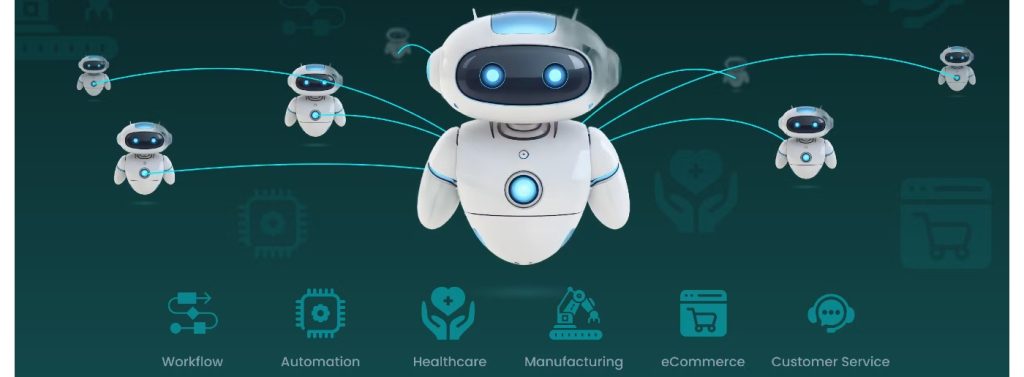
Every company is different. But from working with multiple clients as an AI Consultant, there’s a pattern: generative agents shine in areas where tasks are repeatable, data-driven, and decision-heavy.
Let’s look at seven real-world applications, based on the AI capabilities shown in your screenshot:
1. No-Code & AI-Powered Workflow Automation
You understand conditional logic when you have utilized tools, such as Zapier or Make. But what occurs when circumstances are not in black and white?
That’s where generative agents take over.
Example:
An email comes in from a customer. Instead of tagging it and waiting for a human, the agent reads it, extracts intent, routes it to the right team, and generates a draft response—all automatically.
Benefits:
- No need to pre-define every scenario
- AI adapts to changing inputs
- Works across tools like Notion, Slack, CRMs, and even internal databases
This isn’t just automation. This is thinking automation. And when implemented by the right AI Development Company, it becomes your competitive edge.
2. MLOps & LLMOps Platform Engineering
Managing models in production is messy. Drift, degradation, inconsistent inputs—all of these kill performance fast.
Generative AI Agents can act as:
- Model performance monitors
- Auto-retrain triggers
- Data pipeline optimizers
Instead of waiting for a human to notice a dip in performance, agents track it in real-time and kick off retraining workflows automatically.
This turns your ML/LLM stack into a self-improving system—and that’s exactly what modern Artificial Intelligence Software Development Services, often delivered by an LLM development company with expertise in MLOps consulting, are now offering.
3. AI Agents & Autonomous Workflows
Now let’s talk scale.
Imagine an entire department of AI agents automation —each assigned to a part of the workflow. One handles intake. Another handles documentation. A third handles follow-up. All talking to each other.
This is possible now.
You can build multi-agent systems where agents collaborate, pass data, and even escalate decisions when needed.
Use cases:
- Customer onboarding
- Vendor management
- IT incident resolution
Autonomous workflows mean fewer handoffs, less confusion, and far fewer delays. With a good AI Consultant, you can design these flows to mirror your ideal process—not your current patchwork.
Learn how to streamline your content workflow for efficiency.
4. Predictive Analytics & Decision Intelligence
Analytics are useful. But acting on them? That’s where businesses stumble.
With generative agents:
- You can automate the response to KPI changes
- You can generate insights, not just charts
- You can feed those insights directly into ops
For example, if your churn rate spikes, an agent can alert your team, generate a report, suggest reasons, and even draft outreach emails to at-risk customers.
That’s not reporting. That’s decision support. And with help from an experienced AI Development Company, it becomes plug-and-play.
5. Computer Vision & Multimodal AI
AI Agents automation aren’t limited to text. They can interpret images, video, audio, and sensor data too.
Scenarios:
- In manufacturing, agents scan visual data to detect anomalies
- In logistics, they read invoices or shipping labels from photos
- In retail, they monitor product displays via store cameras
This brings intelligence to places where only humans could operate before. And it’s one of the fastest-growing areas in Artificial Intelligence Software Development Services.
6. Responsible & Secure AI
Multi-agent AI systems need guardrails.
A good AI Consultant ensures:
- Prompt injections are blocked
- Outputs are reviewed and logged
- Role-based access is enforced
- Every action is auditable
You don’t want agents guessing their way through sensitive workflows. You want them grounded, monitored, and aligned with your policies.
That’s the difference between AI that helps and AI that backfires.
7. Training, Adoption & Managed AI Services
Tech is only half the battle. Adoption is the rest.
That’s why many AI Development Companies now offer:
- Internal workshops
- Agent usage dashboards
- Continuous improvement cycles
- Prompt libraries tailored to your business
It’s not about building an agent once. It’s about creating a system your team actually uses, trusts, and benefits from.
Getting Started: What You Need to Make This Work

Here’s what it takes to deploy generative agents successfully:
1. Clarity on Pain Points
Start with stuck workflows. Where are people wasting time? What slows them down?
2. The Right AI Consultant
Find someone who understands both tech and business. You don’t need jargon. You need practical answers.
3. Partner with an AI Development Company
They’ll bring the architecture, models, security, and integration expertise you need to move fast and safely. A trusted AI Agent Development Company ensures everything operates seamlessly.
4. Start Small, Scale Fast
Choose one use case. Test it. Measure time saved. Then replicate.
5. Track Real Results
Don’t just measure tasks completed. Look at AI business process automation: faster cycle times, reduced costs, happier customers.
Final Thoughts: Stop Wrestling with Broken Workflows
Your workflows don’t need more spreadsheets.
They need smart, autonomous support that fits into your systems and helps your team move faster.
AI Agents Automation is that support. And with the help of a skilled AI Consultant or AI Development Company, they’re easier to build and deploy than most teams realize.
Whether you’re streamlining operations, scaling delivery, or just trying to tame internal chaos—these agents give you leverage.
So if your workflow feels stuck, you don’t need another tool.
You need a digital coworker who knows what to do next.