
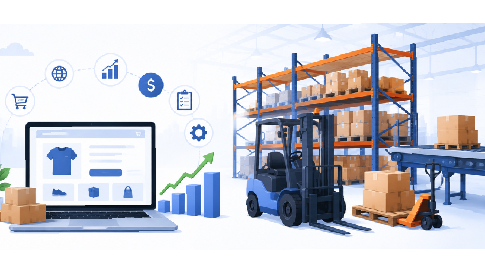
Growing an online store often requires significant investment in warehouse infrastructure. One effective way to control costs is by purchasing quality used warehouse equipment instead of buying everything new. Depending on the equipment and its condition, businesses may reduce upfront costs by 40% to 60%, particularly for durable assets such as pallet racking, shelving, conveyors, and forklifts.
The money saved can instead be invested in inventory, website improvements, SEO, advertising campaigns, or customer acquisition—all of which often generate a stronger return for growing online stores.
However, the trick isn’t simply buying refurbished equipment and hoping for the best. The key is to buy the right equipment for the warehouse you actually need today, and the one you’ll probably need next year.
Warehouses Become Expensive Long Before They Become Large
New ecommerce owners often focus on rent because it’s easy to measure. But rent is only one line on the invoice. The hidden costs usually come from everything required to make the space productive.
A fairly typical warehouse setup includes:
- pallet racking
- shelving
- workbenches
- carts
- forklifts or pallet jacks
- conveyors
- packing stations
- safety barriers
- storage bins
- labels and inventory systems
When looked at individually, these purchases are not extremely expensive. But, of course, a functional warehouse requires most or all of this equipment simultaneously, causing upfront costs to stack up rapidly. In fact, outfitting a space can consume a large portion of your expansion budget before you’ve shipped a single additional order.
Balancing Warehouse Costs with eCommerce Growth

For growing online stores, warehouse investments should support broader business goals rather than consume the entire expansion budget. Money saved on quality used equipment can often deliver a greater return when invested in website improvements, faster hosting, checkout optimization, or higher-quality product photography. These enhancements directly affect customer experience and conversion rates, helping businesses generate more sales from their existing traffic. If you’re planning a new online store or expanding an existing one, it’s equally important to understand how to build an eCommerce website that can scale alongside your operations.
A balanced investment strategy also includes search engine optimization and inventory management. Strong SEO helps attract qualified traffic, while accurate inventory systems ensure customers can purchase products that are actually in stock. When warehouse operations and digital marketing work together, businesses improve both operational efficiency and the overall shopping experience.
Quality Used Equipment Can Be a Practical Alternative
Warehouse equipment isn’t consumer electronics. A steel pallet rack doesn’t suddenly become obsolete because it’s five years old. Neither does industrial shelving built to hold thousands of pounds every day.
In many cases, warehouse equipment on the secondhand market comes from companies that relocated, consolidated operations, or upgraded facilities. In other words, the equipment didn’t stop working; it’s still perfectly usable.
For ecommerce businesses looking to control startup or expansion costs, used warehouse equipment offers a practical way to reduce upfront spending without sacrificing the functionality that keeps orders moving.
The biggest savings usually come from:
- pallet racking
- industrial shelving
- mezzanines
- pallet jacks
- forklifts
- conveyors
- packing tables
- warehouse carts
These are durable assets designed for years, often decades, of commercial use. It makes more sense to invest in quality used or refurbished equipment than in brand-new alternatives.
The Key: Buy Smarter, Not Cheaper
It’s important to note here that low price alone shouldn’t drive the purchase. You need to evaluate equipment like an operations manager would.
So, ask questions such as:
- Does it meet your current storage requirements?
- Can replacement parts still be sourced?
- Is the equipment compatible with your existing warehouse layout?
- Does it comply with applicable safety standards?
- Has it been inspected or refurbished?
Paying slightly more for equipment that’s been professionally inspected is often far less expensive than absorbing the cost of unexpected downtime later.
Some industry estimates suggest businesses can save roughly 30–40% on capital equipment while still building an efficient warehouse. This is provided the equipment matches operational needs and isn’t simply purchased because it was inexpensive. So yes, evaluation is essential.
Warehouse Layout Often Saves More Money Than Another Forklift
A poorly organized warehouse can waste hundreds of employee hours every year. Workers walk farther, orders take longer, and inventory gets misplaced. In fact, picking operations can make up to 75% of the operating cost in a warehouse.
So, again, before buying additional equipment, ask whether the existing layout actually supports fast picking and packing. If it doesn’t, it’s essential to improve the warehouse layout.
Here are simple improvements often have an outsized impact:
- place fast-selling products closest to packing stations
- reduce unnecessary travel between receiving and shipping
- use vertical storage before renting additional space
- group products frequently purchased together
- maintain clearly labeled inventory locations
Don’t Overlook Vertical Space
Many growing online stores run out of floor space long before they run out of building. But there’s often unused vertical space, especially in warehouses that evolved gradually instead of being designed properly (which is common for growing businesses).
Additional pallet racking or shelving often increases storage capacity without increasing rent. That’s usually a much better financial decision than moving into a larger facility several months too early.
Technology Still Matters When Buying Used
Buying used doesn’t mean running an outdated warehouse. In many cases, it creates the opposite opportunity. That’s why it’s wiser to redirect savings toward software that improves productivity every day instead of spending your entire budget on brand-new hardware.
Technologies such as warehouse management systems (WMS), barcode scanning, mobile inventory apps, shipping automation, order routing software, and inventory forecasting help streamline fulfillment, reduce manual work, and improve inventory accuracy.
Redirecting savings from hardware into software like a WMS pays off quickly. It reduces picking errors, improves inventory accuracy, and shortens fulfillment times. Even modest automation can produce meaningful savings when it removes repetitive manual work rather than replacing entire workflows.
Think in Total Cost of Ownership, Not Purchase Price
A new forklift with the latest features sounds appealing. But it’s important to evaluate whether your current volume justifies the asset’s depreciation curve. Every asset follows a depreciation curve.
To find the true cost, calculate:
- Purchase price vs. financing rates
- Projected maintenance costs
- Expected operational lifespan
- Downtime risk
- Residual resale value
Warehouse equipment typically experiences its steepest depreciation early in its life. Buying after that initial depreciation means someone else has absorbed much of the financial hit.
Investing in Long-Term eCommerce Growth
Building a successful online store requires balancing investments across both digital and physical operations. While quality used warehouse equipment can significantly reduce upfront costs, the savings are often most valuable when reinvested in areas that directly support business growth, such as website improvements, SEO, inventory management, and customer experience.
A reliable warehouse helps fulfill orders efficiently, but customers also expect a fast, trustworthy, and easy-to-use website. Combining efficient warehouse operations with a fast, trustworthy eCommerce website creates a stronger foundation for sustainable business growth. Investing strategically in both physical infrastructure and digital experiences helps online stores scale more efficiently while delivering the reliable shopping experience customers expect.