
For small businesses, creating a website has always been quite a challenging task. As a business owner, you probably understand this process from both a technical and financial perspective. However, with the advancement of technology, no-code website builders have emerged to the rescue. These builders open up new possibilities, simplifying and making it accessible for users of any skill level to develop a professional and functional website. Their main advantage is that they don’t require any programming. What does this mean for small businesses? A quick start, easier design and content changes, and, just as significant, less dependence on outside developers and lower overall website costs.
No-code website building platforms have undergone significant evolution since their inception. They now offer intuitive management tools, artificial intelligence-based features, and integration with most essential business software.
In this article, you’ll learn why no-code platforms are so important for small businesses, the technologies behind them, and how to use them to effectively grow your business.
Why Small Businesses Are Embracing No-Code
It’s no secret that small businesses often face budget constraints. Time is always on the line, and you need to meet today’s demands by presenting your business appropriately online. No-code platforms allow you to launch a website without the need for specialized developers quickly. These platforms enable you to respond to business needs in real-time. For example, you can update services and expand your product range. Publish new offers or add promotional content without any coding knowledge or specialized skills in engines like Joomla or any other platform.
No-code platforms give you complete control over your website. You can manage updates, customize layouts, and edit content yourself. You no longer need to hire or retain an experienced developer. This independence increases flexibility and allows you to experiment and optimize your site. You can change content and appearance based on user interactions, their feedback, or by conducting your own experiments.
The availability of no-code tools also puts you on a level playing field with larger players. Small businesses can now effectively represent their brand without the need for large teams. This allows them to remain competitive in a turbulent market.
Data shows that the no-code market is projected to grow to $80 billion by 2027, highlighting the widespread adoption of these platforms.
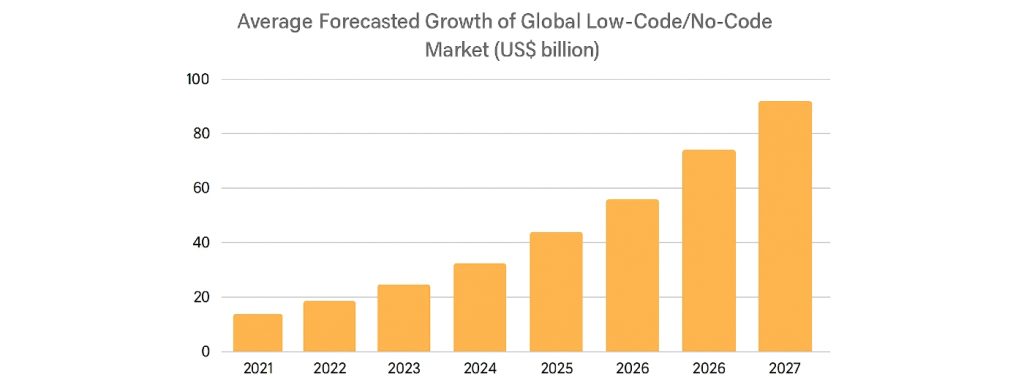

Source: Userguide
Core Technologies Behind No-Code Platforms
The development of websites through no-code platforms depends on multiple intelligent technologies, which enable users to create websites through user-friendly visual interfaces. Users can design their pages through drag-and-drop tools, which let them see their design changes in real time before publication. Users can create websites through hands-on design methods that eliminate coding requirements while maintaining complete design freedom.
The main benefit of no-code platforms includes their built-in collection of pre-designed templates and components. Users can easily incorporate essential website components through a few mouse clicks which allow them to customize these elements for their specific site requirements. The pre-built elements both accelerate website setup and assist users in making design decisions.
Small businesses require integration capabilities as their primary benefit. The majority of no-code platforms integrate seamlessly with standard business tools, including email marketing platforms and analytics dashboards, payment gateways and customer relationship management systems. Your website joins a complete digital system that enhances operational efficiency.
Artificial intelligence now enters the scene to enhance the functionality of existing systems. The platforms now use artificial intelligence to help users with layout recommendations and content generation and search engine optimization. The tools enable your website to establish meaningful connections with visitors which results in improved user engagement and better performance.
Edward Tian, CEO of GPTZero, explains: “These tools don’t just automate tasks—they learn from user interactions to suggest what works best. Even small businesses can deliver personalized experiences, guiding visitors toward relevant content, products, or actions without needing deep technical skills.”
The integration of AI tools into no-code platforms expands the range of possibilities. This opens up virtually unlimited potential for hyper-personalization. A personalized approach to each visitor is a new level of customer service that becomes available to you. At the same time, your team’s potential will be unleashed and redirected toward strategy development and improving the customer experience in the future.
Practical Applications for Small Businesses
No-code platforms open up a wide range of possibilities for small businesses. One of the biggest advantages is e-commerce. You can set up an online store in a fraction of the time it would take with traditional development, and manage products, payments, and shipping all in one place. You have the ability to update listings, add promotions, and respond to customer needs almost instantly.
Service-based businesses also benefit heavily. Small businesses can access numerous opportunities through no-code platforms. The main benefit of no-code platforms lies in their ability to create e-commerce solutions. The process of building an online store through no-code website building platforms becomes much faster than conventional development methods while providing unified management of products and payment processing and shipping operations. The system enables you to make immediate changes to listings and create promotions and handle customer requests. The integration of appointment scheduling and booking systems and client management tools simplifies the operation of daily business activities.
When asked, Liam Derbyshire, CEO & Founder of Influize, shared, “Marketing and campaign landing pages are a major area where no-code shines. You can create pages for promotions, events, or product launches in hours rather than weeks.”
With analytics and performance tracking built into most platforms, you can see what works, tweak it, and iterate on the fly. This kind of speed is particularly valuable in fast-moving industries, where the ability to respond to trends can set you apart from competitors.
Across industries, no-code platforms reduce operational friction. As a result, that allows you to focus more on growing your business and engaging with customers. There are no worries about technical details.
Benefits Beyond Speed and Cost
No-code website building platforms save you time and money. At the same time, their capabilities give you the quintessence of flexibility and efficiency. Quickly testing new ideas, changing layouts, and updating content gives you the freedom to experiment with campaigns and promotions. Instantly adapting to changing circumstances without the need for additional resources is a distinct advantage when working with a limited team and budget.
It’s no wonder these platforms have gained popularity among business owners. According to a Gartner report, over 65% of small and medium-sized businesses are already actively using these tools for their projects.
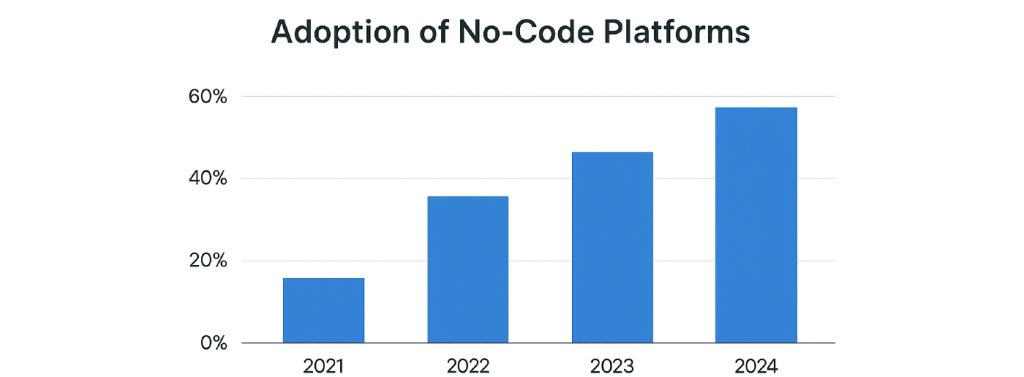
Source: Gartner
Another advantage is improved customer experience. Anthony Mixides, Founder & CEO of Bond Digital Web Design FZCO – Web Design Dubai, shares, “When you can update content in real time and make interactive features easy to use, visitors are more likely to engage with your site and return.”
Gaining audience trust is challenging. And one of the keys is a responsive and well-maintained website that showcases your professionalism.
Let’s consider the benefits from the perspective of your team’s capabilities. You don’t have to divert your developers’ resources to routine tasks like updating pages, adding content, or adjusting the layout. Now, non-specialists can handle these tasks. This way, you can keep your website up-to-date while saving money. At the same time, the latest offers, products, and announcements will always be available to visitors.
Finally, no-code website building platforms support your business’s growth. As you scale, these platforms can connect to analytics, marketing tools, and customer management systems. Your website grows with you. No additional costs, no need to build a new site from scratch.
Strategies to Implement No-Code Effectively
To get the most out of a no-code website creation platform, we recommend first creating a concrete plan. Start by defining your business needs: what you expect from the website and what you need it for. Determine the type of content you plan to publish. Make a list of necessary and desired features, which external tools you plan to work with, and which integrations might be useful. Having such a list will help you choose the optimal platform that meets your goals and workflow.
Dean Fankhauder, Founder & CEO of Movingto, explains: “Even in services like relocation, focusing on what your users need most—whether it’s guidance, resources, or information—makes the digital experience feel intuitive and relevant.”
Start small. Launch a landing page or a simple website to test the platform. Explore the design options it offers, what features you can use, and whether the performance tracking tools are convenient for you. Most platforms offer these features without a significant upfront investment.
Keep your workflows organized. Set your standard design elements regarding your brand book: make templates, standardized design components. Document regular processes to make your updates remain consistent. Make sure your departments of marketing, operations, and customer-facing teams can access the website in the parts they should.
Jack Johnson, Operations Director at RhinoRank, notes: “A website isn’t just for visitors—it’s for search engines too. Every layout decision, integration, and feature should enhance usability while making content easy for search engines to index. Good user experience and SEO go hand in hand.”
Finally, focus on user experience. Your main goal is to create a website that will be intuitive and understandable for your audience. All your design and functionality ideas should be made with this in mind. The arrangement of elements, adding new features, and integrating three-part tools — all of these should enhance the user experience. An informative website with intuitive navigation, an eye-catching and clear design has a much better chance to attract the user’s attention than any other one.
How to Choose the Right No-Code Tool for Your Website or App
Choosing a no-code website building platform is a decision that will significantly impact the potential of your website. Not all tools are created equal. It’s your responsibility to choose the features you need. Some platforms are better suited for e-commerce, others for content management or booking services, while still others are more suitable for apps than websites.
Ernestas Duzinas, Founder/CEO of GoTranscript Inc, notes: “A platform that balances usability and flexibility makes it easier to manage content, handle client interactions, and adapt as your needs change.”
When comparing options, consider your own comfort level with technology and the platform’s learning curve. Look also at scalability. If you plan to multiply your business possible, you’ll need to expand your website – add more pages, features, or new integrations. So choosing the platform, think about the future – make sure it can grow with you.
Pay attention to the communities and support. If your website is managed by a team of non-specialists who are implementing new ideas, you will need information. Platforms with active communities, tutorials, and available customer support make it easier to resolve any issues. And also discover best practices for bringing your ideas in life. Test different platforms on a small project and you’ll decide which one works best for your workflow. So save headaches down the line, take the time for it.
Integrate Your Website with Marketing and Sales
A website without code is just a cog in the marketing machine. External tools integration gives you a possibility to turn it into a growth hub for your business. Connecting your website to email newsletters, social networks, analytics, and CRM systems helps you attract traffic more effectively. And, consequently, potential customers, stimulating further growth and profit.
Such external tools allow you to personalize email campaigns as much as possible, track their behavior, analyze data, and make more effective decisions based on that data.
When your website meets the needs of your marketing strategy, each of its elements contributes to measurable results. Integrating useful tools allows you to respond more quickly to trends and independently monitor the effectiveness of your website.
Plan for Future Growth and Scalability
No-code website building platforms bring you a lot of advantages, and the main one is the ability to adapt step by step when your business grows. Every business dreams of future expansion. Consider this when planning your website so it doesn’t become an obstacle to future growth. So choosing a platform that supports expansion could be a solution.
Abdul Saboor, Link Building Specialist at Outreaching.io — Qwoted Link Building, points out: “Platforms that make it easy to reorganize content and add new sections help businesses stay agile without constantly rebuilding their site.”
To expand your website’s capabilities, create a logical and clear structure on the design maket step. Organize content, pages, and categories so scaling is easy. Create modular design elements. Adding new content or features with the reusable sections or templates will save you time.
Stay tuned for updates and keep in touch with your platform’s community. This will keep you informed about new features and how they can be used to increase productivity, integrate new functions, and improve the user experience.
Htet Aung Shine, Co-Founder of NextClinic, notes: “Regularly exploring new features will allow your site to keep pace with business needs — whether it’s adding telemedicine tools, e-commerce features, or service booking systems — without having to start from scratch.”
Future Trends in No-Code Website Building
Platforms that do not require coding continue to improve. So, we can expect impressive developments in this area in the next few years. AI-based design tools will become even smarter, with automated recommendations for layouts, suggested text, and SEO optimization options. This evolution will simplify the creation and maintenance of websites of any complexity, opening up new opportunities for businesses on the one hand, but also raising the stakes in the competitive struggle on the other.
Integration with advanced technologies is also expanding. No-code platforms are starting to connect with AR experiences, IoT devices, and marketing automation systems, giving small businesses access to tools that were previously complex or expensive to implement.
No-code website building platforms are the perfect solution for small teams. Managing content, design, and updates becomes easier, and you end up with team synergy without wasting resources.
Security and compliance features will continue to improve. So in the future, you can plan to use your website for mission-critical operations. Overall, platforms are becoming more functional and flexible to the needs of small businesses.
Designing for Engagement on No-Code Platforms
No-code website building platforms allow you to experiment with design. You can conduct A/B testing of layouts and respond effectively to user feedback while maintaining a professional and consistent look that has already earned the trust of your visitors. At the same time, you don’t need to hire a whole team of specialists to make such changes.
Marissa Burrett, Lead Design for DreamSofa, emphasizes: “Even small businesses can create visually appealing and user-friendly websites without programming tools. Focusing on an intuitive structure, clear navigation, and consistent branding ensures that visitors will engage with your content.”
The key is to find a balance between aesthetics and functionality. In UI design, it is important that each element serves a specific purpose and guides users toward meaningful actions.
Adapting Functionality as Your Business Grows
You can implement new features, test their effectiveness, and easily integrate them into existing workflows depending on changing customer expectations or changes in your brand voice and target audience. This gives you an advantage that large businesses do not have.
LJ Tabango, Founder & CEO of Leak Experts USA, notes: “No-code website building tools allow businesses to add new functionality as they scale—whether that’s online booking for clients, service tracking dashboards, appointment reminders, or integrating payment solutions—without rebuilding from scratch. The flexibility helps businesses respond to changing needs, whether they operate in home services, healthcare, e-commerce, or creative industries.”
Conclusion
Platforms for websites without programming are changing the approach of small businesses to creating and managing their websites. Until recently, creating a website was a lengthy and expensive process. Now, instead of planning your budget years in advance and carefully selecting a team of designers and developers, you need to choose from ready-made, code-free platforms to create your website. The primary advantage of such tools is that they can be used by even non-specialists. They give you speed of launch, flexibility in marketing campaigns, the potential to scale your site as your business grows, and independence from external developers.
A well-chosen tool, tailored to your planned tasks, will enable you to enhance customer engagement, optimize operations, and respond promptly to shifting market conditions. The development of artificial intelligence also works in your favor, simplifying content writing, data analysis, and automating SEO processes. In the future, you can expect platforms to offer even more tools to grow your online presence.