
A website redesign quote used to be a fairly predictable document. Design hours, front-end build, content migration, a small line for SEO, maybe a plugin or two. You could hand last year’s estimate to a new agency, and it would look familiar.
That template is breaking. AI has pulled the floor out from under some of the biggest line items on a redesign quote, left others almost exactly where they were, and quietly added a handful of new ones that nobody was budgeting for two years ago. If you are scoping a redesign now, it helps to know which is which before you start negotiating.
The Line Items That Are Shrinking
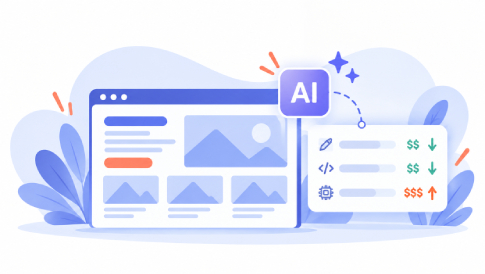
The parts of a redesign that AI is chewing through tend to be the ones that involved a lot of repetitive human keystrokes. None of them are disappearing entirely, but the hours attached to some of them may be falling, although the effect on the final project price depends on how agencies use those productivity gains. A useful breakdown of redesign costs can help you sanity-check whether the numbers you are being quoted still reflect what the work actually takes.
- Initial visual comps. Generating first-round design directions used to be a week of moodboards and Figma files. Designers can now use image and layout models to generate several early directions from a brand brief in a fraction of the time traditional exploration might take. The senior designer still has to pick, refine, and defend the direction, but the raw production time can be significantly lower.
- Front-end scaffolding. Turning approved comps into working components used to be a real chunk of the build. Coding assistants now handle routine markup, styling, and state wiring, so less time is needed for routine front-end work.
- Copy drafts and content migration. First-draft page copy, meta descriptions, alt text, and reformatting old blog posts into new templates were quietly expensive. AI takes the first swing at all of it. Editors still need to rewrite for voice and accuracy, but the blank-page tax is gone.
The Line Items That Are Holding Steady


Some parts of a redesign have barely moved, and it is worth understanding why. These are the line items where the value is in judgment, coordination, or legal exposure, not in production speed. If a vendor is quoting these dramatically lower because the software supposedly handles them now, push back. A clear website redesign strategy can help keep those human-led decisions visible in the project scope.
- Discovery and strategy. Deciding what the site is for, who it serves, and how success gets measured is still a human conversation with stakeholders who disagree with each other. AI can summarize interview transcripts, but it cannot sit in the room and read the politics.
- Custom integrations. Connecting the site to a CRM, a booking system, a payment processor, or a proprietary internal tool is the same work it was five years ago. AI helps a developer write the glue code faster, but the specification, testing, and edge-case handling still land on a human.
- Accessibility remediation. Real accessibility work has actually gotten more expensive, not less, because regulators and plaintiffs have gotten sharper about overlay widgets that promise compliance without delivering it. A recent FTC settlement with an accessibility widget vendor made clear that a script in the footer is not a substitute for building the site right. Budget for a human audit.
The Line Items That Are Brand New
This is where redesign budgets go sideways. There are categories of work that may not have appeared on a 2022 quote but can now become relevant when a redesign includes AI-powered features or workflows. Ignoring them does not make them go away; it just means you will pay for them later, out of a different budget, in a worse mood.
AI Search and Answer Visibility
For some businesses, prospects are increasingly encountering their brand through AI-generated answers and search summaries rather than visiting the homepage first. That creates a potential new optimization workstream around structured content, schema, source information, and making important business information easy for search and AI systems to interpret. It is related to SEO, but the work may extend beyond traditional rankings and keyword targeting.
AI-Assist Features on the Site Itself
Chat widgets, semantic search, product recommenders, and personalized onboarding flows all show up on redesign wish lists now. Each can introduce its own product, engineering, testing, and maintenance requirements, with its own model costs, prompts, guardrails, and evaluation harness.
Metered Usage Costs
AI features that run at runtime can introduce ongoing usage-based costs rather than a one-time development expense. The 2026 Gartner CMO Spend Survey, as reported by Chief Marketer, found that 56% of respondents had increased the share of their martech budget allocated to consumption-based pricing over the previous year. For a redesign that includes AI features, budget separately for expected usage, monitoring, and spending limits.
Governance and Evaluation
If AI is answering questions on your site, someone has to check what it is saying. That means logging, red-teaming, refusal rules, and a periodic human review of transcripts. It sits between engineering and legal, and it doesn’t have a natural home in the old redesign quote.
AI Data, Privacy, and Security
If a redesigned site sends customer questions, form submissions, uploaded files, or other business data to an AI service, the project needs to account for how that information is processed and protected. Teams may need to review what data can be sent to an AI provider, configure access controls, document data flows, and update privacy disclosures or vendor agreements where necessary. These requirements can add work for developers, security teams, and legal or compliance reviewers.