
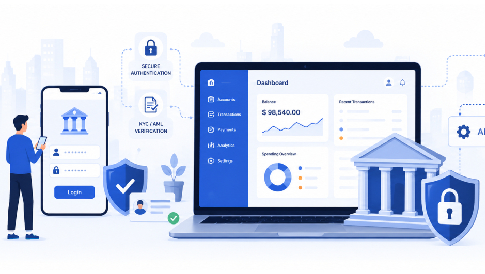
Modern financial services increasingly rely on secure web applications to deliver online banking, payment processing, lending platforms, and customer portals. As artificial intelligence becomes part of these platforms, developers face a new challenge: adding AI-powered capabilities without compromising security, compliance, or customer trust.
Building AI-powered FinTech web applications requires more than choosing the right model. It requires a secure architecture that separates AI reasoning from financial controls, protects sensitive data, and provides clear governance throughout the application. The strongest solutions treat AI as one component within a broader web platform, where every layer has clearly defined responsibilities.
Building Secure Web Applications for Financial Services
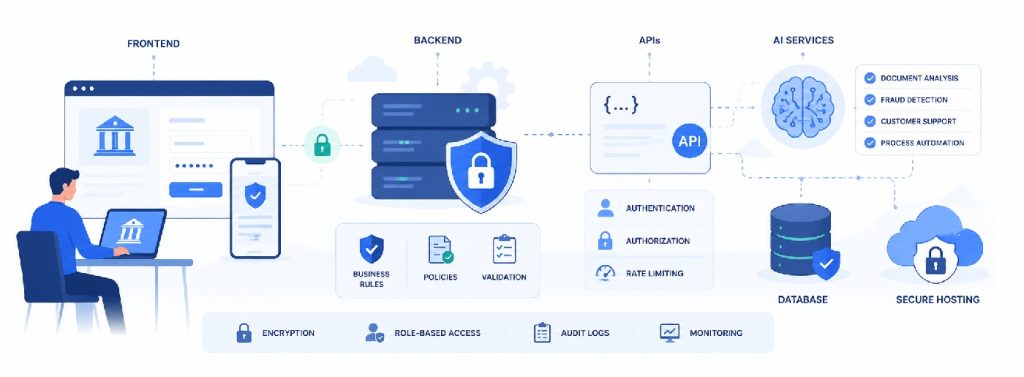
AI is only one part of a secure FinTech platform. Every layer of the web application should contribute to protecting customer data and financial operations. The frontend handles customer interactions, including secure registration, identity verification, and FinTech onboarding, while backend services enforce business rules, process transactions, and validate requests. APIs should expose only the functionality required for each workflow, with strong authentication, authorization, and monitoring.
Administrative dashboards and CMS interfaces also require careful protection because they often provide access to customer information and operational settings. Secure hosting, encrypted communication, role-based permissions, and continuous monitoring help reduce security risks. Within this architecture, AI services support tasks such as document analysis, fraud detection, or customer assistance while operating inside well-defined security boundaries rather than replacing core financial controls.
Start with Boundaries, not the Model
Model selection tends to attract attention because it is visible and easy to compare. For a production FinTech application, however, the more important questions concern boundaries. What data can the AI access? Which actions can it propose? Which actions can it execute? When must a person approve the result? How will the organisation reconstruct the decision later?
These questions should be answered before implementation. A customer-support assistant may read product information and a limited account summary, but it should not receive unrestricted access to transaction systems. A fraud-investigation agent may assemble evidence, yet a separate authorised service should control whether an account is restricted. Separating reasoning from execution reduces the effect of a poor or manipulated model output.
A useful enterprise AI architecture treats the model as one replaceable component inside a governed system. Authentication, policy, data access, monitoring and audit storage remain outside the model boundary. This prevents the application from depending on prompt instructions as its main security mechanism.
Capture Intent Before an Agent Acts

Conventional AI-powered FinTech web applications validate a request at an API boundary and then follow a programmed sequence. An agent may interpret the request, create a plan and choose tools dynamically. If governance begins only when the final action is submitted, unsafe reasoning may already have exposed data or invoked an inappropriate service.
The application should first create an intent record. This identifies the requester, purpose, relevant account or case, jurisdiction, data classification and permitted outcome. A policy service then decides whether the task can proceed, which tools are available and whether human approval is required.
The resulting permission envelope should be enforced technically. Tool brokers can restrict available operations. Short-lived credentials can limit access to a specific task. Network policies can prevent direct connections to systems outside the envelope. Rate and value limits can constrain financial exposure. These controls must not depend on the agent remembering a sentence in its prompt.
Intent records also improve explainability. When a decision is reviewed, the organisation can show what was requested and which policy applied before the model began its work. That is far more useful than retaining only the final response.
Keep Financial Policy in the Domain Layer
Business rules often become scattered across prompts, application code and service configurations. This makes changes hard to govern and creates conflicting interpretations. Financial policy should remain in the domain that owns it, exposed through versioned services or executable rules.
An affordability rule belongs to the lending domain. Screening policy belongs to financial crime operations. Data-retention rules belong to a controlled information-governance layer. Agents may consult these capabilities, but they should not improvise replacements.
Domain boundaries also reduce unnecessary data sharing. An agent dealing with onboarding should receive the attributes needed for that workflow, not a complete view of every product held by the customer. Data minimisation limits both privacy risk and the impact of prompt injection or accidental disclosure.
For actions that cross domains, event-driven integration can preserve separation. Services publish durable facts such as “identity check completed” or “payment review requested”, while authorised consumers decide how to respond. Event schemas need strong ownership, idempotency and replay controls because duplicate or misunderstood events can have financial consequences.
Build Evidence into Every Consequential Decision
An AI-powered FinTech system should be able to reconstruct what happened without relying on screenshots or individual memory. For each material decision, retain the intent, relevant inputs, policy version, model or agent identity, tools invoked, outputs, approvals and final action.
This evidence needs stable correlation identifiers so teams can follow one journey across the web application, AI runtime and financial services. Sensitive model inputs should be protected according to their data class, and retention should match legal and operational requirements. Logging everything indefinitely is not a substitute for an evidence design.
Observability should cover more than latency and errors. Teams need to watch refusal rates, human overrides, policy blocks, unusual tool-call patterns and changes in output quality. These signals reveal whether an agent is drifting or encountering requests outside its intended scope.
Replay is particularly valuable. Given a decision identifier, reviewers should be able to see the policy and system state used at that time. A model update should not erase the ability to explain an earlier result.
Governance Should Extend Across the Entire Web Platform
Governance should apply to the entire web application rather than focusing only on AI models. Customer-facing websites should also incorporate strong trust signals alongside secure APIs, CMS interfaces, customer portals, and AI services to reinforce user confidence while protecting sensitive financial information.
Treating governance as a platform-wide responsibility helps organizations maintain consistent policies as AI-powered FinTech web applications evolve. Changes to authentication, permissions, or compliance requirements can be implemented across the platform without redesigning AI workflows, creating a more secure and maintainable financial application.
Choose the Right Level of Autonomy
Not every workflow needs the same level of automation. Human-in-the-loop designs require approval before each consequential action. Semi-autonomous systems can complete low-risk actions within a defined envelope and escalate exceptions. Full autonomy should remain uncommon where an error can move customer money, deny access to a financial service or create a regulatory filing.
Four factors help determine the appropriate level:
- Potential harm if the decision is wrong.
- Ease and speed of reversing the action.
- Quality of the evidence available to reviewers.
- Reliability of tests across realistic and adversarial cases.
A document-classification task with cheap correction may support greater autonomy than a payment release. An agent that drafts a case summary may operate freely while the final disposition remains with an authorised analyst. These distinctions let teams gain efficiency without treating every capability as equally safe.
Before widening an agent’s permissions, run it through a complete operational and audit cycle. Test rollback, escalation and incident response. Confirm that support teams can understand the traces and that policy owners can change thresholds without rewriting prompts.
Design for Model and Vendor Change
Secure AI-powered FinTech web applications rely on more than advanced AI models. Long-term success comes from combining modern web development practices with strong governance, secure architecture, and continuous monitoring across the entire platform.
When AI operates within clearly defined security boundaries, businesses can improve customer experiences, streamline financial workflows, and support innovation without compromising trust or regulatory compliance. Organizations planning long-term AI strategies should also consider how their architecture can adapt to future technologies and reduce the risk of AI obsolescence as models, platforms, and business requirements continue to evolve.
A well-designed web application provides the foundation that allows AI capabilities to evolve safely over time. By combining AI with robust web architecture and ongoing governance, businesses can build financial platforms that remain secure, scalable, and ready for future innovation.