
Short-form video ads can generate thousands of views and still fail to deliver meaningful results. People might watch the first few seconds but scroll away before seeing your offer. Or they might watch the entire video without clicking through or buying.
Despite the challenges, short-form video ads dominate paid social, with 85% of marketers believing it’s the most effective format.
If you’re seeing subpar performance with short-form video ads, the problem might not be targeting or advertising budget. Sometimes, small creative decisions, such as the opening hook, video style, or call to action, can make a big difference.
This guide covers practical ways to improve short-form video ad performance on platforms like TikTok, Meta, and YouTube.
How to Improve Short-Form Video Ads
If you believe your campaign setup is strong but your ad isn’t delivering strong results, you should focus on the actual ad creative, that is, the short-form video you’re using. Here are seven ways to improve the short-form paid social ad and, by extension, its performance.
1. Test Different Hooks
The first few seconds of a short-form video ad are incredibly important because what you show and say in those seconds determines whether the viewer stays or scrolls past.
According to TikTok’s creative best practices, 90% of an ad’s recall impact is captured within the first six seconds.
While there’s no fixed formula for a good hook, certain types of short-form video hooks have historically done well on social media. Such approaches include:
- Problem-based hooks: Highlight a frustration your target audience experiences.
- Question hooks: Ask something that sparks curiosity.
- Bold statements: Lead with a surprising claim you can substantiate.
- Visual hooks: Open with a dramatic product demonstration, transformation, or unexpected visual.
- Results-driven hooks: Show the desired outcome before explaining how your product or service helps achieve it.
Creative Milkshake, an agency specializing in short-form, creator-led ads, recommends creating several versions of the same ad with different opening hooks while keeping the rest of the video consistent. You can then scale the opening that drives high early viewer retention, engagement, and conversion.
2. Focus Each Video Ad on One Clear Message

With limited time to communicate your offer, trying to squeeze five different benefits into a 20-second advertisement can leave viewers remembering none of them.
Instead, build each short-form video ad around a single compelling message.
Suppose you’re advertising a skincare product with three distinct features or advantages like natural ingredients, quick results, and an affordable price. You could create three separate ads, each highlighting a different benefit. One short-form video could focus on the ingredients, while another highlights the quick results with before-and-after photos.
Each ad communicates one distinct value proposition and speaks to a particular customer need. That makes the messaging easier to follow and lets you discover which benefits resonate most with your audience.
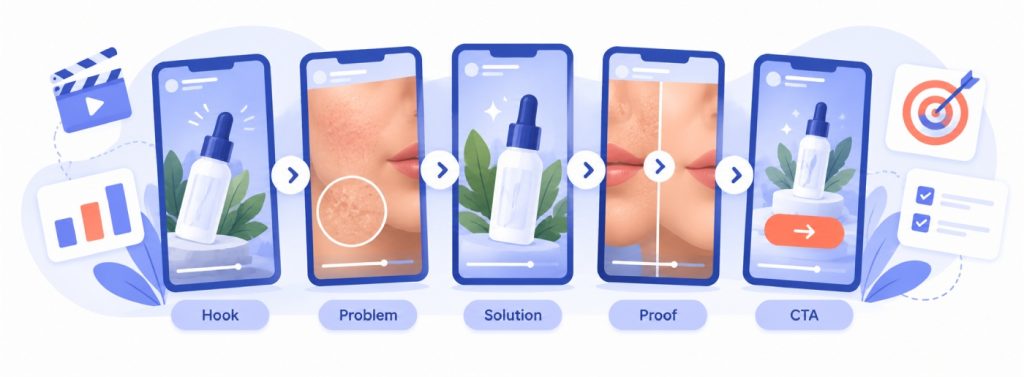
For such ads, follow this structure:
Hook → problem → solution → proof → CTA.
You don’t necessarily need to include every element as a separate scene. The key is that viewers understand what you’re offering, why it matters, and what to do next.
3. Shoot in 9:16 Format
Short-form video platforms are designed primarily for mobile viewing, so horizontal ads feel out of place. For full-screen mobile placements, start with a 9:16 vertical format. It’s well suited to Instagram Reels, Facebook Reels, TikTok, and YouTube Shorts.
This isn’t just a visual preference. Meta reports that, in an analysis of 15 split tests involving Reels-only campaigns, 9:16 video ads with audio and key messaging inside safe zones achieved a 34.5% lower cost per result compared with image ads.
In other words, you want the short-form video ad to feel as native as possible, and the 9:16 format is a good place to start.
Here are some important tips to keep in mind:
- Don’t compromise on quality. Use high-resolution footage. 1080 × 1920 pixels is a practical standard for vertical video.
- Keep important elements within safe zones. Leave room for usernames, captions, engagement buttons, and other platform interface elements.
- Frame the subject appropriately. Keep products, faces, and demonstrations clearly visible without forcing viewers to focus on a tiny section of the screen.
- Before launching, preview your ad in each intended placement. A video that looks great in your editing software might have important text obscured when displayed on a platform.
4. Optimize Video Length, Pacing, and Visuals
Short-form video advertising rewards concise, engaging storytelling. However, shorter isn’t automatically better.
A 10-second advertisement might work perfectly for promoting a limited-time sale, while a 30-second product demonstration might need more time to explain its value.
Your best shot is to use only the time needed to communicate your message and inspire action, even if the video can be extended into several minutes.
As a principle, remove anything that doesn’t contribute to the story. Long introductions, unnecessary pauses, repetitive explanations, and excessive transitions can all reduce viewer interest.
But here’s the most important part. You need to maintain visual momentum throughout to keep the viewer’s attention.
You can maintain visual momentum by varying camera angles, adding contextual footage, or using relevant memes. Zooms, text overlays, and visual effects can also help sustain attention when they support the message.
This is especially important for a platform like TikTok where capturing attention isn’t always easy. It may help to work with a dedicated TikTok Ads agency that can support creative production and test variations to find high-performing concepts you can replicate. For a broader look at promoting a brand on the platform, explore our guide on how to use TikTok for business.
5. Use Captions, On-Screen Text, and Audio Strategically
Audio and text should complement the visuals. Some viewers watch video ads without sound, while others expect voiceovers, music, and sound effects to play an important role. Your creative should work in both situations.
Add captions for spoken dialogue and use short text overlays to highlight important information. This lets viewers follow the message even when the audio is muted.
Don’t cover the screen with large blocks of text. Short-form video moves quickly, and viewers need enough time to read what’s displayed.
Consider the following best practices:
- Use high-contrast text that’s easy to read on mobile screens.
- Keep captions synchronized with the dialogue.
- Highlight only the most important product benefits, offers, or statistics.
- Choose background music that supports the intended mood; a trending track can work if it fits the ad and is licensed for commercial use.
- Use voiceovers to explain demonstrations or add personality.
- Avoid overpowering dialogue with loud music or unnecessary sound effects.
Audio is also important. Google’s video advertising guidance recommends using voiceovers to reinforce branding and messaging, particularly in YouTube’s sound-on environment.
6. Strengthen the Call to Action
A short-form video ad can be entertaining, informative, and visually impressive without generating a single conversion. A common culprit behind that is poor use of call to action (CTA).
Your CTA should clearly communicate what you want viewers to do and why they should do it. For more ideas on writing effective CTAs and aligning them with the conversion journey, see our guide to call-to-action marketing.
While platforms like Meta and TikTok provide specific CTA options, it’s also recommended to use a CTA in the actual video script. That reinforces the idea as the video ends.
Match the CTA with the offer. If the ad talks about ‘free shipping,’ mention it in the CTA.
7. Partner with UGC Creators for More Relatability
Creator content, especially user-generated content (UGC), performs well in short-form video.
According to TikTok’s 2025 Creator Advantage report, creator-led ads achieved a 70% higher click-through rate and a 159% higher engagement rate than non-creator ads at the same cost per thousand impressions (CPM), based on TikTok’s internal campaign analysis.
Two factors may help explain this performance:
- Creator content feels more native on social platforms
- Users find creator testimonials and claims more believable and relatable
You don’t need an overly polished video with elaborate sets or professional actors. You can license influencer or UGC assets and use them in your campaigns. Some brands also whitelist creators (running ads via creator accounts).
Creator-led ads can work well for product unboxings and close-ups, tutorials demonstrating how a product works, and before-and-after content where the results can be substantiated.
How to Measure the Performance of Short-Form Video Ads
Watch for metrics like hook rate, average watch time, video completion, click-through rate, conversion rate, and return on ad spend to measure the performance of your short-form video ads.
Keep in mind that different performance metrics reveal different problems, so monitor both engagement and conversion indicators.
| Metric | What it tells you |
| Hook rate | How effectively the opening captures attention, often measured as 3-second views divided by impressions |
| Average watch time | How long viewers continue watching |
| Video completion rate | The percentage of eligible video plays that reach the end |
| Click-through rate (CTR) | The percentage of impressions that generate clicks |
| Conversion rate | The percentage of clicks or visits that result in a desired action |
| Cost per acquisition (CPA) | How much you spend to acquire a customer or lead |
| Return on ad spend (ROAS) | How much attributed revenue your ads generate for each dollar spent |
Note: Video metrics and their definitions vary between advertising platforms, so use consistent measurement methods when comparing performance.
Look at the metrics as a whole and relative to others.
For example, if your short-form video ad has a low hook rate, the opening might not be compelling enough. If viewers watch most of the video but rarely click, your CTA or offer might need improvement.
Similarly, a high CTR with a low conversion rate may mean your landing page doesn’t meet visitors’ expectations.
Use these patterns to prioritize improvements. Don’t make drastic changes. Instead, make changes to address the lagging metric. This is why having variations of the video is important, so you can test different elements.
Better Short-Form Video Ads Start With Strong Creative Strategy
Improving short-form video ad performance comes down to how you present your message. And there are multiple ways to deliver a message.
As you brainstorm the campaign’s creative strategy, think about your audience: what they care about, what kind of content they might consume, and what problem your offering solves for them.
Then use your answers to these questions to develop short-form video creatives. To keep production costs under control, plan variations from the start.
Connect your improvements to meaningful performance metrics, test different approaches, and use the results to guide future production.
FAQs
What is the ideal length for a short-form video ad?
There’s no universally ideal length, but most short-form video ads are usually between 10 and 30 seconds. Some creative angles or offers may require a longer duration. The right duration depends on your platform, campaign objective, and message complexity.
How often should you refresh short-form video ad creatives?
Refresh creatives when performance begins to decline, or the audience shows signs of fatigue. High-spend campaigns may benefit from new variations every week, while smaller campaigns may need less frequent updates. Monitor metrics like CTR, CPA, ROAS, and frequency.
Should you use the same short-form video ads on TikTok, Instagram, and YouTube Shorts?
You can repurpose the same core footage, but you should adapt the creative for each platform. Different audiences may respond to different hooks, pacing, captions, sounds, and storytelling styles. Also, check each platform’s current specifications and safe zones before publishing.