
The Same AI Video Model Won’t Fit Everyone
Seedance 2.5, MiniMax H3 and Wan 3.0 can all produce striking AI video, but “which is best” is the wrong question. The honest answer depends entirely on who’s asking. Here’s how the three line up against six very different buyers.
The Short Version
Ask five creators which AI video model is “the best” and you’ll get five different answers, because they’re solving five different problems. A solo creator racing to post a trend before it cools has almost nothing in common with a VFX supervisor blocking out a scene, or a developer who needs model weights running on their own hardware. The feature that thrills one buyer is irrelevant to the next.
So this comparison doesn’t crown a winner. Instead it maps the documented capabilities of three current-generation options — Seedance 2.5, MiniMax H3 and Wan 3.0 — and asks a more useful question for each of six personas: given what this person needs, which workflow’s documented capabilities line up best?
One caveat sits underneath everything below, and it matters.
| How to read this comparison:
Every capability here comes from eachAI video model’s Topview product page, not from hands-on testing; no performance, quality or speed results are asserted. Wan 3.0 is now also documented in Alibaba Cloud’s public model catalog, but availability and supported capabilities can vary by platform and workflow. Confirm the live configuration before planning a production deliverable. |
The Three Models at a Glance
Seedance 2.5 is positioned for longer, more controllable storytelling. It documents coherent single-pass clips of 4–30 seconds, up to 50 multimodal references, second-level timestamp direction, storyboard and keyframe control, local segment editing and video extension, a toolkit for people who want to direct a sequence rather than gamble on a single shot.
MiniMax H3 takes a different shape. It is an open-weight, omni-modal AI video model that understands text, image, video and audio and produces native audiovisual output with stereo sound, at up to 15 seconds and native 2K resolution. Its published weights support self-hosting, fine-tuning and private deployment, making it as much a building block for developers as a creative tool.
Wan 3.0 is presented with multimodal reference capabilities, smart duration, adaptive aspect ratios, and up to 30-second generation. Unlike the earlier preview stage, Wan 3.0 is now documented in Alibaba Cloud’s public model catalog, although availability and capabilities can still vary by platform and workflow.
The Specs, Side by Side
Rather than repeat full feature lists inside every persona section, here is the master reference. The rest of the article draws on it selectively.
| Attribute | Seedance 2.5 | MiniMax H3 | Wan 3.0 |
| Access / hosting | Topview workflow | Topview + open-weight self-host | Topview / Alibaba Cloud |
| Model status | Released model | Open-weight released model | Officially documented |
| Max duration | 4–30 s, single pass | 5–15 s | 2–30 s |
| Max resolution | Up to 1080p | Native 2K | Up to 1080p |
| Aspect ratios | 16:9 (generator) | Adaptive | Adaptive |
| Input types | Text · image · video · audio | Text · image · video · audio | Text · image · video · audio |
| Reference capacity | Up to 50 (30 img / 10 vid / 10 aud) | Multimodal; no published cap | Up to 20 multimodal reference materials |
| Native audio | Synced audio; multilingual dialogue + subtitles | Native stereo audiovisual | Yes |
| Shot direction | Second-level timestamps; storyboard, keyframe, white-model, green-screen | Instruction-led; V2V motion transfer | Shot-level direction |
| Segment editing | Local segment editing | Instruction-led precision editing | Video editing and element modification |
| Continuation | Video extension | Not documented | Video extension + smart duration |
| Deployment / control | Hosted only | Self-host, fine-tune, integrate, private deploy | Hosted / Alibaba Cloud Model Studio |
| Positioned for | Longer controllable storytelling; ads, avatars, fashion & beauty | Commercial ads, e-commerce, games, UI/motion; open builders | Narrative briefs; agencies, previs, educators |
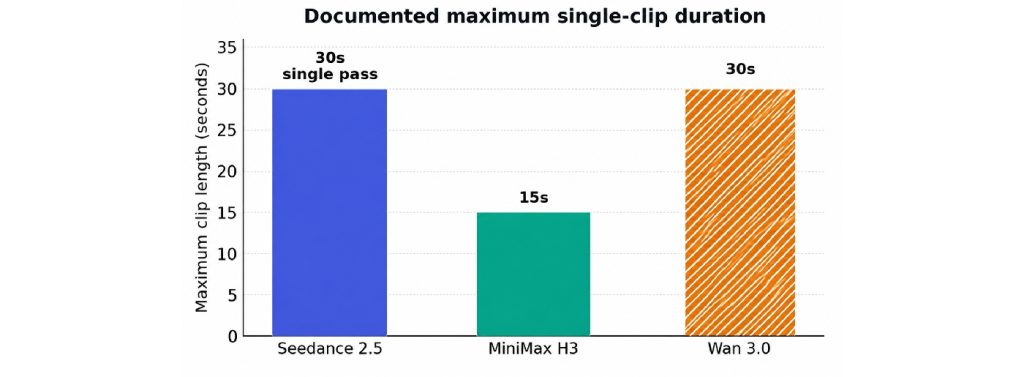

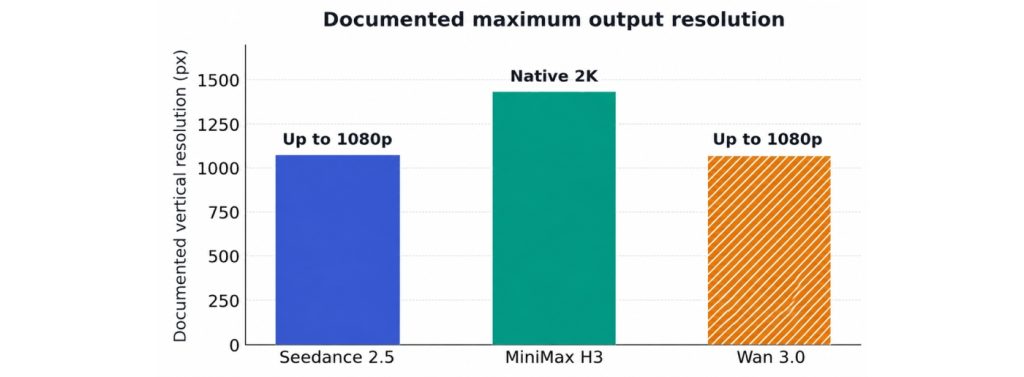
Two differences jump out of the numbers. On documented duration, Seedance 2.5 offers 30-second single-pass clips today and MiniMax H3 caps at 15, while Wan 3.0 also reaches 30 seconds, while its smart-duration capability is designed to adapt generation length to the creative brief. On resolution the order flips: MiniMax H3 is the only one documenting native 2K, with Seedance at 1080p and with Wan 3.0 also supporting output up to 1080p. Neither difference decides anything on its own; it depends who is buying.
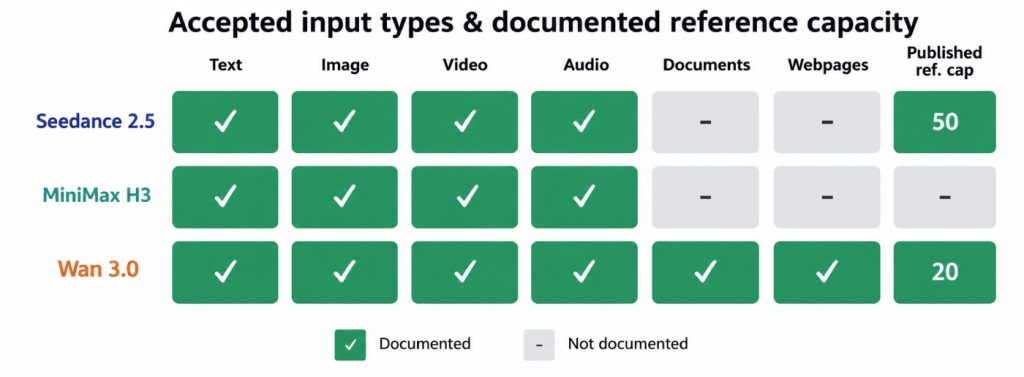
On inputs, all three accept the core text / image / video / audio set, but only Seedance 2.5 publishes a hard reference budget (up to 50 assets: 30 images, 10 video clips and 10 audio files), and Wan 3.0 also extends the input workflow to documents and webpages.
Capability and Control at a Glance
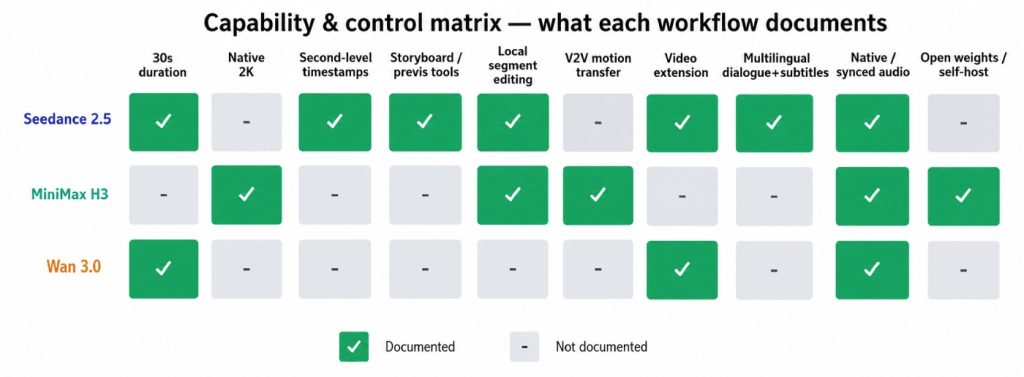
Read down the columns, and the three tools separate cleanly. Seedance 2.5 focuses on direction and continuity, timestamps, previs, segment editing, extension, and multilingual dialogue with subtitles, with a 1080p ceiling. MiniMax H3 trades duration and those directorial controls for native 2K, V2V motion transfer and, crucially, open weights. Wan 3.0 combines multimodal inputs with broader direction and editing capabilities, although exact availability can vary by platform. A blank cell means a capability isn’t stated on the product page, not that it’s impossible.
How Much Direction Does Each Workflow Expect?
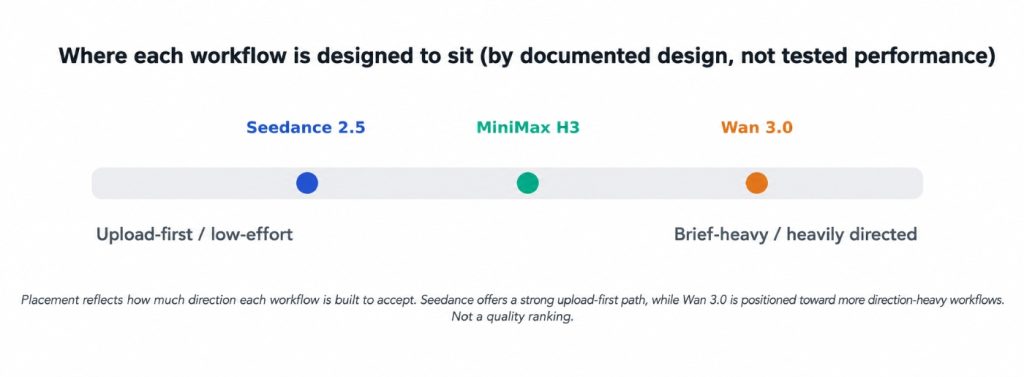
Capability isn’t only about ceilings; it’s also about how much creative direction a workflow is built to take in. Seedance 2.5 explicitly courts an upload-first, low-effort path, its page notes that a meaningful share of paying users simply upload assets and let the system do the rest, while still supporting deep direction. Wan 3.0’s multimodal brief sits at the opposite end, designed to ingest decks, sites, storyboards and references before a frame is generated. MiniMax H3 lands between, leaning on instruction-following and references.
1. The Solo SocialCreator
What they need. Speed, and as little friction as possible. A solo creator making short-form vertical content lives or dies by turnaround, the goal is a watchable, shareable clip with sound before a trend cools, usually without writing a shot list or managing a reference library. Deep camera control and deployment options are beside the point; sound, a vertical frame and a fast path from idea to export are what matter.
This is the one persona Seedance 2.5’s page addresses by name. It calls out viral social formats, pet videos, creator skits, POV concepts and trend hooks as core use cases, and, more tellingly, highlights an upload-first workflow for people who’d rather start from existing assets than craft long prompts. Combined with synchronized audio and a conversational canvas for quick tweaks, that’s a workflow shaped around exactly this buyer’s impatience. A 30-second ceiling is far more than most hooks need, so length isn’t an issue here.
MiniMax H3 is a strong alternative where polish counts. Its adaptive aspect ratio suits vertical placements, and native stereo audio gives short clips finished sound; a 15-second cap rarely constrains this format. Wan 3.0 lists 9:16 among its aspect ratios, but its natural home is the heavily-briefed project, and its broader workflow makes it a more situational choice for someone who just needs to post today.
Bottom line: Seedance 2.5 fits the solo creator’s tempo most directly, with MiniMax H3 a credible pick when audiovisual polish matters more than raw speed.
2. The YouTuber
What they need. Room to tell a story. Longer-form creators, explainer channels, video essayists, narrative and talking-head formats, need continuity across multiple shots, clean dialogue and readable on-screen text far more than a single perfect three-second clip. Pacing, subtitles and the ability to sustain a character or presenter across a sequence are the priorities.
Seedance 2.5 is built for this. Its 30-second single-pass generation gives a scene space to establish, develop and resolve without stitching fragments; second-level timestamps let a creator choreograph shot changes across that span; and its multilingual dialogue with more reliable subtitles directly serves explainer and localized content. Add avatar-led video up to 30 seconds and video extension to continue a strong clip, and it reads like a toolkit for episodic storytelling.
Wan 3.0 is the interesting wildcard here. Its document-to-video explainer concept — planning a paced visual explanation from a brief, lesson plan or report — is squarely aimed at educational creators, and its 30-second duration suits the format. That’s a genuinely compelling direction to consider. MiniMax H3’s 15-second ceiling makes long narrative beats harder to sustain, though its 2K output is attractive for high-quality inserts and B-roll.
Bottom line: For delivery today, Seedance 2.5 is the natural fit; Wan 3.0’s document-to-video is an interesting alternative for explainer channels.
3. The E-Commerce Brand
What they need. The product to look right, and to stay right. For a DTC or e-commerce team the whole game is fidelity, a recognizable product, consistent across shots, with legible logos and packaging text, dressed in enough lifestyle context to convert. They also need the same hero asset re-cut into multiple placements for paid social and marketplaces.
This is where two tools make a strong case for different reasons. MiniMax H3 leans into brand fidelity explicitly, preserving product cues, typography intent and logos across generations, and its native 2K output keeps packaging and product detail crisp, which matters when the frame is a storefront. Its documented AI-influencer product demos (holding bottles, dispensing liquids, applying cosmetics) and V2V motion transfer for spinning up variations map neatly onto product-marketing workflows.
Seedance 2.5 answers the same brief from the other side. Fashion, beauty and shopping content sit near the top of its documented usage, and it’s built to turn product images into complete ad sequences, close-ups, lifestyle scenes, creator-style shots and a closing CTA up to 30 seconds, for TikTok, Reels, Shorts, Shopify and Amazon. With up to 30 image references to lock product identity and local segment editing to fix one shot without redoing the rest, it suits brands wanting a longer, more directed spot. Wan 3.0’s webpage-to-video concept, turning a product page into a launch film is a natural conceptual fit for this buyer, depending on platform availability.
Bottom line: Reach for MiniMax H3 when 2K crispness and typography/logo fidelity lead; reach for Seedance 2.5 when the deliverable is a longer, reference-heavy product sequence. A genuine split, not a tie to be broken.
4. The Marketing Agency
What they need. To turn a client’s raw materials into reviewable video, fast, across many accounts. An agency’s constraint isn’t any single clip, it’s throughput and translation: taking a brand deck, a website, a set of references and a storyboard and producing on-brand directions the client can react to, without rebuilding the brief by hand every time. Reuse, iteration and workflow efficiency win here.
On paper, Wan 3.0 is the closest fit of any persona-model pairing in this article. Its page names creative agencies directly and describes exactly this workflow: combine a client’s deck, site, brand references, voice and storyboard into reviewable directions. Its documented multimodal reference workflow, reference-locked story worlds for variations, and webpage/document ingestion read as if designed for account teams. The asterisk is unavoidable, though it’s a preview, so it belongs in pipeline planning, not on this quarter’s deliverables.
For what ships today, two options carry the load. Seedance 2.5’s conversational canvas lets a team refine directions through natural-language instructions and lean on up to 50 references plus storyboard control, useful for iterating client work. MiniMax H3’s strength is instruction-following that turns detailed creative direction into coherent output with less manual correction, brand fidelity for on-brand consistency, and V2V motion transfer to reuse a movement across variations plus a deployment option when a client’s assets must stay on private infrastructure.
Bottom line: Wan 3.0 is the closest fit for agency briefs when its broader multimodal workflow is available. Seedance 2.5 (for canvas iteration) and MiniMax H3 (for instruction-following and deployment) are the pragmatic picks.
5. The Filmmaking / VFX Team
What they need. Control and a way to plan before committing. Filmmakers and VFX teams think in shots, camera language and continuity. They want to block a scene, test performances and camera moves, hold a character consistent across a sequence, and execute demanding visual effects, ideally with previs that communicates intent before a full production commitment.
Seedance 2.5’s documented toolset speaks this language. Its 3D Director Console and white-model previs let a team block characters, cameras and movement before generating, then use that white-model sequence as a reference; storyboard, keyframe and green-screen inputs define shot order and staging; second-level timestamps direct action, shots and transitions across a 30-second span; and local segment editing plus video extension support iterating a scene shot by shot. For directed, multi-shot work, that’s a purpose-built previs-to-shot pipeline.
MiniMax H3 is the strong complement for effects-driven shots. Its page documents natural facial performance and under-skin effects, complex physics and assembly simulation, and cinematic drone and camera paths, all at native 2K, with V2V motion transfer to carry a performance or camera language into a new subject, powerful within its 15-second window. Wan 3.0 names filmmakers and previs teams among its intended users and documents a photoreal world renderer and reference-locked story worlds, which are promising for previs and effects-heavy workflows.
Bottom line: Seedance 2.5 for the directed, continuity-heavy previs pipeline; MiniMax H3 for high-fidelity VFX and physics in shorter shots at 2K.
6. The AI Developer
What they need. Access to the AI video model itself. A developer or AI-platform builder isn’t shopping for a web workflow, they need weights they can run, fine-tune, integrate and control, ideally with the option to keep sensitive prompts and assets on their own infrastructure. Hosted-only tools, however polished, don’t satisfy this requirement.
Here the field narrows to one. MiniMax H3 is the only option of the three that documents open weights, with explicit support for self-hosting, private deployment, fine-tuning and workflow integration, and it names open-source developers, enterprise deployment teams and tool builders among its intended users. For anyone embedding video generation into a product or pipeline, or handling assets that can’t leave controlled infrastructure, that’s the decisive capability.
Neither of the others competes on this axis as documented. Seedance 2.5 is presented as a Topview-hosted workflow with no open-weight or self-hosting path on its page. Wan 3.0 is also primarily presented through hosted workflows, with no published weights or self-hosting options documented on the pages reviewed. While the broader Wan family has a history of open releases, Wan 3.0 specifically does not currently document an equivalent open-weight deployment path.
Bottom line: For developers, MiniMax H3 is effectively the only fit among the three, not because the others are weaker tools, but because they aren’t built to be deployed.
The Verdict: Matched to the Buyer, Not Crowned Overall
Line the six personas up and the point of the exercise becomes obvious: there is no single best AI video model here, only best fits.
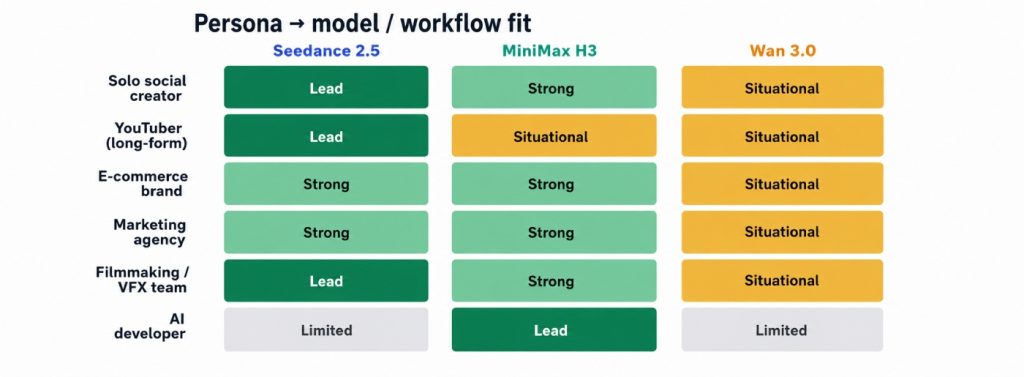
| Persona | Leading fit | Also strong | Situational | Deciding factor |
| Solo social creator | Seedance 2.5 | MiniMax H3 | Wan 3.0 | Upload-first path + synced audio; H3’s adaptive aspect ratio and stereo audio suit short vertical hooks. |
| YouTuber (long-form) | Seedance 2.5 | — | Wan 3.0 doc-to-video; MiniMax H3 limited by 15 s | 30 s single-pass continuity, second-level timestamps and multilingual subtitles fit narrative and explainer formats. |
| E-commerce brand | Seedance 2.5 & MiniMax H3 (split) | — | Wan 3.0 webpage-to-video | H3 for native 2K + logo/typography fidelity; Seedance for longer, reference-heavy product sequences. |
| Marketing agency | Seedance 2.5 / MiniMax H3 | — | Wan 3.0 omni-brief | Wan’s deck/site/storyboard brief is the conceptual fit; Seedance canvas and H3 instruction-following + deployment are strong alternatives. |
| Filmmaking / VFX team | Seedance 2.5 | MiniMax H3 | Wan 3.0 previs | Seedance’s 3D previs, storyboard/keyframe, timestamps and extension; H3 for 2K VFX and physics in short shots. |
| AI developer | MiniMax H3 | — | — | Only H3 documents open weights, self-hosting, fine-tuning and integration; the others are presented as hosted workflows. |
Seedance 2.5 turns out to be the most broadly applicable across creative personas: 30-second continuity, directorial controls and an upload-first path make it a lead or strong fit for solo creators, YouTubers, product sequences, agency iteration and previs alike. MiniMax H3 wins outright exactly where its two differentiators matter most, native 2K fidelity for e-commerce, high-fidelity VFX in short shots, and open weights for developers, and is a strong alternative almost everywhere else.
Wan 3.0 has the broadest documented input and direction ambitions of the three, including multimodal reference, smart duration, adaptive aspect ratio, and up to 30-second generation. It is particularly interesting for agency briefs and explainers that benefit from more structured creative context.
Which means the right question was never “which AI video model is best?” It was “best for whom, doing what?”, and on that question, the three sort themselves out cleanly.
How We Compared
| • This is a capability-based comparison drawn from each AI video model’s documented Topview product page (Seedance 2.5, MiniMax H3 and Wan 3.0). No firsthand testing was conducted; no usability, quality, speed or performance results are claimed or implied.
• Wan 3.0 is now listed in Alibaba Cloud’s public model documentation. Its documented specifications include 2–30 second generation, 480P, 720P, and 1080P output, along with all-in-one reference, audio, smart duration, and adaptive aspect ratio capabilities. Availability and supported settings may vary by deployment and platform, so confirm the live workflow before planning a production deliverable. • In the matrices, a blank or “not documented” cell means a capability is not stated on that product page, not that it is impossible or unavailable. • Availability, resolution and duration options, aspect ratios, reference limits, pricing and licensing vary by account, plan and workflow, and can change over time. Confirm commercial-use rights before publishing any output. • Third-party AI video model and brand names belong to their respective owners; Topview provides access to these third-party models through its platform and is not their developer. |