
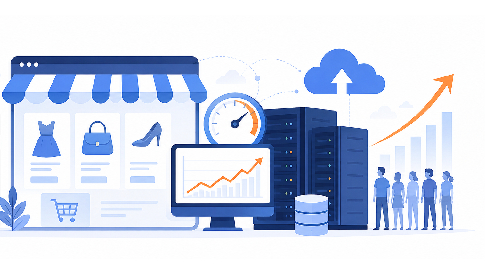
For an eCommerce business, reliable hosting is part of the customer experience. When traffic suddenly increases, insufficient infrastructure can turn a successful campaign into lost sales and frustrated customers.
Imagine it is 11:40 am on the Friday after Thanksgiving. Your email campaign went out at 11:00, a mid-sized account posted your product to 90,000 followers at 11:15, and the checkout page has been returning a 503 error for six minutes. Nobody in the building knows how to fix it, the support queue quotes four hours, and the traffic you spent three months earning is going to competitors while you refresh a dashboard.
The Shape of a Spike
Traffic on peak shopping days can increase several times above normal levels, while individual campaigns can produce much sharper spikes over a short period. The distribution is what causes the damage. A day with triple the traffic spread evenly is manageable, while the same volume arriving between 10am and 2pm is a different engineering problem, and that is precisely when it arrives.
Spikes are also the least predictable thing a small store deals with. A planned sale can be prepared for. A product landing in somebody’s newsletter arrives without notice and produces the sharper curve of the two.
The First Component to Fail
Servers rarely fall over from serving pages. The database goes first. Every product view, cart update, and search query becomes a database query, and a shared plan gives your account a fixed number of simultaneous connections. Once those are used, requests queue, the queue grows faster than it drains, and the site stops answering.
PHP worker limits produce the same result by a different route. A plan allowing 20 concurrent processes handles roughly 20 shoppers at once regardless of how much bandwidth is included, and bandwidth is the number the sales page advertises. Concurrency limits are usually published in a support document nobody reads until the site is already down.
Capacity and Plan Limits


Image source: Magnific
Capacity is bought before it is needed, which is why it gets postponed. A store doing steady weekly numbers on an entry plan has no reason to look at concurrency limits until the week those limits are hit. Moving to reliable web hosting with isolated resources costs about $12 a week and takes an afternoon to migrate.
The timing rule is simple. Any upgrade should happen at least a month before the season, since a migration during a spike is a second outage stacked on the first. A month also leaves time to find the caching plugin that stopped working on the new setup.
Downtime Arithmetic
US shoppers spent a record $11.8 billion online on a single Black Friday, with $12.5 million passing through checkouts every minute at the peak. Ecommerce sites lose 20% to 30% of daily sales for every hour they are unavailable.
The figures that matter to a small store are lower. A store under $10 million in revenue loses around $427 per minute of downtime on average. Two hours of a broken checkout is $51,000, which is more than most owners have ever spent on infrastructure in total.
Peak demand keeps moving upward. Cyber Monday was expected to become the biggest US online shopping day on record, with spending projected at $14.2 billion, and AI traffic to U.S. retail sites increased 670% year over year on Cyber Monday, according to Adobe. That last figure is a category of visitor nobody had capacity-planned for.
Shared Infrastructure and Neighbour Load
On a shared plan your neighbours are your risk. Another account on the same machine running an unindexed query during your busiest hour consumes the resources you needed, and you have no visibility into it and no way to stop it.
Bots, Crawlers, and Unplanned Load
Human shoppers are not the only visitors consuming capacity. Bot traffic has overtaken human traffic outright, and price scrapers hit product pages hardest during exactly the periods when prices are changing.
The volume grew again with model training. Artificial intelligence crawlers now hammer sites at a rate that pushed one large media archive’s bandwidth up 50%, and much of that traffic does not directly contribute to sales. Rate limiting the obvious offenders returns capacity to customers at no cost. The traffic logs show which agents to limit within ten minutes of looking.
Caching, Queues, and Static Pages
Most of what a store serves during a spike does not need to be generated fresh. Product pages change rarely.
Category listings change less often than that. Serving cached copies removes the database from most requests. Page caching is the cheapest capacity increase available.
Queue systems are the other option worth knowing about. Holding shoppers in an ordered waiting room while the checkout processes them at a sustainable rate converts a crash into a delay, and a customer who waits four minutes still buys. The queue also gives the owner a number to watch, since a waiting room 900 deep is information a crashed site never provides.
Load Testing Before the Season
Guessing at capacity is how stores discover their limits in public. A load test costs very little and answers the only question that matters, which is how many simultaneous shoppers the current plan supports before response times degrade. Run it in October. Test the checkout path specifically rather than the homepage, since the homepage is cached and the checkout is not. Whatever number comes back, compare it to your best hour last year and multiply by three. If the plan cannot serve that figure, the decision has already been made for you.
Paying for Capacity You May Never Use
The uncomfortable part is that most small stores never get the spike. The newsletter mention does not happen, the sale is ordinary, and the extra capacity goes unused for a year. That is the correct outcome and it still justifies the spend, because the annual cost of that unused headroom is smaller than one hour of a broken checkout in November.
Traffic spikes are difficult to predict, but the consequences of an unprepared eCommerce website are much easier to anticipate. Reliable hosting, adequate capacity, caching, load testing, and sensible traffic management can help businesses keep their stores available when demand increases.
The goal isn’t to pay for unlimited infrastructure that will rarely be used. It’s to build enough headroom to handle realistic peaks without allowing performance problems to disrupt the customer experience. Preparing before a major campaign or shopping season gives eCommerce businesses a much better chance of turning increased traffic into completed sales rather than lost opportunities.