

Performance marketing has always been a creative treadmill. The difference today is speed. Ad fatigue sets in faster than ever — what worked last week can stop converting almost overnight.
Once an algorithm finds a winning combination of visuals and copy, audiences quickly adapt. Banner blindness kicks in, engagement drops, and conversion rates follow. Traditionally, the response was slow and expensive: go back to design, brief a team, wait days (or weeks) for new assets.
That model doesn’t hold anymore.
AI hasn’t just accelerated content creation — it’s changed how creative work happens. The real advantage isn’t generating something “perfect.” It’s the ability to iterate quickly, test variations, and extend the life of what already works.
Moving from Creation to Iteration in AI Marketing
Early AI adoption focused on generating content from scratch. In reality, that’s rarely the bottleneck in marketing teams.
The real challenge is scaling what already performs.
Instead of asking, “What should we create?” teams are asking:


This is where the creative refresh cycle becomes practical. Rather than replacing creatives entirely, marketers adjust elements — background, lighting, layout, positioning — and test quickly.
Tools like Banana Pro are built for this type of workflow. They’re not trying to produce artistic masterpieces. They’re designed for speed and controlled variation.
That said, there’s a trade-off. Faster models often sacrifice detail. For high-resolution placements, a final polish or manual adjustment is still necessary.
Turning AI Tools into a Practical Workflow
The biggest shift isn’t technical — it’s operational.
Teams that succeed with AI stop thinking in terms of prompts and start thinking in terms of editing.
Instead of generating from nothing, they work with existing assets:
- adjust composition
- change environments
- test variations in context
The image-to-image workflow is key here.
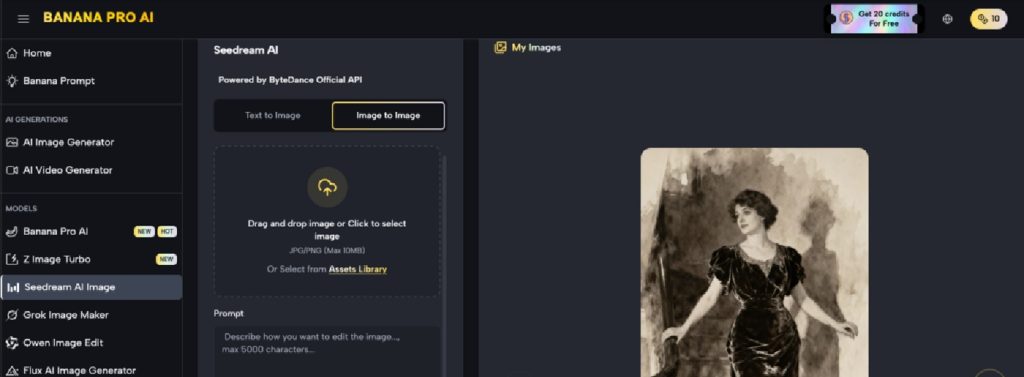

A single product photo can be adapted into multiple scenarios:
- office environment
- home setting
- seasonal context
This allows campaigns to feel more relevant without creating entirely new assets every time.
Scaling Creative Output Without Losing Control
As output increases, managing consistency becomes harder.
Platforms like Banana Pro try to solve this by centralizing the workflow — from generation to refinement. One of the most useful features is the canvas-based approach, which gives marketers control over layout and composition.
That matters.
Traditional AI generation often feels like a black box. You input a prompt and hope for the best. But marketing doesn’t work that way. Placement, spacing, and hierarchy are not optional — they’re requirements.
Canvas workflows allow teams to:
- control composition
- protect CTA placement
- maintain structure across variations
Still, consistency isn’t automatic. Brand elements like colors, logos, and typography often require manual handling in the final stage. Most teams use AI for environments and variations, while keeping brand assets tightly controlled.
From Static Ads to Motion Content
Short-form video has created a new pressure point.
Static images struggle to compete in feeds dominated by motion. But producing video at scale has traditionally been expensive and time-consuming.
AI is starting to close that gap.
Instead of full production, teams now add micro-motion to existing creatives:
- subtle camera movement
- animated lighting
- background shifts
Using a video generator, a strong static ad can be turned into multiple short-form variations. It’s not about cinematic quality — it’s about stopping the scroll.
This static-to-motion pipeline extends the value of existing assets and helps campaigns stay relevant longer.

Why Speed Beats Perfection in Creative Testing
In performance marketing, speed often matters more than polish.
Spending days perfecting a single creative is risky. If it fails, the time is lost.
That’s why lightweight models like Nano Banana are useful in early testing stages, and browsing nano banana prompts beforehand can speed up that first round of testing even further. The goal isn’t quality — it’s direction.
Marketers test:
- visual styles
- messaging angles
- layout differences
Once something works, they invest in refinement.
The Limits of AI in Creative Work
AI speeds things up, but it doesn’t replace judgment.
Generative models work on patterns, not intent. They can produce visually impressive results that miss brand guidelines or emotional nuance.
There’s also a practical issue: quality control.
If you generate 100 creatives, someone still needs to review them. Errors, inconsistencies, or unrealistic details are common. Time saved in creation often shifts into curation.
Another risk is sameness.
As more teams use similar tools and datasets, creative outputs can start to look alike. Maintaining a distinct brand identity requires effort — not just generation.
Building a Repeatable Creative System
To make this sustainable, teams need a structured approach.
A simple model looks like this:
- Hypothesis phase
Test broad variations quickly to identify what resonates. - Refinement phase
Improve winning concepts using editing tools and controlled adjustments. - Expansion phase
Adapt successful creatives into new formats (especially video).
This approach reduces wasted effort and keeps campaigns moving.
Why the Creative Refresh Cycle Matters
The advantage today isn’t budget — it’s learning speed.
Teams that iterate faster:
- waste less time on losing ideas
- adapt quicker to audience behavior
- extend the life of winning creatives
AI makes this possible, but it doesn’t replace strategy.
The strongest results still come from understanding:
- your audience
- your message
- your positioning
The tools only amplify that.
Used correctly, the creative refresh cycle isn’t just about working faster — it’s about making better decisions, sooner.
Feel free to check our article 10 Best AI Image Editors for Fast, Pro-Quality Visuals.