
From competitor pricing to product trends, here’s how to collect and apply market data reliably to help your eCommerce business stay competitive.
There are now over 28 million online stores globally, with thousands more launching every day. Which means that whatever niche you’re in, someone else is already in it, and probably watching what you do.
The brands that hold their ground in this market aren’t necessarily those with bigger budgets or better products. Often, they’re the ones with the clearest picture of the market they operate in.
They know what their competitors charge, what’s in/out of stock, which complaints their customers often make, and how trend lines are pointing at any given time. Much of this information can be gathered from publicly available sources, provided businesses respect applicable laws, platform rules, and privacy requirements.
The hard part is knowing what exactly to collect, how to collect it responsibly, and how to separate useful signals from noise. Below we briefly go over how to collect competitor data reliably for smarter ecommerce decisions.
Start With the Decisions You Need to Make
Ecommerce businesses tend to collect competitor data backwards. They gather as much information as possible, dump it into a spreadsheet, and hope something useful eventually jumps out. It rarely does.
A better approach starts with asking meaningful questions:
- Are your prices still competitive?
- Which products are customers talking about?
- Which products are competitors pushing hardest right now?
- Why are shoppers choosing another store instead of yours?
- Are buying habits starting to shift?
These questions tell you exactly what data deserves your attention. Collecting data without a decision to anchor it is how you end up with a folder full of screenshots no one ever uses.
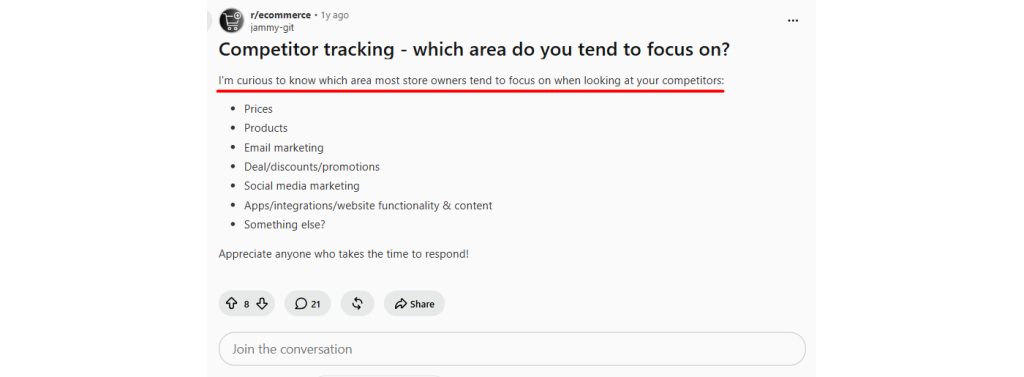
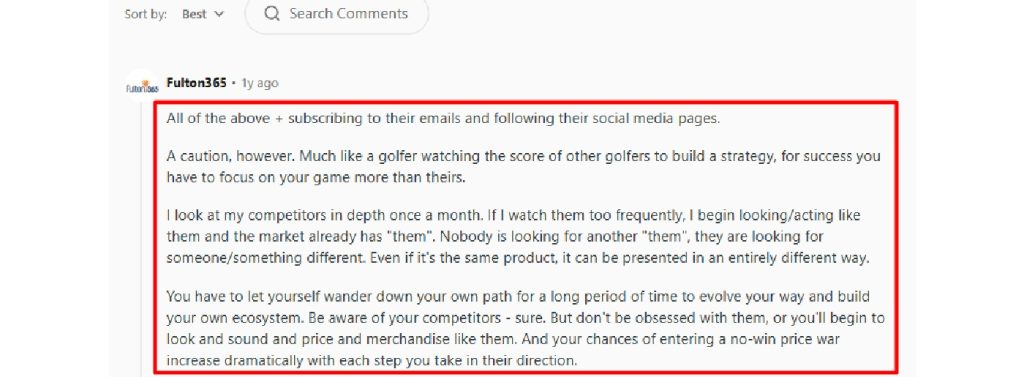
There’s another trap worth avoiding. Competitor research should inform your strategy, not replace it. Spend too much time watching every move your rivals make, and it’s easy to start copying them without realizing it. Here’s how one marketer describes this:

Once you know what you’re looking for, narrow your focus. Tracking dozens of competitors usually creates more noise than insight. Instead, identify 3 to 5 businesses that target the same audience, sell at similar price points, and have an established presence in your market. Prioritize competitors with an established presence and a business model similar to yours, as they are generally more useful benchmarks.
To find competitors worth studying, Google the keywords your buyers actually search, browse Amazon’s category pages, and check Crunchbase for established brands in your space.
Hype Proxies is one resource ecommerce teams use when they need reliable infrastructure for collecting this kind of public market data at scale, particularly for pricing and inventory research across multiple platforms.
Your Competitors Leave Clues Everywhere
A competitor’s homepage only tells part of the story. The more useful insights are usually scattered across the rest of their online presence.
Pay attention to things like:
- Product pages: Which products receive the most attention? Which ones have multiple variants, prominent placement, or frequent updates? Are they leading with price, social proof, or ingredient/material claims? Those are often the products driving the business.
- Site structure and navigation: Categories featured in the main menu usually reflect where the company sees the biggest opportunity. If “free returns” is in the top-level menu, that’s a deliberate conversion decision (and probably one that’s working for them).
- Landing pages: These can hint at seasonal campaigns or new product launches before they are announced elsewhere.
- Content strategy: Blogs, buying guides, and comparison pages reveal which products or customer segments competitors are usually investing in for the long term. Tools like Ahrefs and Similarweb can help you see which keywords drive traffic and where that visibility is growing.
- Advertising: The Meta Ad Library lets you view active campaigns for free. If the same ad has been running for months, there’s a good chance it’s delivering results.
- Email marketing: Subscribe to competitors’ newsletters. Their welcome emails, promotions, and discount timing reveal far more about their priorities than a press release ever will.
- Technology stack: Tools like BuiltWith show which ecommerce platforms, payment systems, and marketing tools a store uses. While this doesn’t reveal everything, it offers useful clues about where they’re investing.
None of these sources tells the whole story on its own. Put them together, though, and you begin to see where a competitor is placing its biggest bets and how its strategy is evolving over time.
Turn Competitor Insights Into Website Improvements
Competitor research becomes more valuable when it leads to practical changes on your own website. Pricing and product research may influence which products receive more prominent placement, while insights from competitor navigation and landing pages can help identify opportunities to improve your own site structure. Competitor research can also reveal which product-page elements deserve more attention, from product information and visuals to trust-building details and calls to action. Content gaps can also inform new blog posts, buying guides, and product pages.
The goal isn’t to copy another store’s website. Instead, use competitor data to identify customer expectations, gaps in the market, and areas where your own eCommerce website can be improved. A flexible website platform makes it easier to test these improvements and adapt the site as customer behavior and market conditions change.
The Best Insights Usually Come From Customers

Source: Kindel Media @ Pexels
Marketing tells you what a business wants customers to believe. Customers usually tell you what actually happened. That’s why reviews are one of the most valuable sources of competitor intelligence.
Browse Amazon listings. Read Trustpilot reviews. Spend a few minutes on Reddit or social media. Don’t stop at the overall rating, but look closely for complaints that appear repeatedly. We’re talking:
- Late deliveries
- Poor packaging
- Sizing issues
- Products that break sooner than expected
- Customer service that disappears after checkout
A single complaint may not reveal a broader pattern. Repeated complaints about the same issue can provide a much stronger signal. Those patterns often highlight opportunities you won’t find anywhere else. If customers consistently complain about slow shipping, fast delivery needs to become part of your primary competitive advantage.
If buyers love a competitor’s product but dislike the packaging, you’ve found something you can improve from day one. Pricing tells a similar story.
A business that constantly discounts products may be clearing inventory rather than enjoying record sales. A product that’s frequently out of stock could signal growing demand or supply problems. Context always matters more than the number itself.
Consistency Beats One-Off Research
Competitor research isn’t something you do once a quarter and forget about. Markets tend to move quickly, prices can always change overnight, new competitors always appear, and your advertising campaigns begin and end within days.
Businesses that notice those shifts early have more time to respond. Everyone else ends up reacting after customers have already moved on. That doesn’t mean someone on your team needs to refresh competitor websites every morning.
Automation handles much of that work. Price monitoring tools, inventory trackers, search visibility platforms, and web data collection systems make it possible to monitor public information continuously instead of manually checking dozens of pages every week. Where automated collection is used, businesses should respect website terms, robots directives where applicable, rate limits, and relevant privacy and data-protection requirements.
Just like checking the weather, you wouldn’t look outside once in January and assume you know what July will bring. Markets work the same way. Small changes happen every day. Over time, those small changes become trends, and trends eventually reshape entire categories.
Better Data Should Lead to Better Decisions
Online stores that invest in competitor research sometimes stumble at what is arguably the most important step. They collect the data, organize it, and end up doing little to nothing meaningful with it.
A simple SWOT framework (Strengths, Weaknesses, Opportunities, Threats) gives you a structure to synthesize what you’ve found into something actionable.
It doesn’t need to be a 40-slide presentation. A shared document that maps competitive insights to specific decisions is enough.
- Which pricing move does the data support?
- Which product gap is worth pursuing?
- What complaint keeps surfacing that your store can genuinely address?
The stores that treat competitor analysis as an ongoing operating habit rather than a one-time audit are the ones that stop being surprised by the market. By the time a trend becomes obvious to everyone, they’ve already acted on it.
The most useful competitor data is not the information you collect but the decisions it helps you make. When market research informs pricing, product selection, content, SEO, and website improvements, eCommerce businesses can respond to changing customer expectations without simply copying competitors. A website that evolves alongside the market gives businesses a stronger foundation for long-term growth.